
How much of an apparent evolutionary change comes from a different way of preserving bodies?
Peary Land contains more than one extraordinary window into early life. The older window is the Portfjeld Formation in southern Peary Land, including samples west of Øvre Midsommersø. The younger is the geographically separate Sirius Passet locality farther north, where dark rocks of the Buen Formation preserve Cambrian animals. The map marker identifies Sirius Passet; it does not place the Portfjeld sampling site at the same spot. Today’s Arctic position also does not establish either deposit’s ancient latitude.
Portfjeld carbonates contain microscopic organic structures replicated in phosphate. Researchers describe algae, microbial material and spherical forms resembling stages of development. Some comparisons with embryos are suggestive, but shape alone cannot securely identify an animal. The Ediacaran age relies on stratigraphy and carbon-isotope correlation, rather than a direct date on every fossil. This snapshot therefore uses a broad 580–560 million-year envelope. These small objects reveal forms of life that a search for large shells could easily miss.
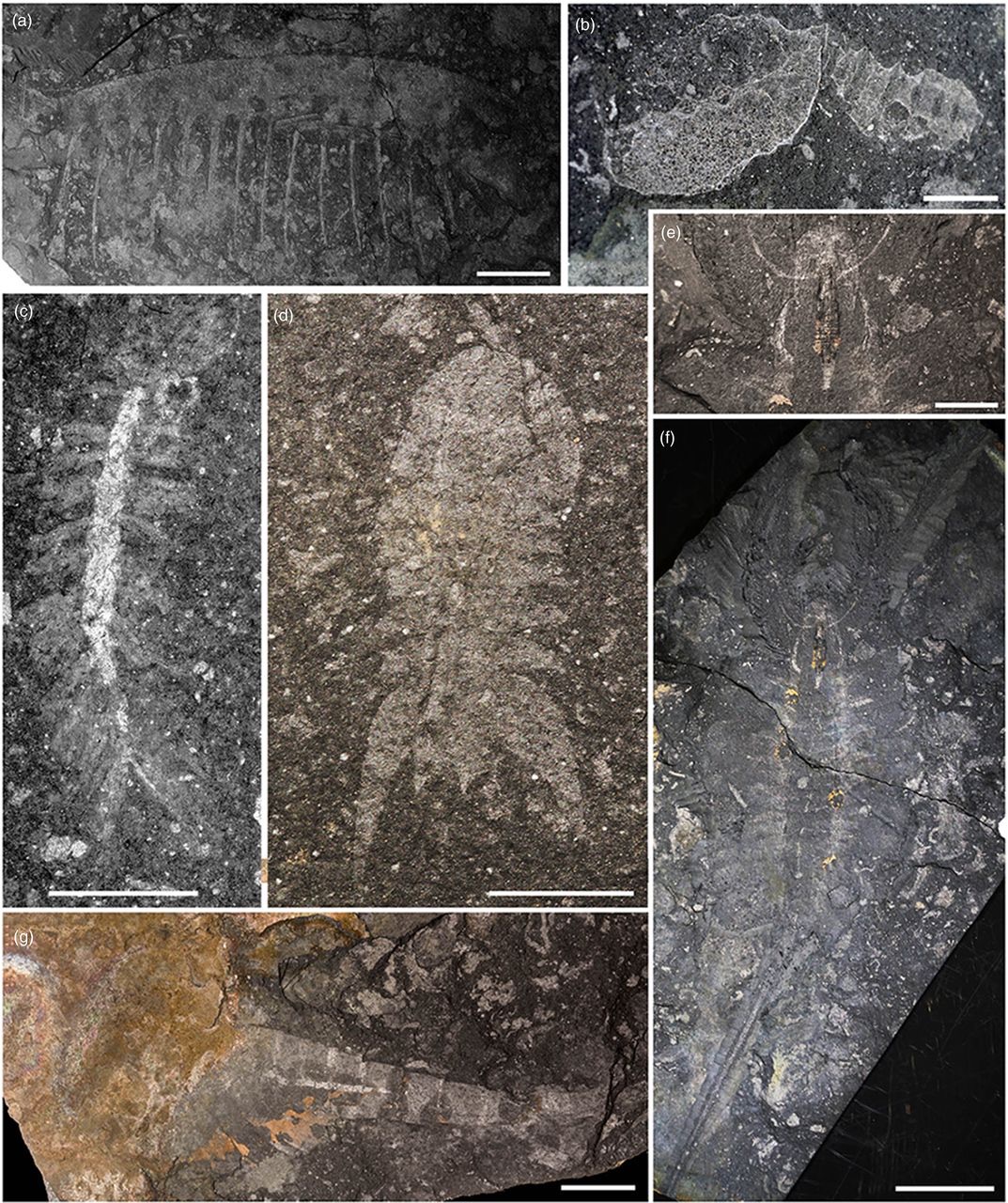
At Sirius Passet, roughly 518 million years ago, marine mud buried a remarkably different collection. Worms with retractable, spiny front ends occur alongside arthropods and other animals. Chalazoscolex pharkus preserves detailed body ornamentation; the fossils establish an anatomical design, while its behaviour must be inferred. Measurements of iron and other chemical components help reconstruct oxygen conditions near the seafloor. Low oxygen could assist preservation, yet animals and microbial processes require a more nuanced account than a permanently lifeless basin.
These windows are separated by tens of millions of years, different localities and different preservational processes. Their contrast is evidence of both biological change and the selectivity of the fossil record. It cannot measure the exact pace at which one community became the other. Reading the two together asks a better question: which bodies were present, and which had a realistic chance of entering the archive?
[1] [2] [3] [4]Time windows and evidence
Older ages are on the left. Bars span the dated intervals. A dot marks a single age.
- Microscopic life in a carbonate sea 560–580 Ma
- A Cambrian seafloor preserved in mud 514–521 Ma
- Portfjeld microfossils west of Øvre Midsommersø 560–580 Ma
- Chalazoscolex pharkus from Sirius Passet 514–521 Ma
- Iron and organic-carbon measurements at Sirius Passet 514–521 Ma
Researched windowsEvidence records
570 Ma · interval 560–580 Ma
Microscopic life in a carbonate sea
Shallow marine Portfjeld carbonates preserve phosphatized microorganisms and other microscopic structures. The broad Ediacaran envelope reflects isotope correlation and stratigraphic constraints, including comparison with the Shuram excursion; 570 Ma is a representative value, not a direct radiometric age. The documented samples lie in southern Peary Land, away from the Sirius Passet marker. This was a carbonate-producing marine environment whose tiny inhabitants were preserved by an unusual mineral pathway.
[1] [2]Locate this time in the atlas ↗Observed
Phosphatized microscopic structures occur in carbonate samples west of Øvre Midsommersø.
Reconstructed
A shallow marine ecosystem with microbial and algal components.
Uncertain
Some embryo-like structures have disputed biological affinities; the age model is indirect.
Evidence windows overlapping this state: 1. Overlap does not establish exact coexistence.
518 Ma · interval 514–521 Ma
A Cambrian seafloor preserved in mud
The Buen Formation at Sirius Passet preserves soft-bodied animals in fine marine sediments. Its Cambrian Series 2, Stage 3 placement gives the broad 521–514 Ma envelope used here; the 518 Ma snapshot is approximate. Fossil anatomy, sedimentary context and geochemistry together indicate a seafloor ecosystem affected by limited and changing oxygen availability. Burial and subsequent alteration strongly influence which tissues remain recognizable.
[3] [4]Locate this time in the atlas ↗Observed
Worms and arthropods occur with fine sediment and measurable chemical signals.
Reconstructed
A marine seafloor with variable oxygen conditions and exceptional preservation.
Uncertain
Stage correlation is broader than a bed-specific date; chemical signals can be altered after burial.
Evidence windows overlapping this state: 2. Overlap does not establish exact coexistence.
body fossil · Peary Land & Sirius Passet ↗
Chalazoscolex pharkus from Sirius Passet
Named specimens of Chalazoscolex pharkus preserve a wormlike body with a differentiated front end and patterned surface ornament. Their compressions on shale bedding surfaces document anatomy rarely recorded by isolated hard parts. The description compares these animals with other palaeoscolecidans and proposes a life on or within the sediment. That ecological interpretation is plausible from structure and context, but is not a directly observed behaviour. The age follows Cambrian Stage 3 correlation.
geochemistry · Peary Land & Sirius Passet ↗
Iron and organic-carbon measurements at Sirius Passet
Geochemical sampling of the fossil-bearing succession provides a second line of evidence alongside animal anatomy. Iron chemistry and associated measurements are used to assess oxygen availability during deposition and early burial. Their interpretation supports low-oxygen environmental conditions with variation through the succession. These measurements do not justify painting the entire inhabited seafloor as continuously anoxic. Metamorphism and later alteration must be considered when relating present rock chemistry to the original seawater.
What this story cannot resolve
The region combines separate Peary Land localities. The older age is a correlation envelope, and no ancient coordinates are asserted.
Keep these ideas handy
Exceptional preservation
Preservation that retains normally lost features such as soft tissues. Geologists call a deposit rich in such fossils a Konservat-Lagerstätte. Explore the idea ↗
Oxygenation
The rise or redistribution of free oxygen in an environment, including the atmosphere and different parts of the ocean. Explore the idea ↗
Uncertainty & reconstruction limits
Explicit limits on what evidence and models allow us to infer, including uncertainty in age, identity, place and process. Explore the idea ↗
The evidence notebook
body fossil · Peary Land & Sirius Passet ↗
Portfjeld microfossils west of Øvre Midsommersø
Carbonate samples from southern Peary Land, including the studied GGU 271770 material, contain phosphatized microscopic fossils. Their three-dimensional preservation permits comparison with algal structures, microbial remains and developmental forms known elsewhere. The objects are observed; assigning every sphere to an animal embryo would go beyond the evidence. The broad age envelope follows the Ediacaran interpretation and its stratigraphic and isotope constraints, rather than a numerical date measured on each object.
body fossil · Peary Land & Sirius Passet ↗
Chalazoscolex pharkus from Sirius Passet
Named specimens of Chalazoscolex pharkus preserve a wormlike body with a differentiated front end and patterned surface ornament. Their compressions on shale bedding surfaces document anatomy rarely recorded by isolated hard parts. The description compares these animals with other palaeoscolecidans and proposes a life on or within the sediment. That ecological interpretation is plausible from structure and context, but is not a directly observed behaviour. The age follows Cambrian Stage 3 correlation.
geochemistry · Peary Land & Sirius Passet ↗
Iron and organic-carbon measurements at Sirius Passet
Geochemical sampling of the fossil-bearing succession provides a second line of evidence alongside animal anatomy. Iron chemistry and associated measurements are used to assess oxygen availability during deposition and early burial. Their interpretation supports low-oxygen environmental conditions with variation through the succession. These measurements do not justify painting the entire inhabited seafloor as continuously anoxic. Metamorphism and later alteration must be considered when relating present rock chemistry to the original seawater.
Follow the evidence
Sources & credits
- Ediacaran Doushantuo-type biota discovered in Laurentia ↗
Willman and colleagues · Communications Biology · 2020
Use, credit & modifications
Reference only; original factual synthesis. No third-party prose or media reproduced.
Credit: Willman and colleagues · Communications Biology — Ediacaran Doushantuo-type biota discovered in Laurentia. Original educational synthesis; rounded age envelopes distinguish teaching windows from analytical errors. No media licence asserted for this reference. Photograph rights are documented separately.
- Cavity-dwelling microorganisms from the Ediacaran and Cambrian of North Greenland (Laurentia) ↗
Journal of Paleontology · 2021
Use, credit & modifications
Reference only; original factual synthesis. No third-party prose or media reproduced.
Credit: Journal of Paleontology — Cavity-dwelling microorganisms from the Ediacaran and Cambrian of North Greenland (Laurentia). Original educational synthesis; rounded age envelopes distinguish teaching windows from analytical errors. No media licence asserted for this reference. Photograph rights are documented separately.
- The Sirius Passet Lagerstätte of North Greenland—A geochemical window on early Cambrian low-oxygen environments and ecosystems ↗
Hammarlund and colleagues · Geobiology · 2019
Use, credit & modifications
Reference only; original factual synthesis. No third-party prose or media reproduced.
Credit: Hammarlund and colleagues · Geobiology — The Sirius Passet Lagerstätte of North Greenland—A geochemical window on early Cambrian low-oxygen environments and ecosystems. Original educational synthesis; rounded age envelopes distinguish teaching windows from analytical errors. No media licence asserted for this reference. Photograph rights are documented separately.
- New palaeoscolecidan worms from the Lower Cambrian: Sirius Passet, Latham Shale, and Kinzers Shale ↗
Simon Conway Morris and John S. Peel · Acta Palaeontologica Polonica · 2010
Use, credit & modifications
Reference only; original factual synthesis. No third-party prose or media reproduced.
Credit: Simon Conway Morris and John S. Peel · Acta Palaeontologica Polonica — New palaeoscolecidan worms from the Lower Cambrian: Sirius Passet, Latham Shale, and Kinzers Shale. Original educational synthesis; rounded age envelopes distinguish teaching windows from analytical errors. No media licence asserted for this reference. Photograph rights are documented separately.
Follow the connections
 Asia
China ↗
Chengjiang
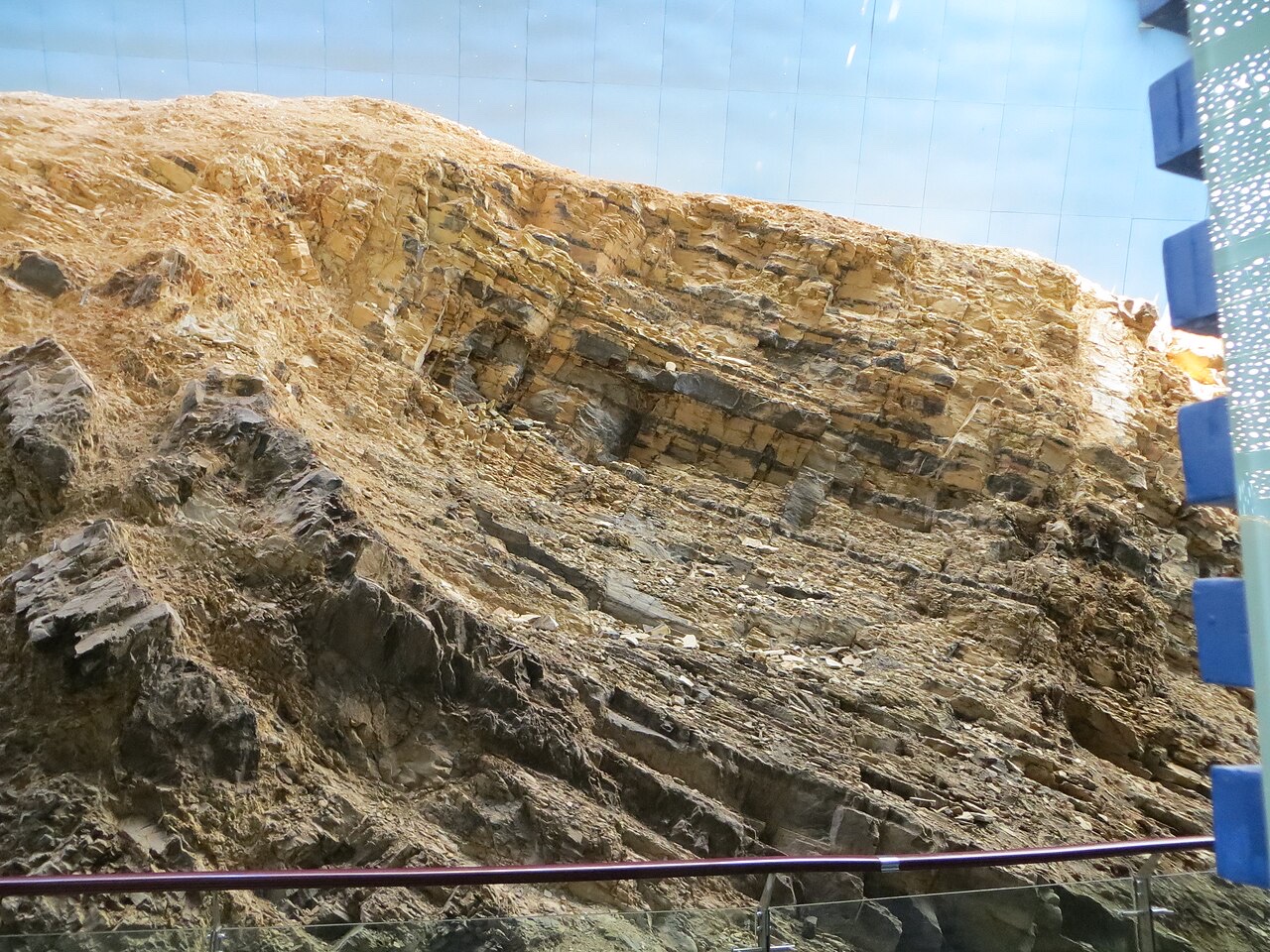
Cambrian mudstones in Yunnan preserve soft anatomy, revealing an ecosystem and an unusually selective route into the fossil record.
518 Ma → Today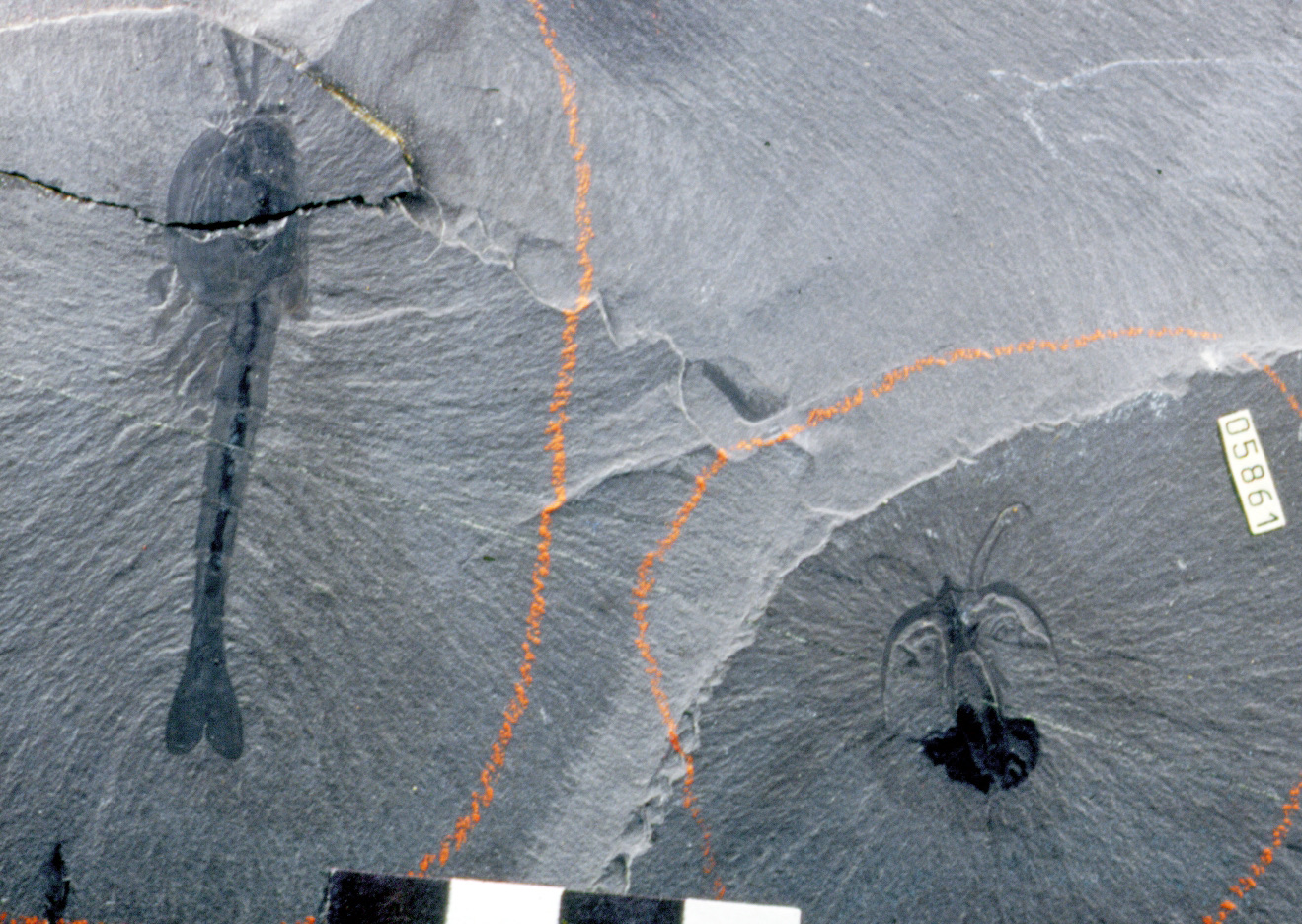 North America
Canada ↗
Burgess Shale
Cambrian mud preserved animals that most fossil sites lose. Today those thin traces are exposed high in the Canadian Rockies, connecting the history of life with the later history of a mountain belt.
508 Ma → Today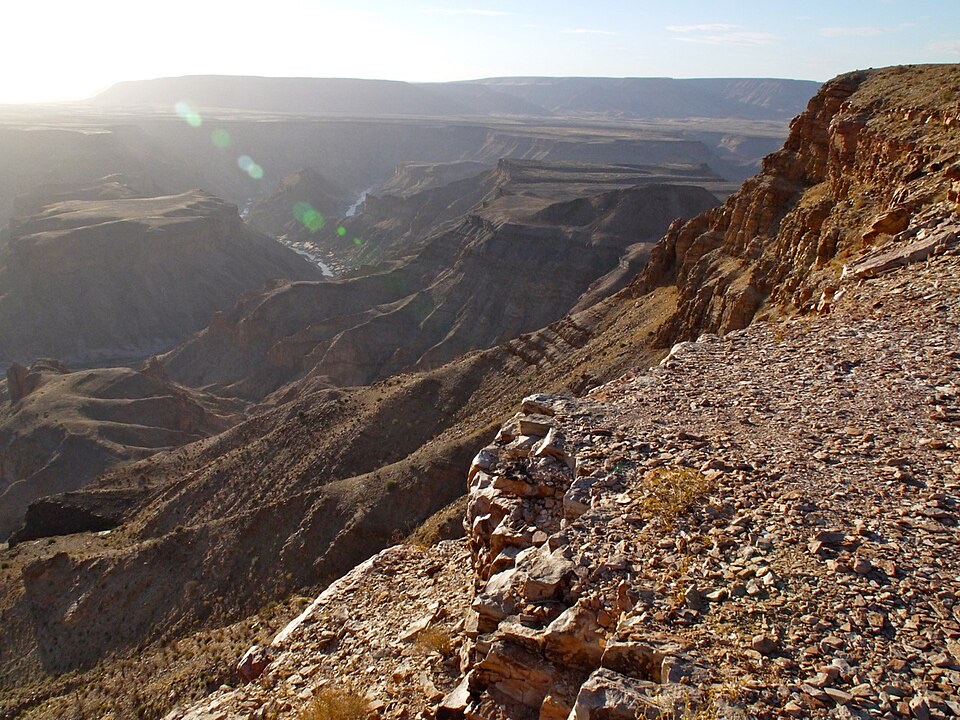 Africa
Namibia ↗
Nama Basin
Late Ediacaran skeletons and younger burrows show two different ways animals began shaping marine habitats in southern Namibia.
548 Ma → 537 Ma