
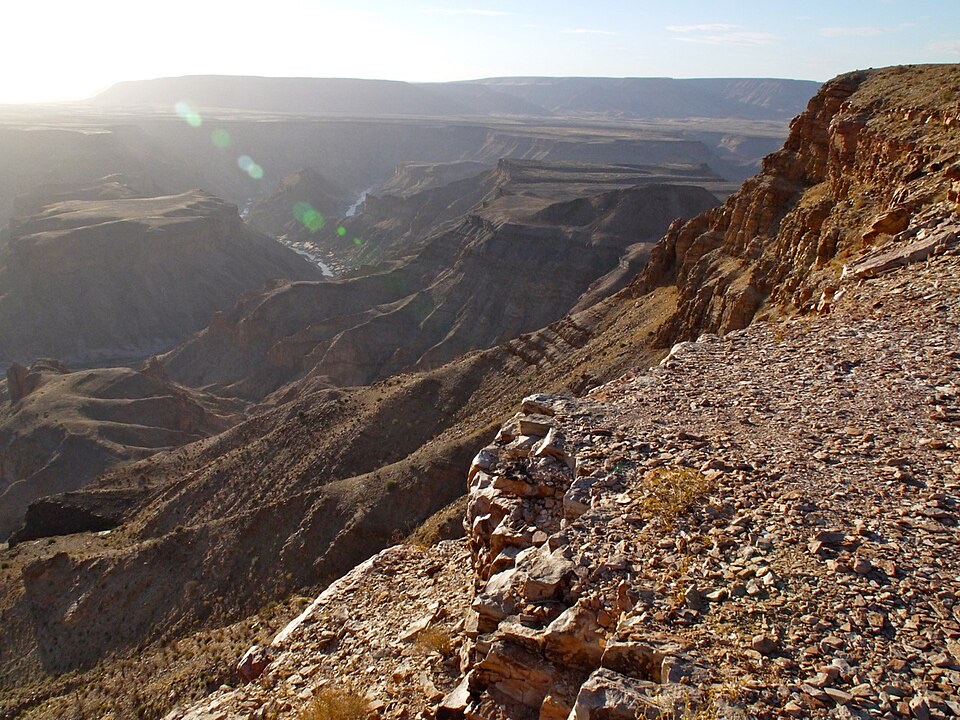
What changed when animals began to alter the seafloor?
The Nama Basin holds a record of an ocean floor that would look unfamiliar even to a diver accustomed to modern reefs. Microbial communities built carbonate structures, while small skeletal organisms occupied parts of the same habitat. Tubes assigned to Cloudina and the delicate cups of Namacalathus occur in late Ediacaran rocks. Their importance lies in what they reveal about interactions with a surface: attachment, crowding, construction and the movement of water through an inhabited patch of seafloor.
Where the tubes lie matters as much as their shape. Some Nama limestone deposits preserve clusters on sheltered surfaces within microbial reefs. At Driedoornvlakte and other localities, three-dimensional imaging of selected clusters revealed broken tubes in sediment. These samples record skeletal debris accumulating within reefs. An attached cluster records a living community; a bed of transported fragments also records currents and burial.
Higher in the regional succession, increasingly complex trace fossils document animals moving through sediment. Treptichnus-type burrows preserve repeated probing rather than the body of the maker. Their appearance is part of the transition toward a seafloor increasingly mixed by animals, not proof that all earlier seafloors were motionless. Matching these events to the Ediacaran–Cambrian boundary requires both fossils and dated ash beds. Erosion, different environments and uncertain correlations make a single sharp worldwide switch a misleading picture.
[1] [2] [3] [4] [5]Time windows and evidence
Older ages are on the left. Bars span the dated intervals. A dot marks a single age.
- A skeletal carbonate community 541–550 Ma
- A seafloor increasingly worked by animals 535–539 Ma
- Cloudina in the Omkyk Member 541–550 Ma
- Namacalathus cups in Nama carbonates 541–550 Ma
- Treptichnus pedum in the upper Nama record 535–539 Ma
Researched windowsEvidence records
548 Ma · interval 541–550 Ma
A skeletal carbonate community
This snapshot represents late Ediacaran carbonate habitats of the Nama Group, particularly the Omkyk Member. Microbial structures, tubes and cup-shaped skeletons occur together, but their arrangement varies among outcrops. The schematic expresses a shallow marine habitat containing organisms with hard parts. It is not a surveyed reef map, and it does not settle the dispute over which fossil clusters retain their original growth positions.
[1] [2] [5]Locate this time in the atlas ↗Observed
Cloudina and Namacalathus skeletons occur in carbonate beds and reef-associated facies.
Reconstructed
An inhabited carbonate seafloor with microbial structures and locally attached skeletal organisms.
Uncertain
Some tube aggregates may be transported debris; exact affinities and original community structure remain debated.
Evidence windows overlapping this state: 2. Overlap does not establish exact coexistence.
body fossil · Nama Basin ↗
Cloudina in the Omkyk Member
Nested, mineralized tubes assigned to Cloudina occur in Nama carbonate rocks. Some examples have been interpreted as mutually attached frameworks, making them evidence for early animal involvement in reef construction. Three-dimensional studies also show that some apparent frameworks are accumulations of transported tube fragments. Keeping both findings visible makes the locality useful for learning how a biological interpretation can depend on sedimentary context.
body fossil · Nama Basin ↗
Namacalathus cups in Nama carbonates
Namacalathus is recognizable by a small cup-like skeleton associated with a stalk. The original description from Namibia established a distinctive component of the terminal Ediacaran marine record. Its association with microbial carbonate structures is observed; its position in the animal family tree and details of feeding require additional anatomical arguments. The fossil illustrates why a well-preserved outline need not yield a complete reconstruction of a living organism.
537 Ma · interval 535–539 Ma
A seafloor increasingly worked by animals
The younger snapshot represents the boundary interval and earliest Cambrian portions of the regional record. Branching burrow patterns show animals repeatedly entering and moving within sediment. This is a behavioural reconstruction from trace geometry, not a portrait of a known species. The displayed age is a rounded teaching position within a difficult correlation interval; it should not be read as a precisely measured first occurrence.
[3] [4]Locate this time in the atlas ↗Observed
Treptichnus pedum and other complex traces are documented in upper Nama regional successions.
Reconstructed
Burrowing animals reworked parts of the seabed and changed the sediment habitat.
Uncertain
First appearances differ with facies and section; absolute boundary calibration continues to be refined.
Evidence windows overlapping this state: 1. Overlap does not establish exact coexistence.
What this story cannot resolve
The marker identifies a broad present-day basin, not the ancient position of a fossil collection. The two teaching intervals summarize different Nama sections; they do not imply continuous deposition at one site.
Keep these ideas handy
Fossilization
The varied processes by which remains or traces of past life enter the geological record. Explore the idea ↗
Trace fossils
Preserved evidence of an organism’s activity, such as a footprint, burrow, feeding mark or coprolite. Explore the idea ↗
Uncertainty & reconstruction limits
Explicit limits on what evidence and models allow us to infer, including uncertainty in age, identity, place and process. Explore the idea ↗
The evidence notebook
body fossil · Nama Basin ↗
Cloudina in the Omkyk Member
Nested, mineralized tubes assigned to Cloudina occur in Nama carbonate rocks. Some examples have been interpreted as mutually attached frameworks, making them evidence for early animal involvement in reef construction. Three-dimensional studies also show that some apparent frameworks are accumulations of transported tube fragments. Keeping both findings visible makes the locality useful for learning how a biological interpretation can depend on sedimentary context.
body fossil · Nama Basin ↗
Namacalathus cups in Nama carbonates
Namacalathus is recognizable by a small cup-like skeleton associated with a stalk. The original description from Namibia established a distinctive component of the terminal Ediacaran marine record. Its association with microbial carbonate structures is observed; its position in the animal family tree and details of feeding require additional anatomical arguments. The fossil illustrates why a well-preserved outline need not yield a complete reconstruction of a living organism.
trace fossil · Nama Basin ↗
Treptichnus pedum in the upper Nama record
Treptichnus pedum is a burrow pattern rather than a fossil species of animal. Successive probes make a recognizable, branching sequence within the sediment. Its upper Nama occurrences are relevant to the early Cambrian, but a first observed occurrence depends on where suitable sediment was deposited and exposed. The age interval here deliberately remains broad because regional correlations and numerical calibration are still discussed in the research literature.
Follow the evidence
Sources & credits
- Extensive metazoan reefs from the Ediacaran Nama Group, Namibia: the rise of benthic suspension feeding ↗
Wood and Curtis; Geobiology / University of Edinburgh · 2015
Use, credit & modifications
Reference only. No third-party prose, figures, photographs or datasets reproduced; factual interpretation written originally for this atlas.
Credit: Wood and Curtis; Geobiology / University of Edinburgh — Extensive metazoan reefs from the Ediacaran Nama Group, Namibia: the rise of benthic suspension feeding. Original educational synthesis; geological ages rounded into explicitly labelled teaching intervals. No licensed media incorporated; no territorial reuse permission asserted.
- Multiscale approach reveals that Cloudina aggregates are detritus and not in situ reef constructions ↗
Mehra and Maloof; PNAS · 2018
Use, credit & modifications
Reference only. No third-party prose, figures, photographs or datasets reproduced; factual interpretation written originally for this atlas.
Credit: Mehra and Maloof; PNAS — Multiscale approach reveals that Cloudina aggregates are detritus and not in situ reef constructions. Original educational synthesis; geological ages rounded into explicitly labelled teaching intervals. No licensed media incorporated; no territorial reuse permission asserted.
- The trace fossil record of the Nama Group, Namibia: Exploring the terminal Ediacaran roots of the Cambrian explosion ↗
Darroch et al.; Earth-Science Reviews · 2021
Use, credit & modifications
Reference only. No third-party prose, figures, photographs or datasets reproduced; factual interpretation written originally for this atlas.
Credit: Darroch et al.; Earth-Science Reviews — The trace fossil record of the Nama Group, Namibia: Exploring the terminal Ediacaran roots of the Cambrian explosion. Original educational synthesis; geological ages rounded into explicitly labelled teaching intervals. No licensed media incorporated; no territorial reuse permission asserted.
- Foundational uncertainties in terminal Ediacaran chronostratigraphy revealed by high-precision zircon U-Pb geochronology of the Nama Group, Namibia ↗
Earth-Science Reviews; White Rose Research Online · 2025
Use, credit & modifications
Reference only. No third-party prose, figures, photographs or datasets reproduced; factual interpretation written originally for this atlas.
Credit: Earth-Science Reviews; White Rose Research Online — Foundational uncertainties in terminal Ediacaran chronostratigraphy revealed by high-precision zircon U-Pb geochronology of the Nama Group, Namibia. Original educational synthesis; geological ages rounded into explicitly labelled teaching intervals. No licensed media incorporated; no territorial reuse permission asserted.
- Calcified metazoans in thrombolite-stromatolite reefs of the terminal Proterozoic Nama Group, Namibia ↗
Grotzinger, Watters and Knoll; Paleobiology · 2000
Use, credit & modifications
Reference only. No third-party prose, figures, photographs or datasets reproduced; factual interpretation written originally for this atlas.
Credit: Grotzinger, Watters and Knoll; Paleobiology — Calcified metazoans in thrombolite-stromatolite reefs of the terminal Proterozoic Nama Group, Namibia. Original educational synthesis; geological ages rounded into explicitly labelled teaching intervals. No licensed media incorporated; no territorial reuse permission asserted.
Follow the connections
 Oceania
Australia ↗
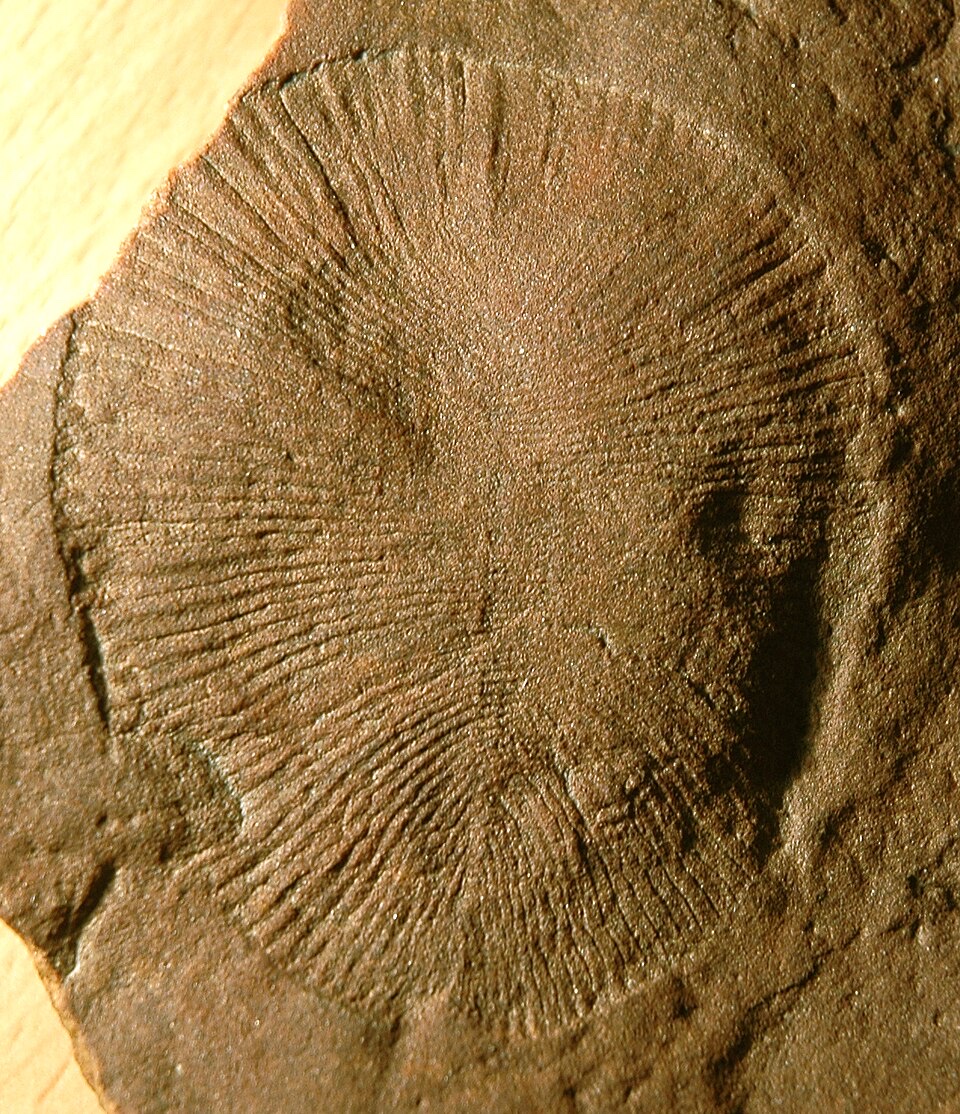
Ediacara & Nilpena
South Australian bedding surfaces record soft-bodied Ediacaran organisms and the patchiness of life on an ancient marine floor.
555 Ma → Today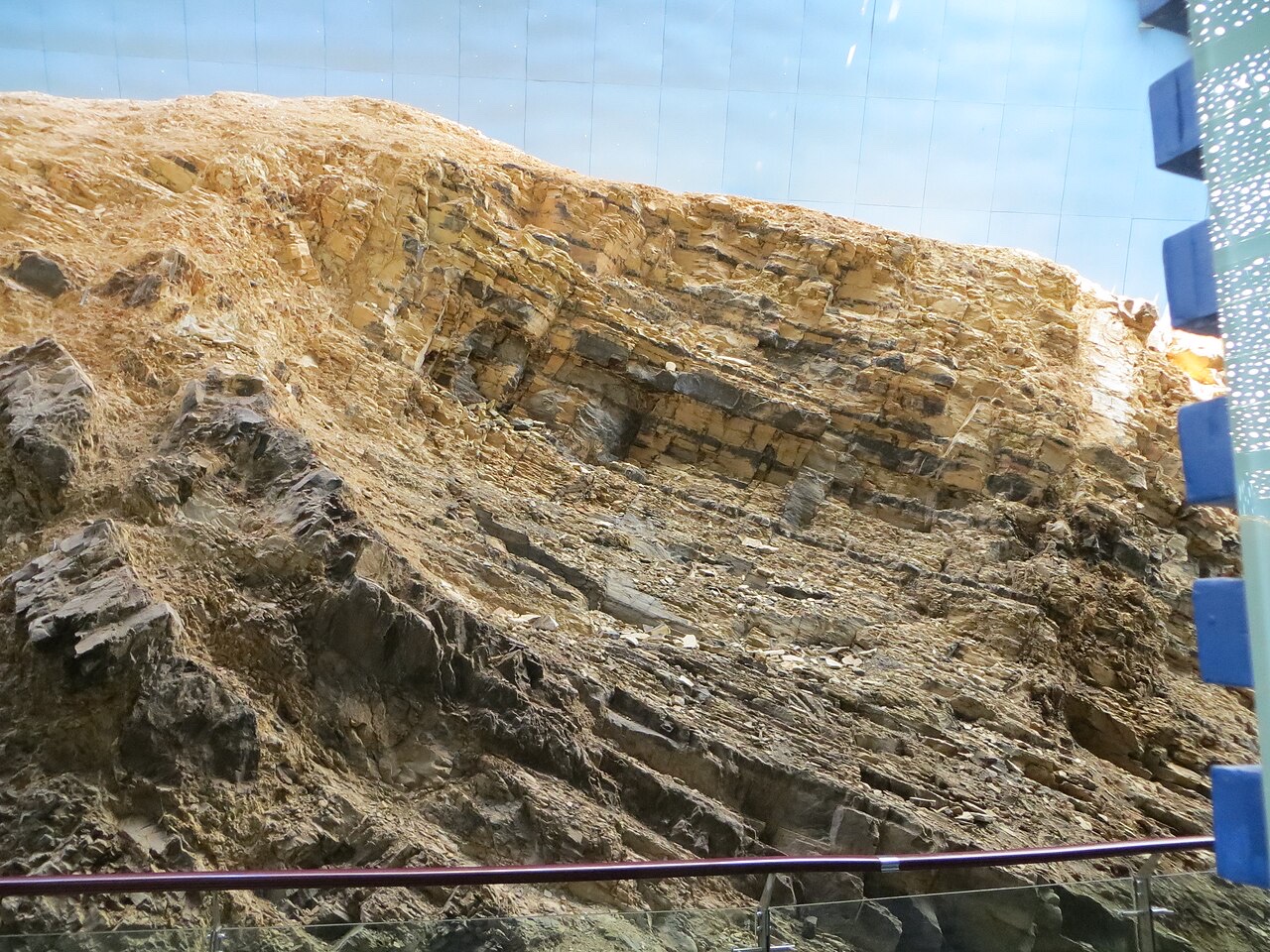 Asia
China ↗
Chengjiang
Cambrian mudstones in Yunnan preserve soft anatomy, revealing an ecosystem and an unusually selective route into the fossil record.
518 Ma → Today