
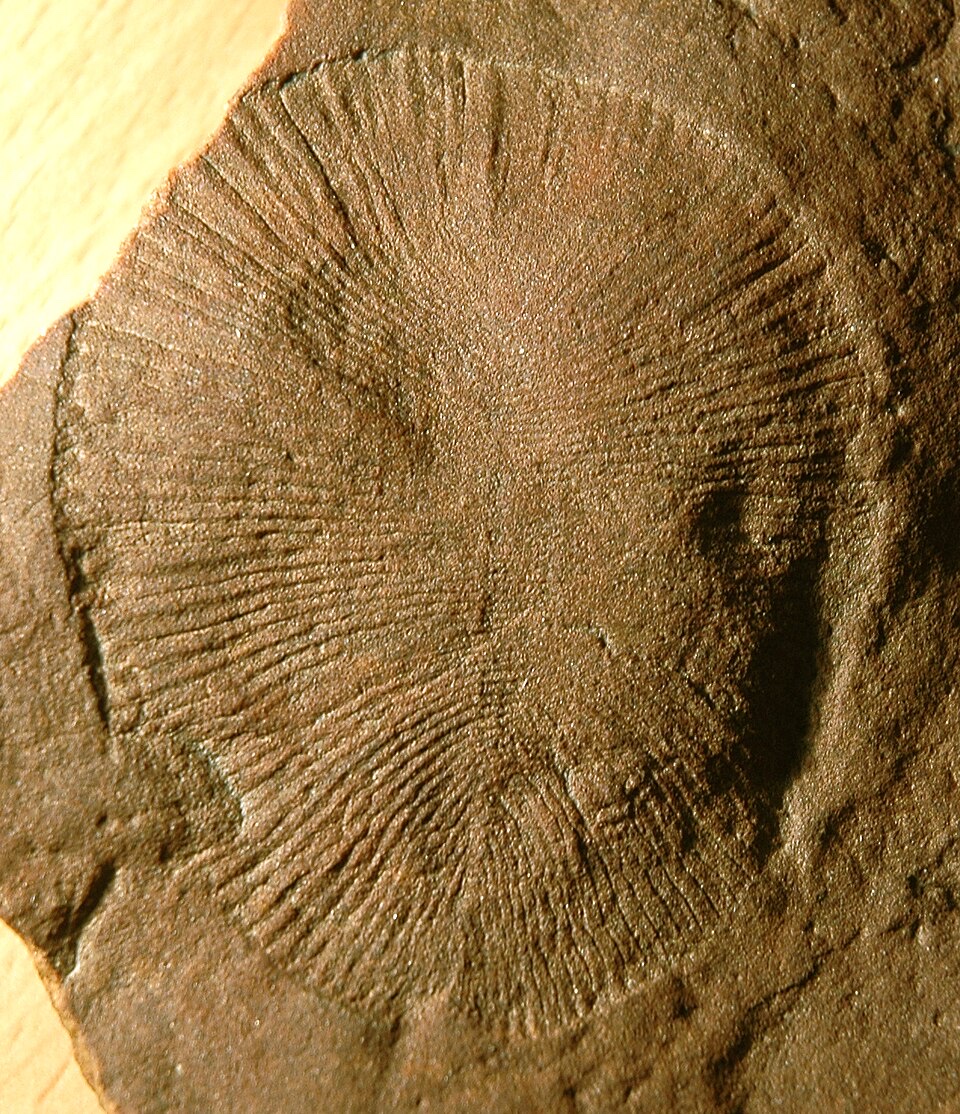
Can an impression preserve a community as well as an individual?
An Ediacaran fossil may look more like a patterned impression than a familiar shell or bone. At Nilpena, bedding surfaces preserve many such forms together. Dickinsonia, Spriggina and dense assemblages of other organisms belong to a late Ediacaran marine record around 555 million years old. Some relationships to living animal groups remain uncertain. Giving an organism a recognizable name does not remove that uncertainty, and drawing a modern jellyfish or worm over an impression can imply more than the fossil supports.
On some excavated Nilpena beds, the tubular fossil Funisia dominates. Other beds preserve different combinations of organisms and textures. A site-wide tally would hide these changes. Mapping individual surfaces lets researchers compare what is preserved together and assess whether organisms were buried close to where they lived.
The modern arid hills provide a dramatic contrast with that marine setting, but the comparison skips a vast intervening geological history. Rocks were buried, altered and later exposed. The atlas makes this discontinuity explicit instead of inventing a smooth transition from seafloor to present hills. It also avoids older popular claims that every Ediacaran form can be assigned confidently to a familiar modern group. The strongest story is the one the surfaces themselves permit: sizeable, patterned organisms lived together before the later Cambrian fossil record became widespread.
[1] [2] [3] [4] [5]Time windows and evidence
Older ages are on the left. Bars span the dated intervals. A dot marks a single age.
- A patchwork of marine communities 550–560 Ma
- The archive in an arid landscape Today
- Dickinsonia in the Ediacara Member 550–560 Ma
- Spriggina from South Australia 550–560 Ma
- Dense Funisia assemblages at Nilpena 550–560 Ma
Researched windowsEvidence records
555 Ma · interval 550–560 Ma
A patchwork of marine communities
This scene represents the late Ediacaran seafloor recorded by the Ediacara Member of the Rawnsley Quartzite. Multiple fossil-bearing surfaces reveal differently composed communities. The schematic shows organisms distributed across a substrate, with no claim to reproduce a surveyed Nilpena bed or the precise bodies of uncertain taxa. The rounded age interval provides context for the fossil assemblage, not a single instantaneous date for every surface.
[3] [2] [4]Locate this time in the atlas ↗Observed
Soft-bodied impressions and sedimentary textures occur together on extensive bedding surfaces.
Reconstructed
Organisms occupied a marine floor in spatially variable communities.
Uncertain
Affinities, life habits and the completeness of each preserved community vary in confidence.
Evidence windows overlapping this state: 3. Overlap does not establish exact coexistence.
body fossil · Ediacara & Nilpena ↗
Dickinsonia in the Ediacara Member
Dickinsonia impressions display a repeated pattern across a flattened body outline. Specimens from South Australia differ in size and form, providing material for examining growth and the limits of fossil species definitions. A named morphospecies is identified from preserved shape; it is not equivalent to directly observing reproductive boundaries in a living population. The record is most useful when form, substrate and preservation are considered together.
body fossil · Ediacara & Nilpena ↗
Spriggina from South Australia
Spriggina is one of the distinctive fossils documented in the South Australian Ediacara assemblage. Its repeated body units and differentiated end invite comparisons with later animals, but those comparisons must be tested rather than treated as self-evident ancestry. Its presence on a fossil-bearing surface is secure evidence; a precise reconstruction of how it moved or fed is a further interpretive step.
locality · Ediacara & Nilpena ↗
Dense Funisia assemblages at Nilpena
Some Nilpena surfaces contain exceptionally dense associations of tubular fossils assigned to Funisia. Their distribution is evidence about occupation of space, not simply another name in a species list. Comparing surfaces reveals that the fossil community varies from bed to bed. Such a pattern can reflect ecology and preservation together, so counts should be interpreted within a mapped surface rather than extrapolated to the whole ancient ocean.
Today · interval Today
The archive in an arid landscape
The ancient bedding surfaces now form part of an exposed fossil archive in South Australia’s Flinders Ranges region. The present scene helps readers orient themselves without reinterpreting the fossil organisms as desert life. Conservation of entire surfaces matters because removing an individual would also remove information about its neighbours and sedimentary context. This is a modern regional locator, not an archaeological or visitor-access map.
[1] [5]Locate this time in the atlas ↗Observed
Fossil-bearing rock surfaces are conserved and studied in the modern Nilpena landscape.
Reconstructed
Later geological history brought a marine archive into an exposed terrestrial setting.
Uncertain
This comparison does not date each burial, deformation or erosion episode between the two states.
Evidence windows overlapping this state: 0. Overlap does not establish exact coexistence.
No curated evidence record overlaps this window. The full notebook for this region appears below.
What this story cannot resolve
The representative 555 Ma age describes the regional fossil record. Bedding surfaces formed at different times and preserve distinct communities and burial conditions.
Keep these ideas handy
Fossilization
The varied processes by which remains or traces of past life enter the geological record. Explore the idea ↗
Biogeography
Studying how organisms are distributed through space and time and how those patterns developed. Explore the idea ↗
Relative dating
Determining which event came first without necessarily assigning a numerical age. Explore the idea ↗
The evidence notebook
body fossil · Ediacara & Nilpena ↗
Dickinsonia in the Ediacara Member
Dickinsonia impressions display a repeated pattern across a flattened body outline. Specimens from South Australia differ in size and form, providing material for examining growth and the limits of fossil species definitions. A named morphospecies is identified from preserved shape; it is not equivalent to directly observing reproductive boundaries in a living population. The record is most useful when form, substrate and preservation are considered together.
body fossil · Ediacara & Nilpena ↗
Spriggina from South Australia
Spriggina is one of the distinctive fossils documented in the South Australian Ediacara assemblage. Its repeated body units and differentiated end invite comparisons with later animals, but those comparisons must be tested rather than treated as self-evident ancestry. Its presence on a fossil-bearing surface is secure evidence; a precise reconstruction of how it moved or fed is a further interpretive step.
locality · Ediacara & Nilpena ↗
Dense Funisia assemblages at Nilpena
Some Nilpena surfaces contain exceptionally dense associations of tubular fossils assigned to Funisia. Their distribution is evidence about occupation of space, not simply another name in a species list. Comparing surfaces reveals that the fossil community varies from bed to bed. Such a pattern can reflect ecology and preservation together, so counts should be interpreted within a mapped surface rather than extrapolated to the whole ancient ocean.
Follow the evidence
Sources & credits
- Meet the fossils of Nilpena Ediacara National Park ↗
National Parks and Wildlife Service South Australia · 2023
Use, credit & modifications
Reference only. No third-party prose, figures, photographs or datasets reproduced; factual interpretation written originally for this atlas.
Credit: National Parks and Wildlife Service South Australia — Meet the fossils of Nilpena Ediacara National Park. Original educational synthesis; geological ages rounded into explicitly labelled teaching intervals. No licensed media incorporated; no territorial reuse permission asserted.
- Museum Director marks Ediacara’s 80th anniversary with visit to fossil beds ↗
South Australian Museum · 2026
Use, credit & modifications
Reference only. No third-party prose, figures, photographs or datasets reproduced; factual interpretation written originally for this atlas.
Credit: South Australian Museum — Museum Director marks Ediacara’s 80th anniversary with visit to fossil beds. Original educational synthesis; geological ages rounded into explicitly labelled teaching intervals. No licensed media incorporated; no territorial reuse permission asserted.
- Heterogeneity of the Ediacaran seafloor: An example from the Ediacaran of South Australia ↗
Droser and Gehling; PNAS · 2015
Use, credit & modifications
Reference only. No third-party prose, figures, photographs or datasets reproduced; factual interpretation written originally for this atlas.
Credit: Droser and Gehling; PNAS — Heterogeneity of the Ediacaran seafloor: An example from the Ediacaran of South Australia. Original educational synthesis; geological ages rounded into explicitly labelled teaching intervals. No licensed media incorporated; no territorial reuse permission asserted.
- Species of Dickinsonia Sprigg from the Ediacaran of South Australia ↗
Evans et al.; Palaeontology / Stanford University · 2023
Use, credit & modifications
Reference only. No third-party prose, figures, photographs or datasets reproduced; factual interpretation written originally for this atlas.
Credit: Evans et al.; Palaeontology / Stanford University — Species of Dickinsonia Sprigg from the Ediacaran of South Australia. Original educational synthesis; geological ages rounded into explicitly labelled teaching intervals. No licensed media incorporated; no territorial reuse permission asserted.
- Ediacara Fossil Site — Nilpena ↗
Australian Department of Climate Change, Energy, the Environment and Water · 2026-03-19
Use, credit & modifications
Reference only. No third-party prose, figures, photographs or datasets reproduced; factual interpretation written originally for this atlas.
Credit: Australian Department of Climate Change, Energy, the Environment and Water — Ediacara Fossil Site — Nilpena. Original educational synthesis; geological ages rounded into explicitly labelled teaching intervals. No licensed media incorporated; no territorial reuse permission asserted.
Follow the connections
 Africa
Namibia ↗
Nama Basin
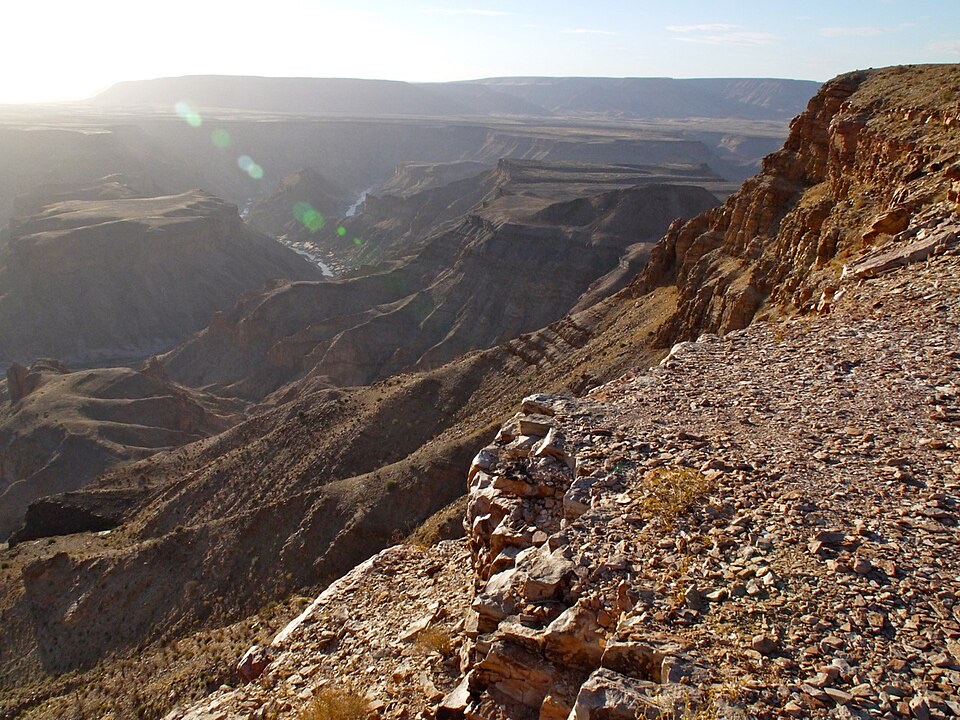
Late Ediacaran skeletons and younger burrows show two different ways animals began shaping marine habitats in southern Namibia.
548 Ma → 537 Ma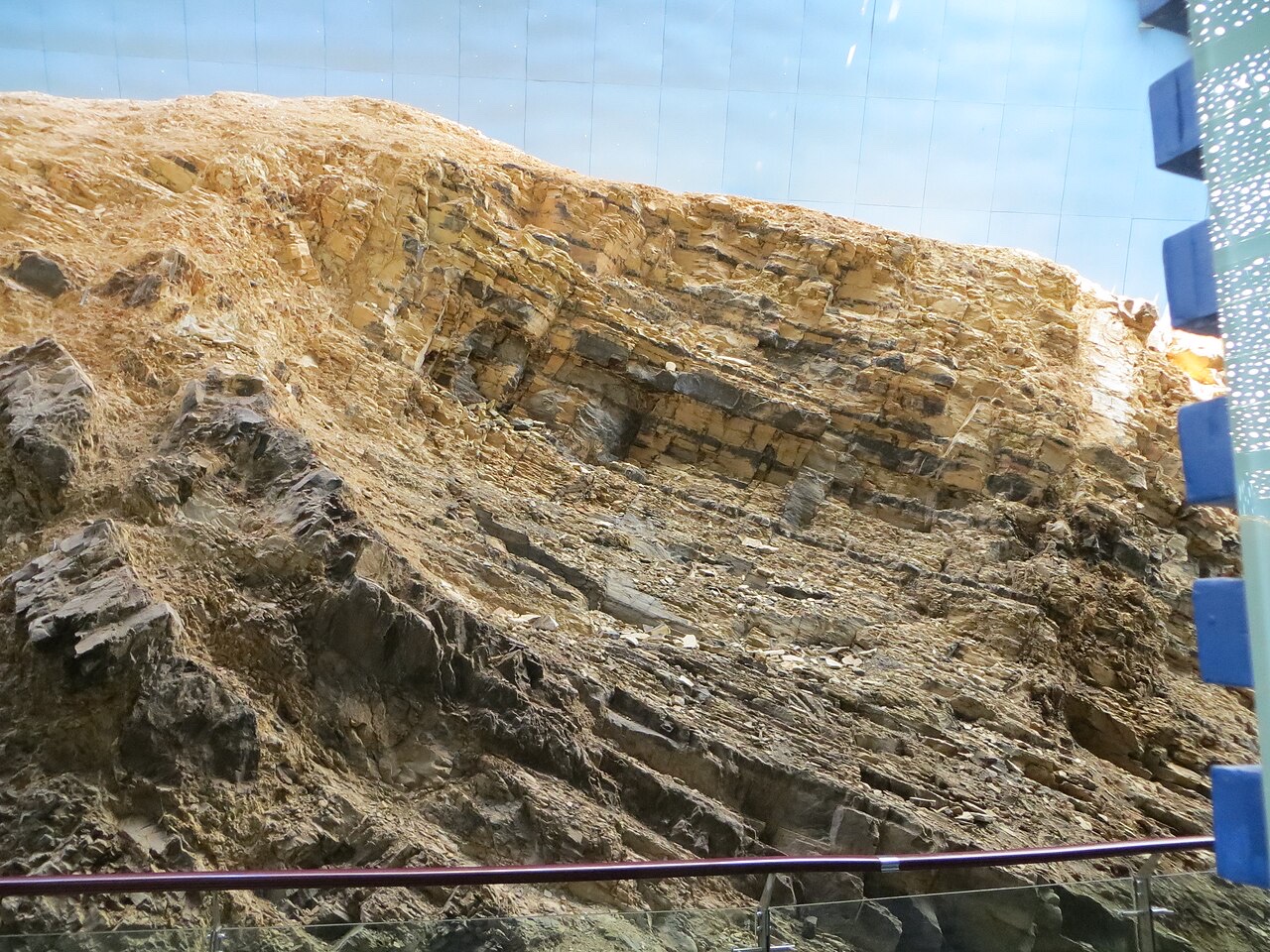 Asia
China ↗
Chengjiang
Cambrian mudstones in Yunnan preserve soft anatomy, revealing an ecosystem and an unusually selective route into the fossil record.
518 Ma → Today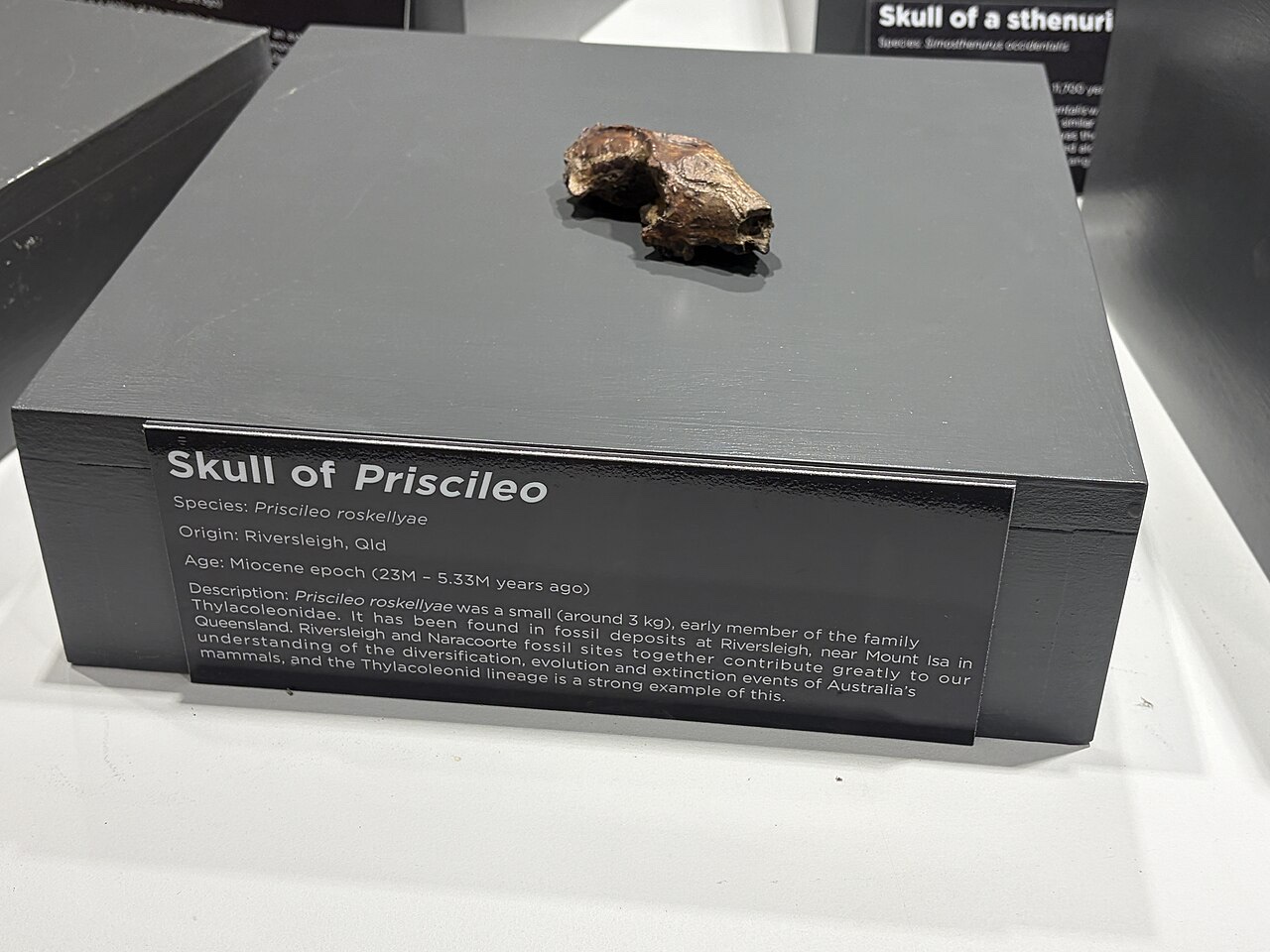 Oceania
Australia ↗
Riversleigh
Riversleigh’s fossil deposits connect wetter Oligocene–Miocene habitats with later faunas, revealing Australian mammals, birds, reptiles and bats.
23 Ma → 2.1 Ma