
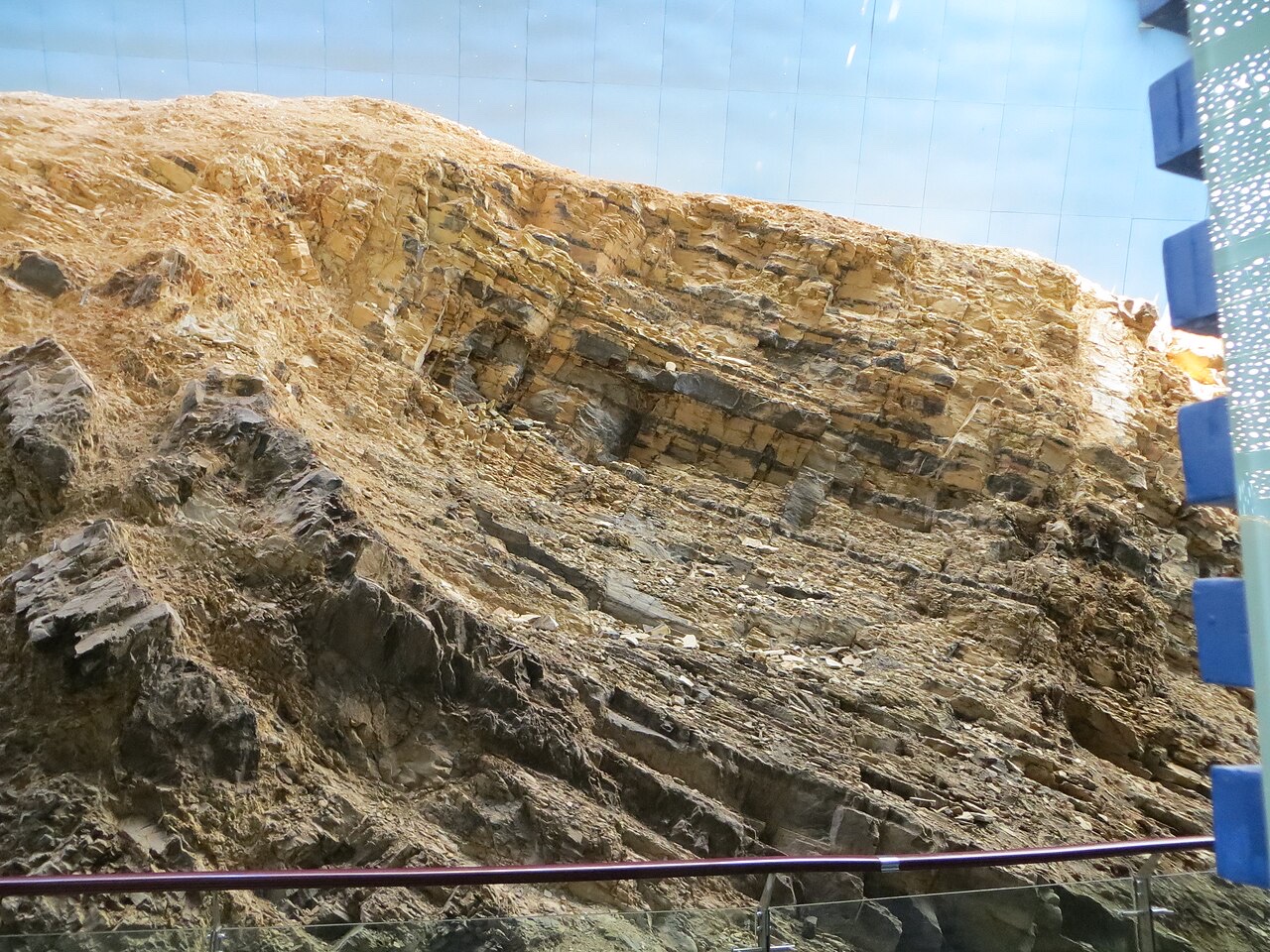
Why does one deposit reveal animals that ordinary fossil beds miss?
At Chengjiang, the familiar rule that fossils mostly preserve hard parts has an important exception. Some organisms retain outlines and internal structures that would usually decay. The result is a window onto Cambrian animals that is much wider than a collection of shells alone. It still is a window, not a complete census. The mix of organisms reflects their original habitat, transport, burial and the particular chemical conditions that allowed delicate remains to survive.
Recent sedimentological work reconstructs a delta system rather than a uniform offshore seabed. The place where an animal lived and the place where its body was buried need not be identical: flows can carry remains into a quieter, oxygen-poor depositional setting. This difference is crucial when interpreting an assemblage. A rich fossil bed may owe its concentration to burial processes as well as to the original diversity of life. Our marine schematic therefore represents a delta margin without asserting a fixed coast or a water depth measured to the metre.
Chengjiang also illustrates the care needed when naming anatomy. Yunnanozoon preserves unusual repeated structures, but researchers disagree about which structures correspond to those of living animals. Preservation can change an outline, and similarity is not automatically common ancestry. Dating provides a separate constraint: a published zircon age near 518 million years offers a maximum-age estimate for the biota, with stated uncertainty. Modern hills expose the archive; they do not reveal what the Cambrian land surface looked like before it was buried and deformed.
[1] [2] [3] [4]Time windows and evidence
Older ages are on the left. Bars span the dated intervals. A dot marks a single age.
- A Cambrian delta margin 517–519 Ma
- An ancient seabed exposed in Yunnan Today
- The Maotianshan fossil assemblage 517–519 Ma
- Yunnanozoon from Chengjiang-area sections 517–519 Ma
- Yu’anshan Formation sediment and trace evidence 517–519 Ma
Researched windowsEvidence records
518 Ma · interval 517–519 Ma
A Cambrian delta margin
A Cambrian delta delivered sediment to a marine basin. The setting is based in part on an unweathered drill core from the Yu’anshan Formation. Its sediments suggest that bodies of animals from shallower, oxygenated water could be carried to quieter settings, where burial preserved unusual detail. The 518 Ma snapshot is rounded from zircon dating. The youngest dated zircon grains tell us the fossil-bearing sediment could have accumulated at that age or later.
[2] [3]Locate this time in the atlas ↗Observed
Soft-bodied fossils occur in fine-grained Cambrian deposits alongside sedimentary evidence for delta processes.
Reconstructed
A delta margin supplied animals and sediment to depositional settings capable of exceptional preservation.
Uncertain
Transport distances, original abundances and anatomical interpretation vary in certainty.
Evidence windows overlapping this state: 3. Overlap does not establish exact coexistence.
locality · Chengjiang ↗
The Maotianshan fossil assemblage
Maotianshan is a key Chengjiang locality where fine-grained rocks preserve a remarkable range of Cambrian organisms. Soft-body details add evidence missing from a shell-only assemblage. The same unusual conditions make the collection selective: organisms and tissues differ in their likelihood of preservation. Comparing this locality with ordinary marine fossil beds therefore requires accounting for the difference in what each type of rock can retain.
body fossil · Chengjiang ↗
Yunnanozoon from Chengjiang-area sections
Hundreds of slabs assigned to yunnanozoans have been examined across Chengjiang-area localities. Repeated arches and other structures are visible, but their biological identity is debated. This record provides a useful example of the difference between documenting a structure and identifying its evolutionary equivalent in living animals. A flattened fossil can preserve fine detail while still leaving competing interpretations of the whole organism.
sediment · Chengjiang ↗
Yu’anshan Formation sediment and trace evidence
The environmental interpretation of Chengjiang depends on sediment as well as body fossils. Facies, sedimentary structures, trace-fossil distribution and chemical evidence were combined in a deltaic reconstruction. These independent observations can explain why a deposit includes organisms from oxygenated habitats alongside evidence for low oxygen during burial. The scene is thus constrained by a depositional model rather than selected only because a delta looks plausible.
Today · interval Today
An ancient seabed exposed in Yunnan
Today the fossil-bearing succession is studied at exposures around Chengjiang and neighbouring areas. The modern upland locator scene identifies where the record can be investigated; it is not an attempt to reconstruct the full later geological history. The fossils are still observations of Cambrian organisms. Choosing the present state helps separate the current location of an archive from the environment in which that archive formed.
[1]Locate this time in the atlas ↗Observed
Cambrian fossil-bearing strata are exposed around modern Chengjiang.
Reconstructed
Burial, geological deformation and later exposure account for the difference between depositional and present settings.
Uncertain
No detailed uplift chronology is supplied by this two-state comparison.
Evidence windows overlapping this state: 0. Overlap does not establish exact coexistence.
No curated evidence record overlaps this window. The full notebook for this region appears below.
What this story cannot resolve
The modern marker covers a group of nearby localities. The scene does not equate fossil concentration with animal population size or claim that every taxon lived at one depth.
Keep these ideas handy
Exceptional preservation
Preservation that retains normally lost features such as soft tissues. Geologists call a deposit rich in such fossils a Konservat-Lagerstätte. Explore the idea ↗
Taphonomy
Studying what happens between an organism’s life, death, burial, preservation and eventual discovery. Explore the idea ↗
Sampling bias
Differences between the history of life and the subset preserved, exposed, collected, identified and published. Explore the idea ↗
The evidence notebook
locality · Chengjiang ↗
The Maotianshan fossil assemblage
Maotianshan is a key Chengjiang locality where fine-grained rocks preserve a remarkable range of Cambrian organisms. Soft-body details add evidence missing from a shell-only assemblage. The same unusual conditions make the collection selective: organisms and tissues differ in their likelihood of preservation. Comparing this locality with ordinary marine fossil beds therefore requires accounting for the difference in what each type of rock can retain.
body fossil · Chengjiang ↗
Yunnanozoon from Chengjiang-area sections
Hundreds of slabs assigned to yunnanozoans have been examined across Chengjiang-area localities. Repeated arches and other structures are visible, but their biological identity is debated. This record provides a useful example of the difference between documenting a structure and identifying its evolutionary equivalent in living animals. A flattened fossil can preserve fine detail while still leaving competing interpretations of the whole organism.
sediment · Chengjiang ↗
Yu’anshan Formation sediment and trace evidence
The environmental interpretation of Chengjiang depends on sediment as well as body fossils. Facies, sedimentary structures, trace-fossil distribution and chemical evidence were combined in a deltaic reconstruction. These independent observations can explain why a deposit includes organisms from oxygenated habitats alongside evidence for low oxygen during burial. The scene is thus constrained by a depositional model rather than selected only because a delta looks plausible.
Follow the evidence
Sources & credits
- Cambrian Chengjiang Fossil Site and Lagerstätte ↗
International Union of Geological Sciences · Not stated
Use, credit & modifications
Reference only. No third-party prose, figures, photographs or datasets reproduced; factual interpretation written originally for this atlas.
Credit: International Union of Geological Sciences — Cambrian Chengjiang Fossil Site and Lagerstätte. Original educational synthesis; geological ages rounded into explicitly labelled teaching intervals. No licensed media incorporated; no territorial reuse permission asserted.
- The Chengjiang Biota inhabited a deltaic environment ↗
Saleh et al.; Nature Communications · 2022
Use, credit & modifications
Reference only. No third-party prose, figures, photographs or datasets reproduced; factual interpretation written originally for this atlas.
Credit: Saleh et al.; Nature Communications — The Chengjiang Biota inhabited a deltaic environment. Original educational synthesis; geological ages rounded into explicitly labelled teaching intervals. No licensed media incorporated; no territorial reuse permission asserted.
- Geochronological constraint on the Cambrian Chengjiang biota, South China ↗
Yang et al.; Journal of the Geological Society / British Geological Survey · 2018
Use, credit & modifications
Reference only. No third-party prose, figures, photographs or datasets reproduced; factual interpretation written originally for this atlas.
Credit: Yang et al.; Journal of the Geological Society / British Geological Survey — Geochronological constraint on the Cambrian Chengjiang biota, South China. Original educational synthesis; geological ages rounded into explicitly labelled teaching intervals. No licensed media incorporated; no territorial reuse permission asserted.
- New data on the palaeobiology of the enigmatic yunnanozoans from the Chengjiang Biota, Lower Cambrian, China ↗
Cong et al.; Palaeontology · 2015
Use, credit & modifications
Reference only. No third-party prose, figures, photographs or datasets reproduced; factual interpretation written originally for this atlas.
Credit: Cong et al.; Palaeontology — New data on the palaeobiology of the enigmatic yunnanozoans from the Chengjiang Biota, Lower Cambrian, China. Original educational synthesis; geological ages rounded into explicitly labelled teaching intervals. No licensed media incorporated; no territorial reuse permission asserted.
Follow the connections
 North America
Canada ↗
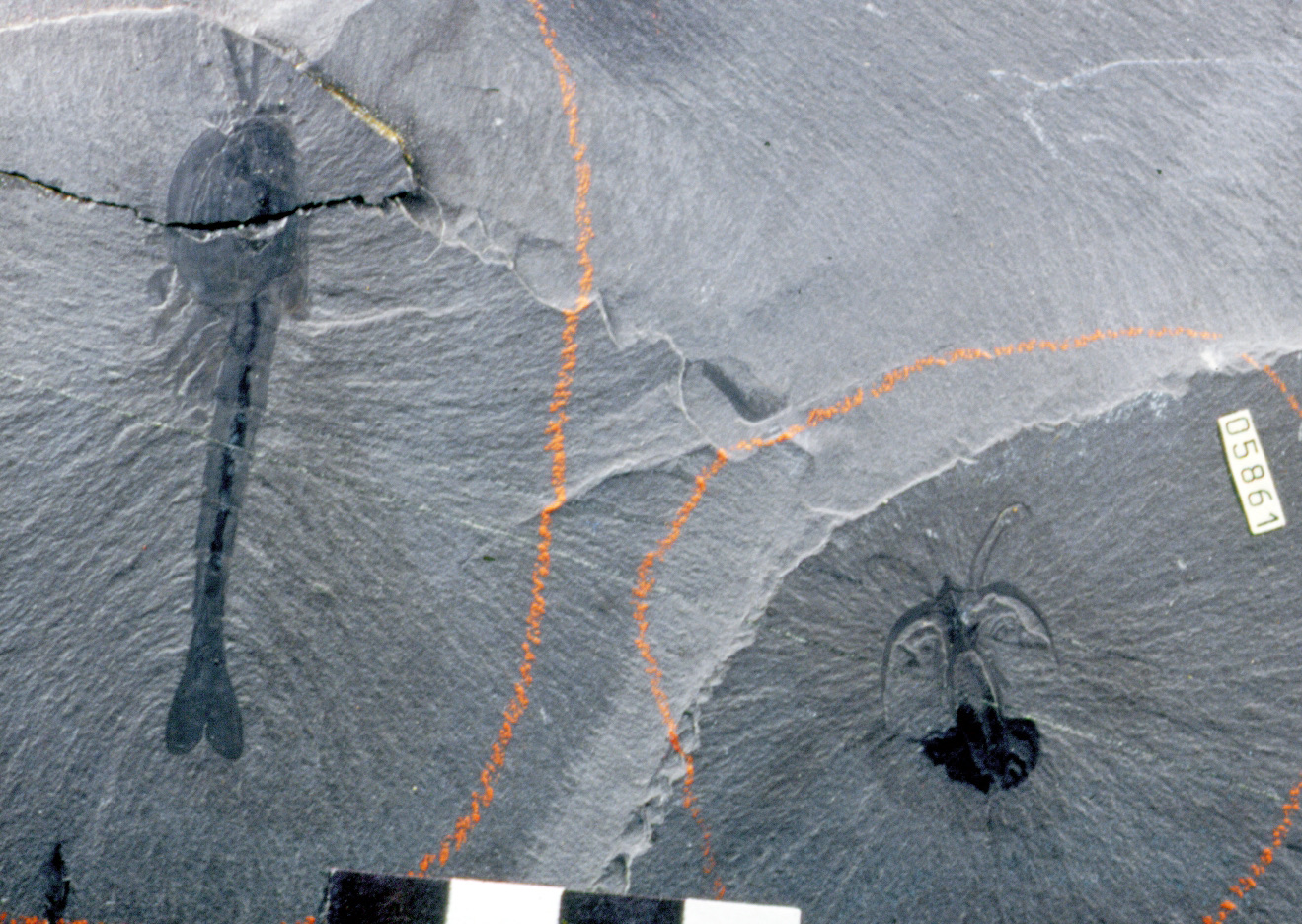
Burgess Shale
Cambrian mud preserved animals that most fossil sites lose. Today those thin traces are exposed high in the Canadian Rockies, connecting the history of life with the later history of a mountain belt.
508 Ma → Today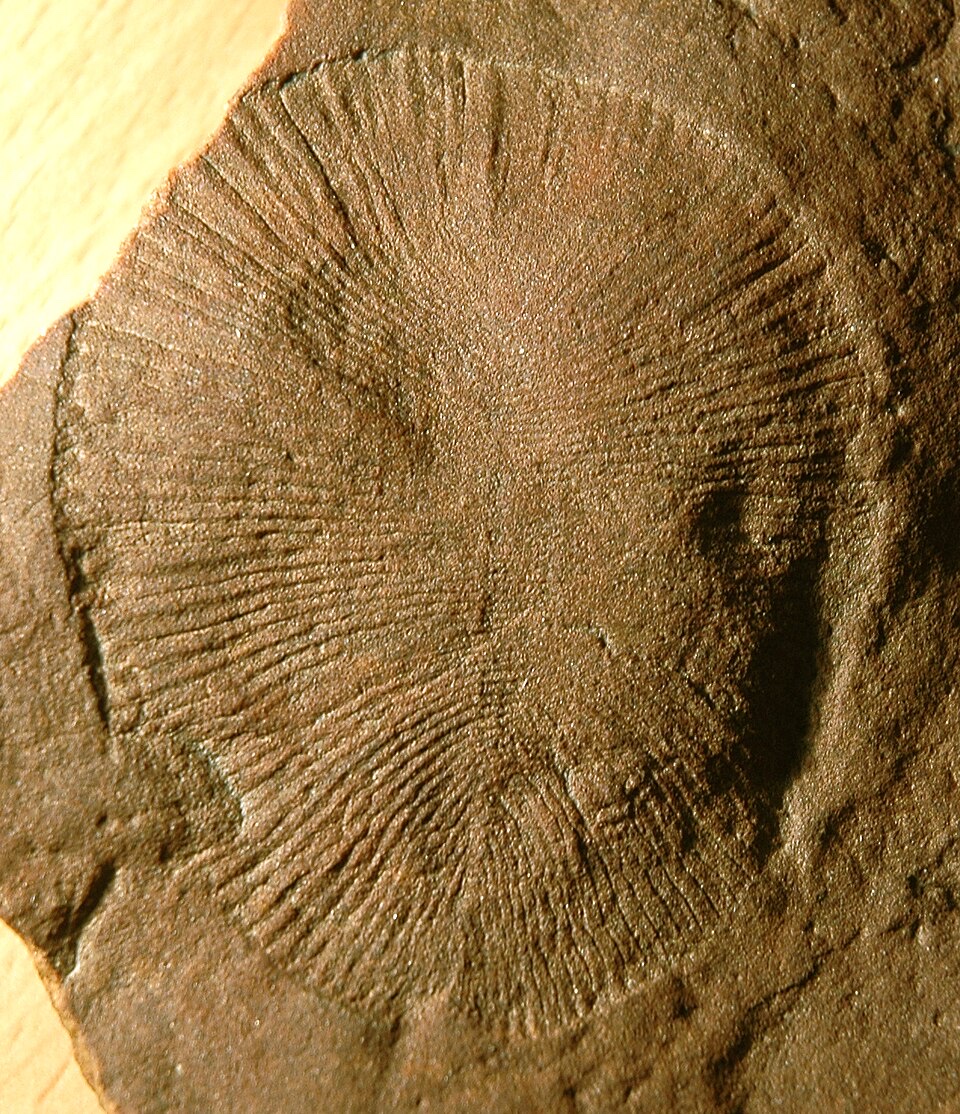 Oceania
Australia ↗
Ediacara & Nilpena
South Australian bedding surfaces record soft-bodied Ediacaran organisms and the patchiness of life on an ancient marine floor.
555 Ma → Today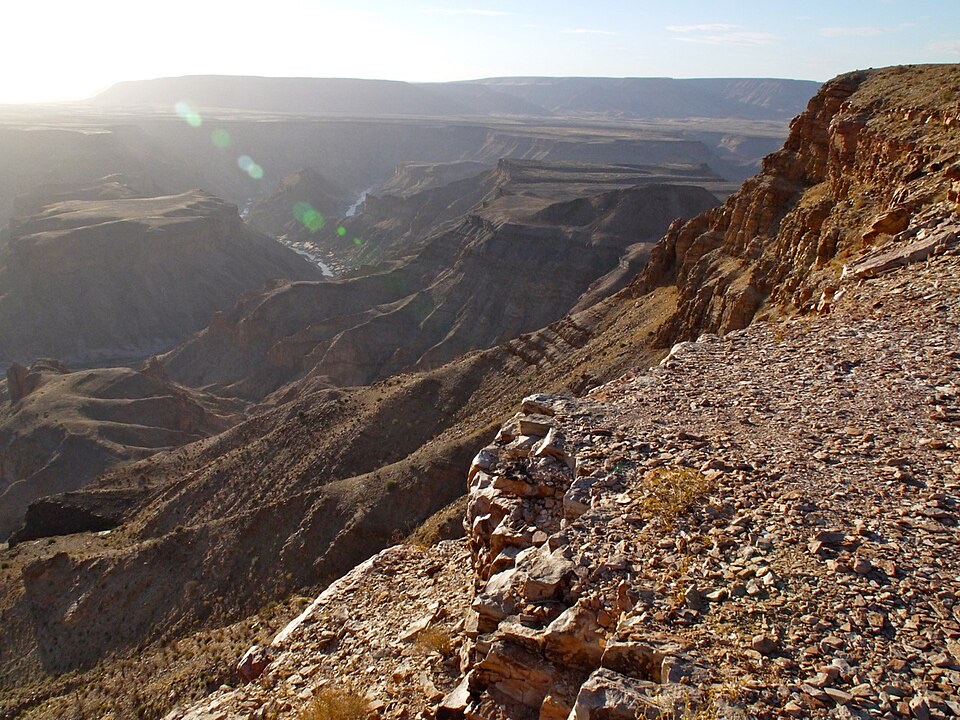 Africa
Namibia ↗
Nama Basin
Late Ediacaran skeletons and younger burrows show two different ways animals began shaping marine habitats in southern Namibia.
548 Ma → 537 Ma