
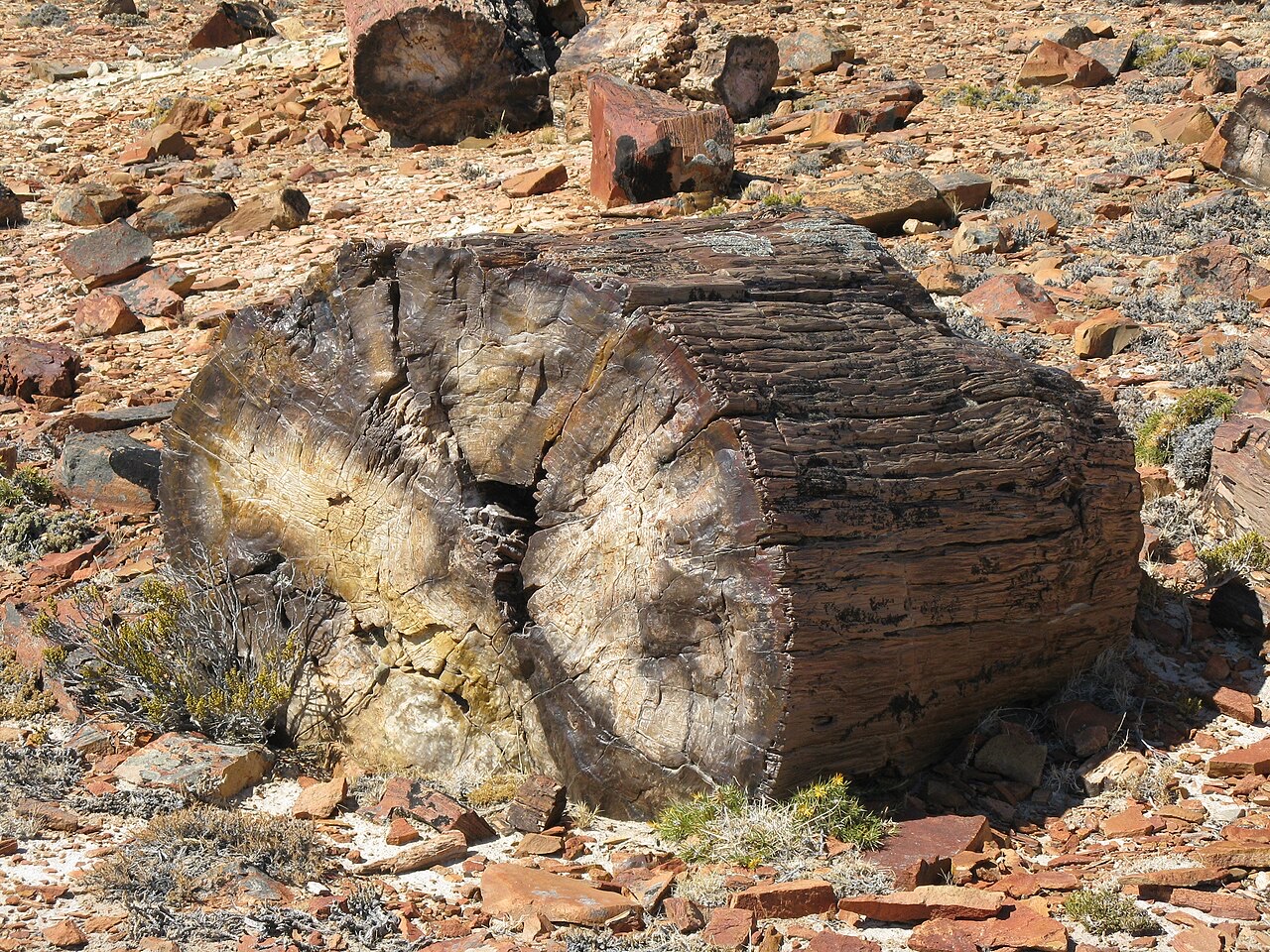
How can two wooded landscapes be separated by more than a hundred million years of ecological change?
The petrified woodlands of the La Matilde Formation contain more than large trunks. Cones, branches and the cellular structure of wood help identify the plants and reconstruct aspects of their growth. Araucaria mirabilis is a familiar name from the Cerro Cuadrado–Jaramillo fossil record. A roughly 160-million-year teaching snapshot places these remains in the Jurassic, while acknowledging that regional public accounts use differing rounded ages. The best reconstruction follows studied horizons rather than a tourism label.
A woodland can also be misrepresented by its arrangement in an illustration. Geological and ecological studies investigate whether trunks remain in growth position, how they were buried and how densely trees stood. Volcanic material was part of the preservational setting, but a layer of ash is not permission to invent an instantaneous photograph of an eruption. Fossil cones offer a separate anatomical perspective from tree spacing. Reading these together turns a spectacular petrified trunk into a testable story about a plant community.
The younger Santa Cruz Formation records a very different world around 17 million years ago. Mammals, fossil soils and sedimentary evidence point to a varied environment containing wooded areas, more open spaces and rivers. Homunculus adds a primate to the record; other mammals reveal ecological combinations unlike those of modern Patagonia. The two windows are regional and separated by a vast gap. Their shared “forest” label is deliberately broad: it cannot imply the same climate, plant composition, animals or continental connections.
[1] [2] [3] [4] [5]Time windows and evidence
Older ages are on the left. Bars span the dated intervals. A dot marks a single age.
- Jurassic conifer woodlands 155–170 Ma
- Miocene rivers, woods and open habitats 15.6–17.4 Ma
- Araucaria mirabilis cones of Cerro Cuadrado 155–170 Ma
- La Matilde petrified woodland structure 155–170 Ma
- Homunculus patagonicus in the Santa Cruz Formation 16.3–18 Ma
Researched windowsEvidence records
160 Ma · interval 155–170 Ma
Jurassic conifer woodlands
This state represents the Jurassic La Matilde petrified-forest record in Santa Cruz Province. Preserved trunks and cones constrain plant identity and aspects of woodland structure. The scene depicts a conifer woodland at broad environmental precision. It does not arrange individual fossil trunks at surveyed coordinates or claim a newly calculated date; the interval accommodates the regional chronology and differing published rounded ages.
[1] [2] [3]Locate this time in the atlas ↗Observed
Petrified trunks, branches and cones occur in La Matilde deposits.
Reconstructed
Araucarian and other conifers formed wooded terrestrial habitats affected by volcaniclastic sedimentation.
Uncertain
Burial history and tree density must be investigated at individual horizons; the regional record is not one instant.
Evidence windows overlapping this state: 2. Overlap does not establish exact coexistence.
body fossil · Southern Patagonia ↗
Araucaria mirabilis cones of Cerro Cuadrado
Permineralized cones from the La Matilde record preserve internal plant structure as well as overall form. They allow comparisons of seed-bearing organs with those of other conifers, extending the evidence beyond an impression of a tree trunk. This is anatomical evidence for a Jurassic plant lineage. It does not mean that the whole extinct tree or the entire surrounding community was identical to a living araucaria woodland.
locality · Southern Patagonia ↗
La Matilde petrified woodland structure
The arrangement and preservation of fossil trunks can be investigated as ecological evidence. Studies of La Matilde woodlands assess growth position, spacing and burial rather than assuming that every log marks where a tree stood. This approach can constrain the structure of a vanished woodland. It also explains why a dense pile of wood might reflect transport or accumulation rather than a densely stocked living forest.
17 Ma · interval 15.6–17.4 Ma
Miocene rivers, woods and open habitats
The younger state represents well-studied Santa Cruz Formation localities. Fossil mammal ecology, soils and sedimentary evidence support a habitat mosaic rather than a uniformly closed forest or a modern dry steppe. The schematic keeps water and wooded cover visible but does not prescribe exact percentages. A rounded 17-million-year position stands for several measured localities and time slices within the published sequence.
[4] [5]Locate this time in the atlas ↗Observed
Mammals, fossil soils and fluvial sedimentary deposits occur in the Santa Cruz Formation.
Reconstructed
Wooded habitats, open areas and river corridors formed a varied landscape.
Uncertain
Taxonomic ecology and climate estimates depend on modern analogues and the precision of fossil provenance.
Evidence windows overlapping this state: 1. Overlap does not establish exact coexistence.
What this story cannot resolve
The locator represents southern Patagonia, not one site containing both formations. The two intervals do not provide continuous evidence for the long period between them.
Keep these ideas handy
Fossilization
The varied processes by which remains or traces of past life enter the geological record. Explore the idea ↗
Continental drift
The changing relative positions of continents through time, explained by plate tectonics. Explore the idea ↗
Facies
The observable characteristics of a rock body that help describe and interpret its depositional setting. Explore the idea ↗
The evidence notebook
body fossil · Southern Patagonia ↗
Araucaria mirabilis cones of Cerro Cuadrado
Permineralized cones from the La Matilde record preserve internal plant structure as well as overall form. They allow comparisons of seed-bearing organs with those of other conifers, extending the evidence beyond an impression of a tree trunk. This is anatomical evidence for a Jurassic plant lineage. It does not mean that the whole extinct tree or the entire surrounding community was identical to a living araucaria woodland.
locality · Southern Patagonia ↗
La Matilde petrified woodland structure
The arrangement and preservation of fossil trunks can be investigated as ecological evidence. Studies of La Matilde woodlands assess growth position, spacing and burial rather than assuming that every log marks where a tree stood. This approach can constrain the structure of a vanished woodland. It also explains why a dense pile of wood might reflect transport or accumulation rather than a densely stocked living forest.
body fossil · Southern Patagonia ↗
Homunculus patagonicus in the Santa Cruz Formation
A skull and associated partial skeleton of Homunculus add information about a Miocene primate from southern Patagonia. Teeth and limb anatomy address different questions: feeding and locomotion cannot be inferred from one body part alone. Combined with the wider Santa Cruz fauna, the specimen contributes to environmental interpretation. Its presence is not a licence to reconstruct the entire region as a modern tropical rainforest.
Follow the evidence
Sources & credits
- Die fossilen Araucaria-Zapfen der La Matilde Formation im versteinerten Wald von Cerro Cuadrado in Patagonien ↗
Dörken and Steinecke; Der Palmengarten / Goethe University Frankfurt · 2020
Use, credit & modifications
Reference only. No third-party prose, figures, photographs or datasets reproduced; factual interpretation written originally for this atlas.
Credit: Dörken and Steinecke; Der Palmengarten / Goethe University Frankfurt — Die fossilen Araucaria-Zapfen der La Matilde Formation im versteinerten Wald von Cerro Cuadrado in Patagonien. Original educational synthesis; geological ages rounded into explicitly labelled teaching intervals. No licensed media incorporated; no territorial reuse permission asserted.
- Araucarian woodlands from the Jurassic of Patagonia, taphonomy and paleoecology ↗
Journal of South American Earth Sciences · 2021
Use, credit & modifications
Reference only. No third-party prose, figures, photographs or datasets reproduced; factual interpretation written originally for this atlas.
Credit: Journal of South American Earth Sciences — Araucarian woodlands from the Jurassic of Patagonia, taphonomy and paleoecology. Original educational synthesis; geological ages rounded into explicitly labelled teaching intervals. No licensed media incorporated; no territorial reuse permission asserted.
- Sistemática, paleoecología e indicaciones paleoclimáticas de la tafoflora Monumento Natural Bosques Petrificados ↗
Paula Falaschi; Universidad Nacional de La Plata · 2009
Use, credit & modifications
Reference only. No third-party prose, figures, photographs or datasets reproduced; factual interpretation written originally for this atlas.
Credit: Paula Falaschi; Universidad Nacional de La Plata — Sistemática, paleoecología e indicaciones paleoclimáticas de la tafoflora Monumento Natural Bosques Petrificados. Original educational synthesis; geological ages rounded into explicitly labelled teaching intervals. No licensed media incorporated; no territorial reuse permission asserted.
- Paleoenvironments and paleoecology of the Santa Cruz Formation along the Río Santa Cruz ↗
Kay et al.; Journal of South American Earth Sciences · 2021
Use, credit & modifications
Reference only. No third-party prose, figures, photographs or datasets reproduced; factual interpretation written originally for this atlas.
Credit: Kay et al.; Journal of South American Earth Sciences — Paleoenvironments and paleoecology of the Santa Cruz Formation along the Río Santa Cruz. Original educational synthesis; geological ages rounded into explicitly labelled teaching intervals. No licensed media incorporated; no territorial reuse permission asserted.
- New skeleton and associated skull of Homunculus patagonicus from the Miocene of Patagonia ↗
Palaeontologia Electronica · 2025
Use, credit & modifications
Reference only. No third-party prose, figures, photographs or datasets reproduced; factual interpretation written originally for this atlas.
Credit: Palaeontologia Electronica — New skeleton and associated skull of Homunculus patagonicus from the Miocene of Patagonia. Original educational synthesis; geological ages rounded into explicitly labelled teaching intervals. No licensed media incorporated; no territorial reuse permission asserted.
Follow the connections
 Antarctica
 ↗
The Antarctic Peninsula
Cretaceous plant fossils and Eocene marine deposits reveal high-latitude environments very different from the familiar ice-covered image of Antarctica.
103 Ma → 40 Ma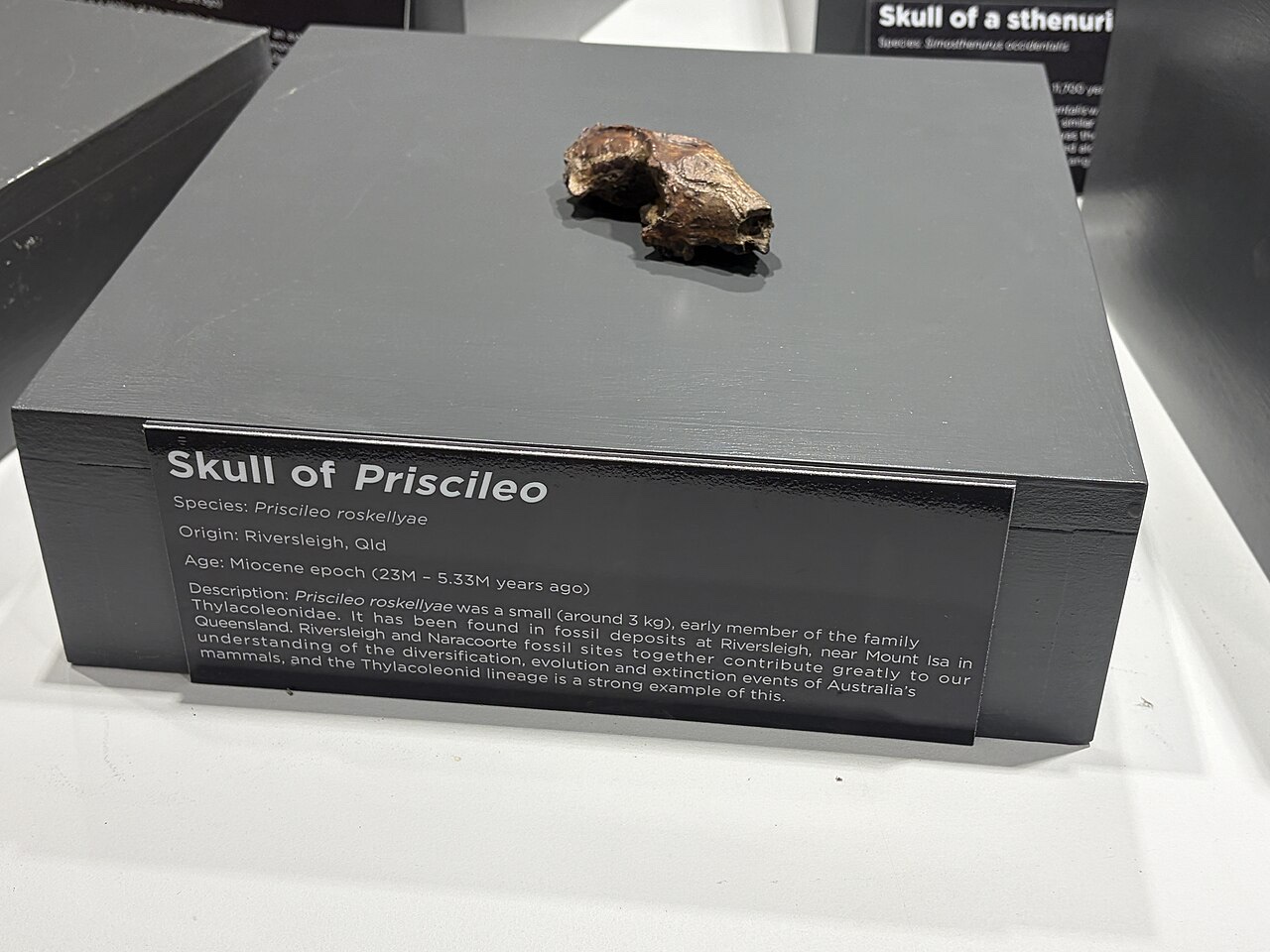 Oceania
Australia ↗
Riversleigh
Riversleigh’s fossil deposits connect wetter Oligocene–Miocene habitats with later faunas, revealing Australian mammals, birds, reptiles and bats.
23 Ma → 2.1 Ma South America
Brazil ↗
The Araripe Basin
The Crato and Romualdo formations preserve contrasting Early Cretaceous depositional settings during the reorganization of northeastern Brazil.
118 Ma → 113 Ma