
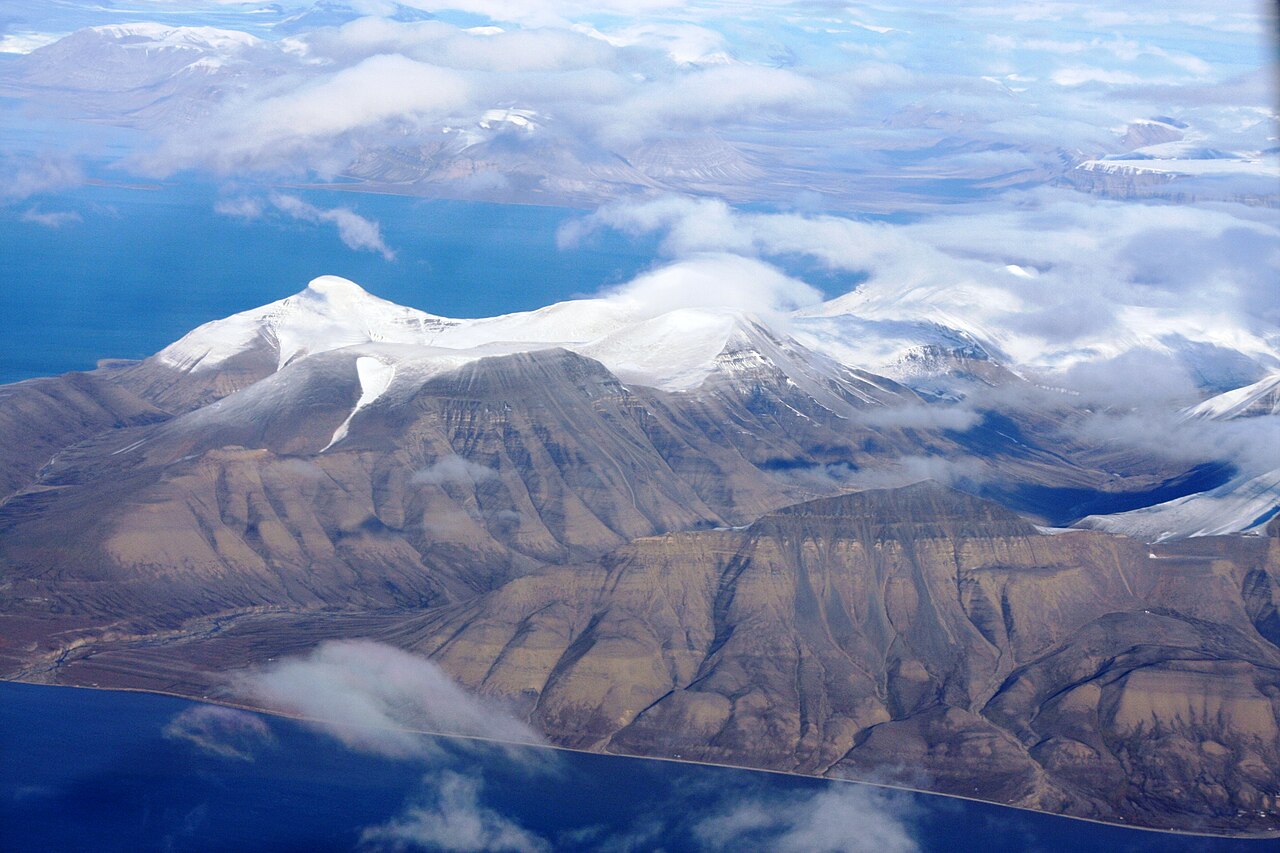
How can fossils in today’s Arctic constrain the evolution of marine reptiles?
Svalbard’s present glaciers and polar light can obscure the environmental variety preserved in its rocks. The archipelago contains sedimentary records from many ages, including seas inhabited by marine reptiles. Modern latitude alone cannot reconstruct those ancient settings. Geological time, plate movement, climate and the local sedimentary record must be considered separately before combining them into a scene.
The older window lies shortly after the end-Permian mass extinction. Vertebrae from Early Triassic concretions in Spitsbergen were identified as belonging to an ichthyopterygian already adapted to marine life. This discovery constrains how early such adaptations were established. It does not provide the complete body of the animal or identify the precise moment when its lineage originated. The oldest specimen yet found sets a minimum known presence, not an evolutionary starting gun.
Roughly a hundred million years later, the Slottsmøya Member recorded another marine ecosystem. Ichthyosaurs and plesiosaurs, including the large pliosaur Pliosaurus funkei, entered a fossil record with varied degrees of articulation. The distribution of bones matters alongside their anatomy. A connected skeleton and a scattered group of elements can represent different carcass histories, even when both came from the same broader sea.
The two snapshots deliberately leave most of Svalbard’s history unsampled. They are not a continuous account of one persistent marine community. Modern erosion exposes the rocks for investigation, while preparation and comparison make partial remains interpretable. The region therefore offers two lessons at different scales: fossils constrain major evolutionary events, and their detailed geological context determines how strongly those constraints can be stated.
[1] [2] [3] [4] [5] [6]Time windows and evidence
Older ages are on the left. Bars span the dated intervals. A dot marks a single age.
- Marine reptiles early in the Triassic 249.5–250.5 Ma
- The Slottsmøya marine shelf 143.1–152 Ma
- Early Triassic ichthyopterygian vertebrae 249.5–250.5 Ma
- Pliosaurus funkei from Slottsmøya 143.1–152 Ma
- Slottsmøya’s marine reptile burial record 143.1–152 Ma
Researched windowsEvidence records
250 Ma · interval 249.5–250.5 Ma
Marine reptiles early in the Triassic
Marine sediment and concretions preserved vertebrate remains in what is now Spitsbergen. The ichthyopterygian tail material indicates established aquatic adaptation by approximately 250 Ma. This interval follows the fossil’s Early Triassic context and is not a date for every vertebrate in the region. The water scene does not reproduce modern Arctic conditions or imply an exact palaeocoastline.
[2] [3]Locate this time in the atlas ↗Observed
Associated vertebrae occur in dated marine strata.
Reconstructed
Aquatic reptiles were present early in post-extinction marine ecosystems.
Uncertain
The animal’s full anatomy and its lineage’s origin predate or exceed the evidence preserved.
Evidence windows overlapping this state: 1. Overlap does not establish exact coexistence.
147 Ma · interval 143.1–152 Ma
The Slottsmøya marine shelf
Upper Jurassic deposits preserve a varied marine reptile assemblage including pliosaurs, other plesiosaurs and ichthyosaurs. Fine sediment and changing carcass histories produced both connected and scattered skeletons. This broad teaching bracket selects the Late Jurassic part of the record. The Slottsmøya Member also extends into the Early Cretaceous; neither the bracket nor the representative age dates its entire assemblage. The diagram is an environmental interpretation rather than a census.
[1] [4] [5] [6]Locate this time in the atlas ↗Observed
Marine reptile fossils occur within the Slottsmøya Member.
Reconstructed
A later shelf ecosystem repeatedly supplied carcasses to the sediment.
Uncertain
Water depth, abundance and precise timing differ among beds and localities.
Evidence windows overlapping this state: 2. Overlap does not establish exact coexistence.
body fossil · Svalbard ↗
Pliosaurus funkei from Slottsmøya
Large pliosaur remains from the Slottsmøya Member provided the basis for describing Pliosaurus funkei. Anatomical comparisons distinguish it from other marine reptiles. Reconstructions of total length depend on incomplete material and comparative proportions, so an exact giant silhouette would imply more certainty than the fossils provide. The specimen nevertheless documents a large predator within a much younger marine community.
locality · Svalbard ↗
Slottsmøya’s marine reptile burial record
The Slottsmøya assemblage includes articulated and disarticulated marine reptile remains. Mapping the position of bones and examining surrounding sediment help reconstruct carcass histories. The presence of many specimens does not mean that all died in one event. Their varied preservation records differences in exposure, disturbance and burial within the depositional system. This context is necessary before interpreting apparent animal abundance. The displayed interval selects its Late Jurassic context; the member itself continues across the Jurassic–Cretaceous boundary.
What this story cannot resolve
The marker represents central Spitsbergen within a large archipelago. Modern Arctic climate is not projected backward. Partial remains and broad regional ages limit reconstruction precision.
Keep these ideas handy
Continental drift
The changing relative positions of continents through time, explained by plate tectonics. Explore the idea ↗
Taphonomy
Studying what happens between an organism’s life, death, burial, preservation and eventual discovery. Explore the idea ↗
Evolutionary tree
A branching hypothesis of relationships among organisms, inferred from shared evidence rather than arranged as a ladder of progress. Explore the idea ↗
The evidence notebook
body fossil · Svalbard ↗
Early Triassic ichthyopterygian vertebrae
An articulated series of tail vertebrae from Early Triassic Spitsbergen deposits documents an already marine-adapted ichthyopterygian. It places an important constraint on the timing of marine reptile evolution after the end-Permian crisis. A partial skeleton does not reveal the entire animal’s appearance, and the earliest known fossil is not automatically the first member of its lineage.
body fossil · Svalbard ↗
Pliosaurus funkei from Slottsmøya
Large pliosaur remains from the Slottsmøya Member provided the basis for describing Pliosaurus funkei. Anatomical comparisons distinguish it from other marine reptiles. Reconstructions of total length depend on incomplete material and comparative proportions, so an exact giant silhouette would imply more certainty than the fossils provide. The specimen nevertheless documents a large predator within a much younger marine community.
locality · Svalbard ↗
Slottsmøya’s marine reptile burial record
The Slottsmøya assemblage includes articulated and disarticulated marine reptile remains. Mapping the position of bones and examining surrounding sediment help reconstruct carcass histories. The presence of many specimens does not mean that all died in one event. Their varied preservation records differences in exposure, disturbance and burial within the depositional system. This context is necessary before interpreting apparent animal abundance. The displayed interval selects its Late Jurassic context; the member itself continues across the Jurassic–Cretaceous boundary.
Follow the evidence
Sources & credits
- The geology of Svalbard ↗
Natural History Museum, University of Oslo · 2024-06-17
Use, credit & modifications
Reference only; no source text, figures or photographs reproduced. Original educational synthesis.
Credit: Natural History Museum, University of Oslo. Original synthesis with explicit approximate teaching windows. No source asset reuse; territorial permissions not applicable.
- Earliest Triassic ichthyosaur fossils push back oceanic reptile origins ↗
Current Biology · 2023
Use, credit & modifications
Reference only; no source text, figures or photographs reproduced. Original educational synthesis.
Credit: Current Biology. Original synthesis with explicit approximate teaching windows. No source asset reuse; territorial permissions not applicable.
- Oldest sea reptile from Age of Dinosaurs found on Arctic island ↗
Uppsala University · 2023-03-13
Use, credit & modifications
Reference only; no source text, figures or photographs reproduced. Original educational synthesis.
Credit: Uppsala University. Original synthesis with explicit approximate teaching windows. No source asset reuse; territorial permissions not applicable.
- A new species of Pliosaurus from the Middle Volgian of central Spitsbergen ↗
Norwegian Journal of Geology · 2012
Use, credit & modifications
Reference only; no source text, figures or photographs reproduced. Original educational synthesis.
Credit: Norwegian Journal of Geology. Original synthesis with explicit approximate teaching windows. No source asset reuse; territorial permissions not applicable.
- The Slottsmøya marine reptile Lagerstätte: depositional environments, taphonomy and diagenesis ↗
Geological Society, London · 2016
Use, credit & modifications
Reference only; no source text, figures or photographs reproduced. Original educational synthesis.
Credit: Geological Society, London. Original synthesis with explicit approximate teaching windows. No source asset reuse; territorial permissions not applicable.
- Osteology and phylogeny of Late Jurassic ichthyosaurs from the Slottsmøya Member Lagerstätte (Spitsbergen, Norway) ↗
Delsett et al. · Acta Palaeontologica Polonica · 2019
Use, credit & modifications
Reference only; no source text, figures or photographs reproduced. Original educational synthesis.
Credit: Delsett et al. · Acta Palaeontologica Polonica. Geological setting paraphrased to distinguish the selected Jurassic teaching window from the member’s Jurassic–Cretaceous span. No source asset reuse; territorial asset permissions not applicable.
Follow the connections
 Antarctica
 ↗
The Antarctic Peninsula
Cretaceous plant fossils and Eocene marine deposits reveal high-latitude environments very different from the familiar ice-covered image of Antarctica.
103 Ma → 40 Ma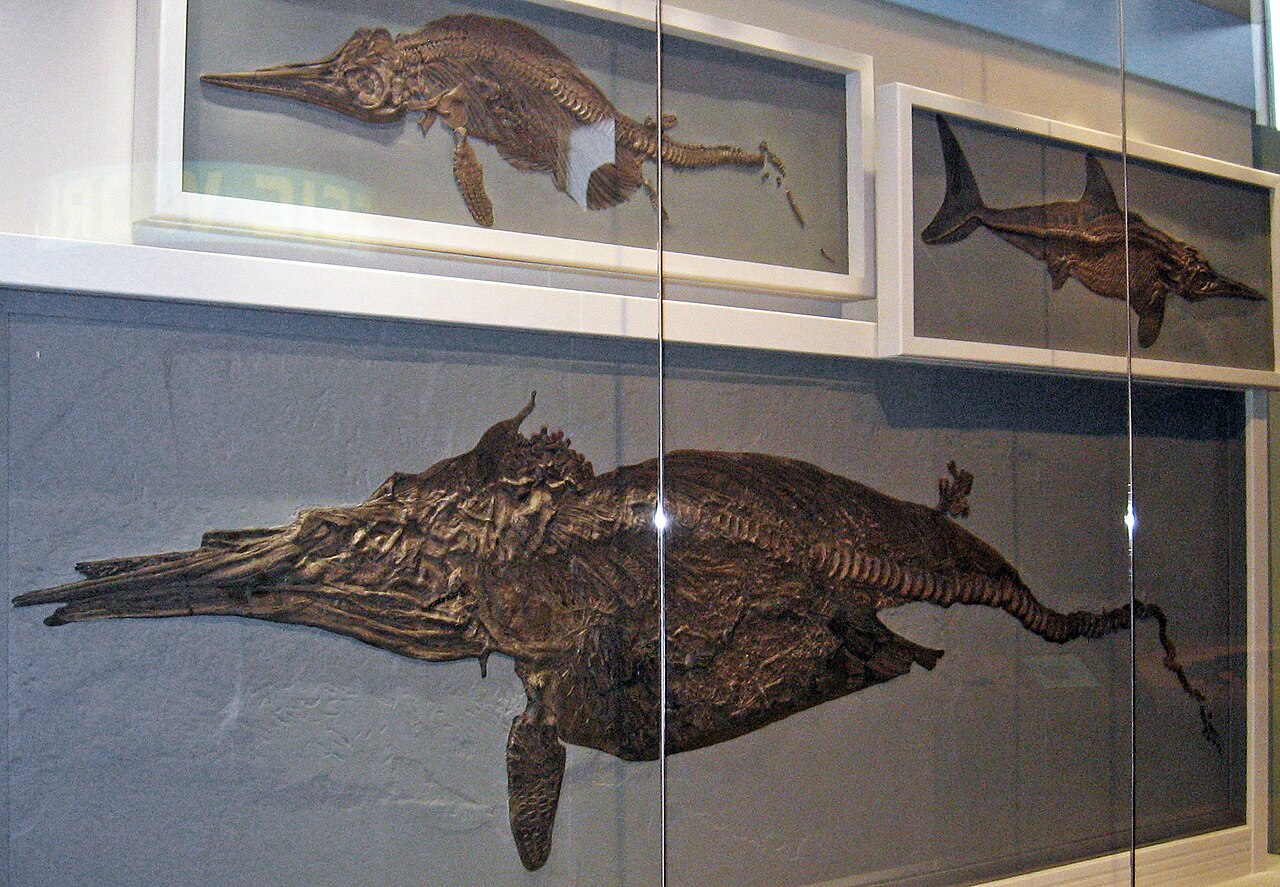 Europe
Germany ↗
Holzmaden
Older Amaltheenton mudstones and younger Posidonia Shale record successive Early Jurassic seas. Their contrast reveals how depositional conditions influence what survives of an ecosystem.
187 Ma → 182 Ma