
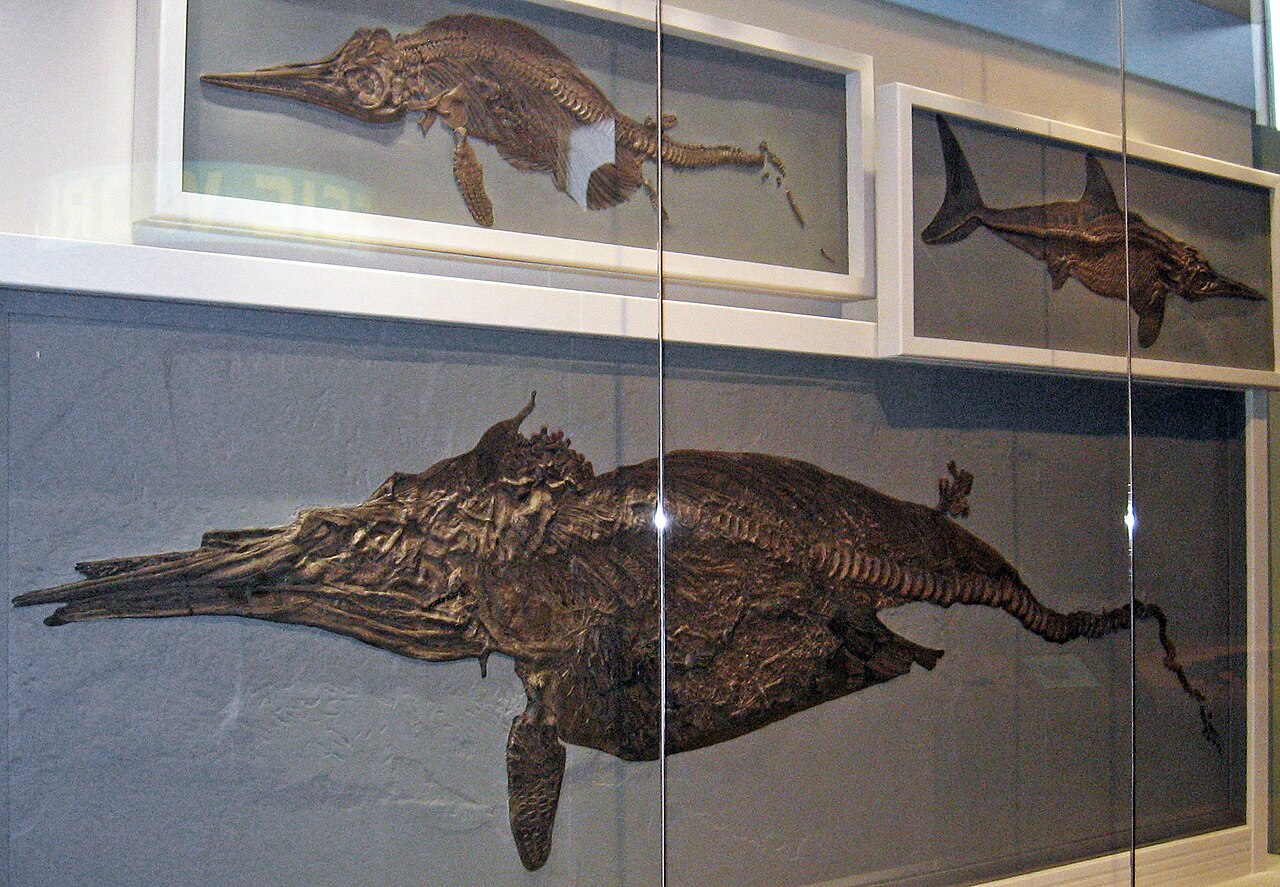
Why are complete marine reptiles concentrated in some beds rather than all marine rocks?
Holzmaden’s famous marine reptiles come from a particular part of a longer Jurassic sequence. The rocks beneath them also record a sea, but they do not preserve the same concentration of complete skeletons. This comparison prevents a common mistake: treating exceptional preservation as evidence that unusually many animals must have lived at one place. The route from death to burial can change the fossil record as strongly as the living community itself.
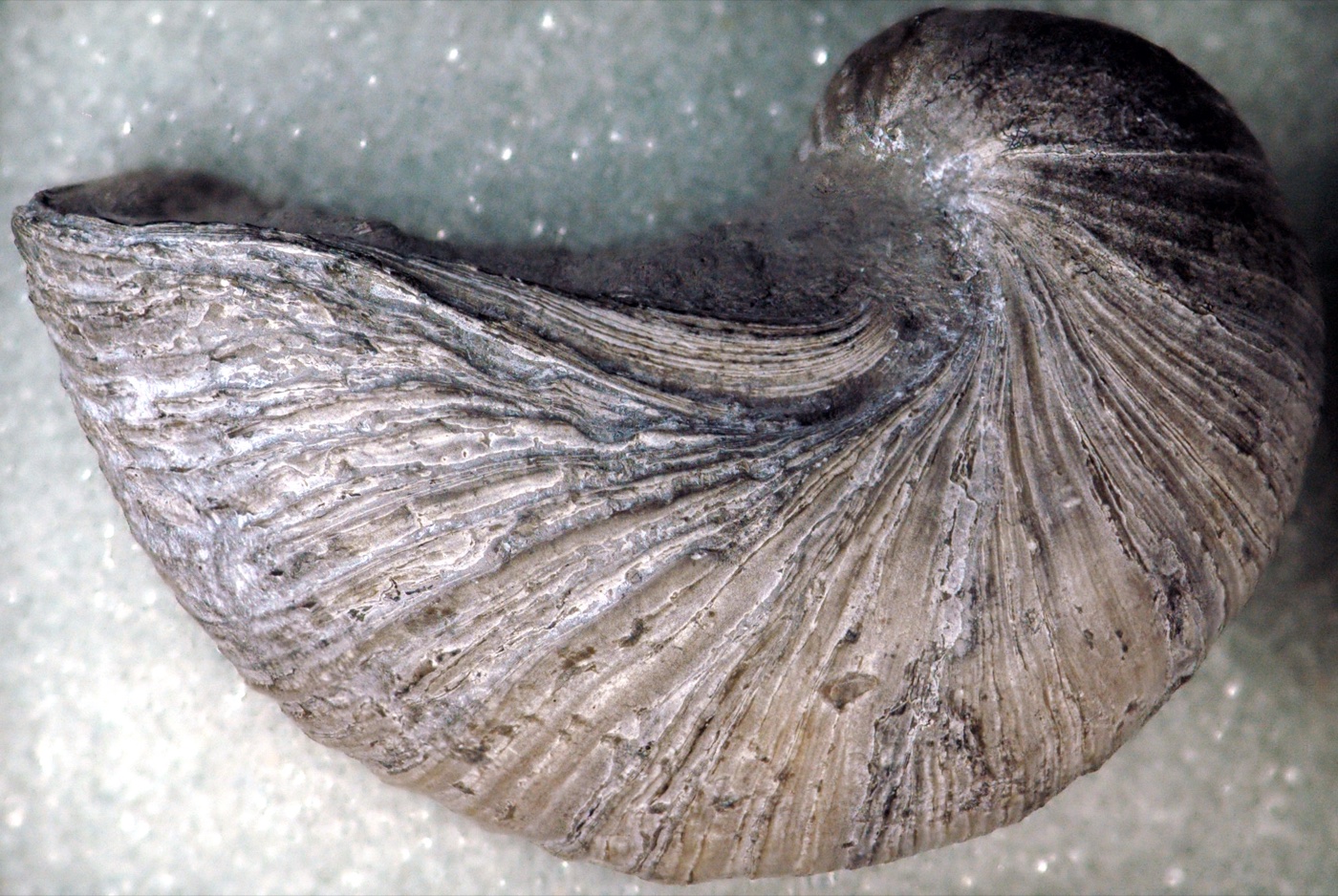
The older Amaltheenton Formation accumulated chiefly muddy marine sediment and includes characteristic Amaltheus ammonites. Fossils help place these rocks in the regional stratigraphic sequence. Their shells also provide biological evidence for the marine setting. The reconstruction is not a complete species list, and its broad late Pliensbachian interval summarizes many beds rather than one episode of deposition.
The younger Posidonia Shale preserves the better-known record of articulated ichthyosaurs, fishes and other organisms. Fine sediment and conditions that limited decay and disruption contributed to that detail. Oxygen availability could differ between the water in which animals moved and the bottom where their remains settled. It also changed through time. A permanently lifeless black sea would therefore be as misleading as a uniformly oxygen-rich seabed.
Modern quarrying and preparation expose this record on slabs that can be examined in museums. The presentation of a complete skeleton is the final stage of a much longer history that includes death, burial, mineral change, excavation and conservation. Comparing the two intervals keeps that history visible. Marine life was present in both; different sedimentary and preservation conditions determined which aspects of it became easiest for us to observe.
[1] [2] [3] [4]Time windows and evidence
Older ages are on the left. Bars span the dated intervals. A dot marks a single age.
- The Amaltheenton marine basin 184.2–190 Ma
- Exceptional burial in the Posidonia sea 180–184.2 Ma
- Amaltheus and the older marine mudstones 184.2–190 Ma
- Ichthyosaurs in the Posidonia Shale 180–184.2 Ma
- Organic-rich Posidonia Shale 180–184.2 Ma
Researched windowsEvidence records
187 Ma · interval 184.2–190 Ma
The Amaltheenton marine basin
Clay-rich sediment accumulated in an Early Jurassic marine basin before the main Posidonia Shale interval. Characteristic ammonites contribute to regional correlation and environmental interpretation. The broad window represents the older formation in the Holzmaden succession; its age is not inferred from dark colour alone. The conceptual sea does not imply a precisely known shoreline or uniform oxygen conditions.
[2] [4]Locate this time in the atlas ↗Observed
Marine mudstones with characteristic ammonites occur beneath the younger succession.
Reconstructed
A marine depositional basin supported an established animal community.
Uncertain
Individual beds and fossils have finer ages than this regional bracket.
Evidence windows overlapping this state: 1. Overlap does not establish exact coexistence.
182 Ma · interval 180–184.2 Ma
Exceptional burial in the Posidonia sea
Fine, organic-rich sediment accumulated during the early Toarcian interval represented here. Conditions at and near the seabed favoured preservation of some articulated animals. The scene distinguishes inhabited water from a bottom where oxygen could be restricted, while allowing variation through time. It is a teaching reconstruction of a preservation system, not an exact view of a particular specimen’s death.
[1] [3]Locate this time in the atlas ↗Observed
Dark layered rocks preserve articulated marine reptiles and other fossils.
Reconstructed
Variable bottom conditions affected decay, scavenging and burial.
Uncertain
Oxygenation and preservation were neither spatially nor temporally uniform.
Evidence windows overlapping this state: 2. Overlap does not establish exact coexistence.
body fossil · Holzmaden ↗
Ichthyosaurs in the Posidonia Shale
Articulated ichthyosaur fossils made the Holzmaden area internationally important. Their skeletons show marine reptile anatomy, while preserved outlines in suitable specimens can supply additional information. A museum mount or prepared slab should not be confused with a carcass untouched by collection. The degree of articulation reflects burial and disturbance as well as the animal’s own anatomy.
sediment · Holzmaden ↗
Organic-rich Posidonia Shale
Dark, finely layered sediment records an environment where organic material was retained unusually well. Restricted oxygen at the seafloor helps explain some preservation patterns, but conditions varied through the succession. The presence of active swimmers does not require an oxygenated bottom at every moment: the water column and seabed can differ. Sedimentary evidence therefore complements, rather than merely decorates, the vertebrate fossils.
What this story cannot resolve
The older evidence includes the regional formation exposed around Holzmaden. Numerical windows are approximate; the onset of a stage does not date every bed in a formation.
Keep these ideas handy
Taphonomy
Studying what happens between an organism’s life, death, burial, preservation and eventual discovery. Explore the idea ↗
Exceptional preservation
Preservation that retains normally lost features such as soft tissues. Geologists call a deposit rich in such fossils a Konservat-Lagerstätte. Explore the idea ↗
Facies
The observable characteristics of a rock body that help describe and interpret its depositional setting. Explore the idea ↗
The evidence notebook
body fossil · Holzmaden ↗
Amaltheus and the older marine mudstones
Ammonites of the genus Amaltheus characterize the regional Amaltheenton succession beneath the younger Posidonia Shale. Their shells provide a biological connection to the marine setting and help correlate beds. The genus is a stratigraphic clue, not a guarantee that every clay-rich outcrop has the same age. Local rock context remains necessary when placing a collected specimen.
body fossil · Holzmaden ↗
Ichthyosaurs in the Posidonia Shale
Articulated ichthyosaur fossils made the Holzmaden area internationally important. Their skeletons show marine reptile anatomy, while preserved outlines in suitable specimens can supply additional information. A museum mount or prepared slab should not be confused with a carcass untouched by collection. The degree of articulation reflects burial and disturbance as well as the animal’s own anatomy.
sediment · Holzmaden ↗
Organic-rich Posidonia Shale
Dark, finely layered sediment records an environment where organic material was retained unusually well. Restricted oxygen at the seafloor helps explain some preservation patterns, but conditions varied through the succession. The presence of active swimmers does not require an oxygenated bottom at every moment: the water column and seabed can differ. Sedimentary evidence therefore complements, rather than merely decorates, the vertebrate fossils.
Follow the evidence
Sources & credits
- Urwelt-Museum Hauff in Holzmaden ↗
LGRB, Geological Survey of Baden-Württemberg · Not stated
Use, credit & modifications
Reference only; no source text, figures or photographs reproduced. Original educational synthesis.
Credit: LGRB, Geological Survey of Baden-Württemberg. Original synthesis with explicit approximate teaching windows. No source asset reuse; territorial permissions not applicable.
- Mittlerer Unterjura ↗
LGRB, Geological Survey of Baden-Württemberg · Not stated
Use, credit & modifications
Reference only; no source text, figures or photographs reproduced. Original educational synthesis.
Credit: LGRB, Geological Survey of Baden-Württemberg. Original synthesis with explicit approximate teaching windows. No source asset reuse; territorial permissions not applicable.
- Posidonienschiefer ↗
LGRB, Geological Survey of Baden-Württemberg · Not stated
Use, credit & modifications
Reference only; no source text, figures or photographs reproduced. Original educational synthesis.
Credit: LGRB, Geological Survey of Baden-Württemberg. Original synthesis with explicit approximate teaching windows. No source asset reuse; territorial permissions not applicable.
- Holzmaden: regional geological setting ↗
LEO-BW / Landesarchiv Baden-Württemberg · Not stated
Use, credit & modifications
Reference only; no source text, figures or photographs reproduced. Original educational synthesis.
Credit: LEO-BW / Landesarchiv Baden-Württemberg. Original synthesis with explicit approximate teaching windows. No source asset reuse; territorial permissions not applicable.
Follow the connections
 Europe
United Kingdom ↗
Lyme Regis & Pinhay Bay
The coastal succession near Lyme Regis connects latest Triassic marginal seas with Early Jurassic marine life. Rock layers, ammonites and fish help separate environmental change from the definition of a time boundary.
202 Ma → 199 Ma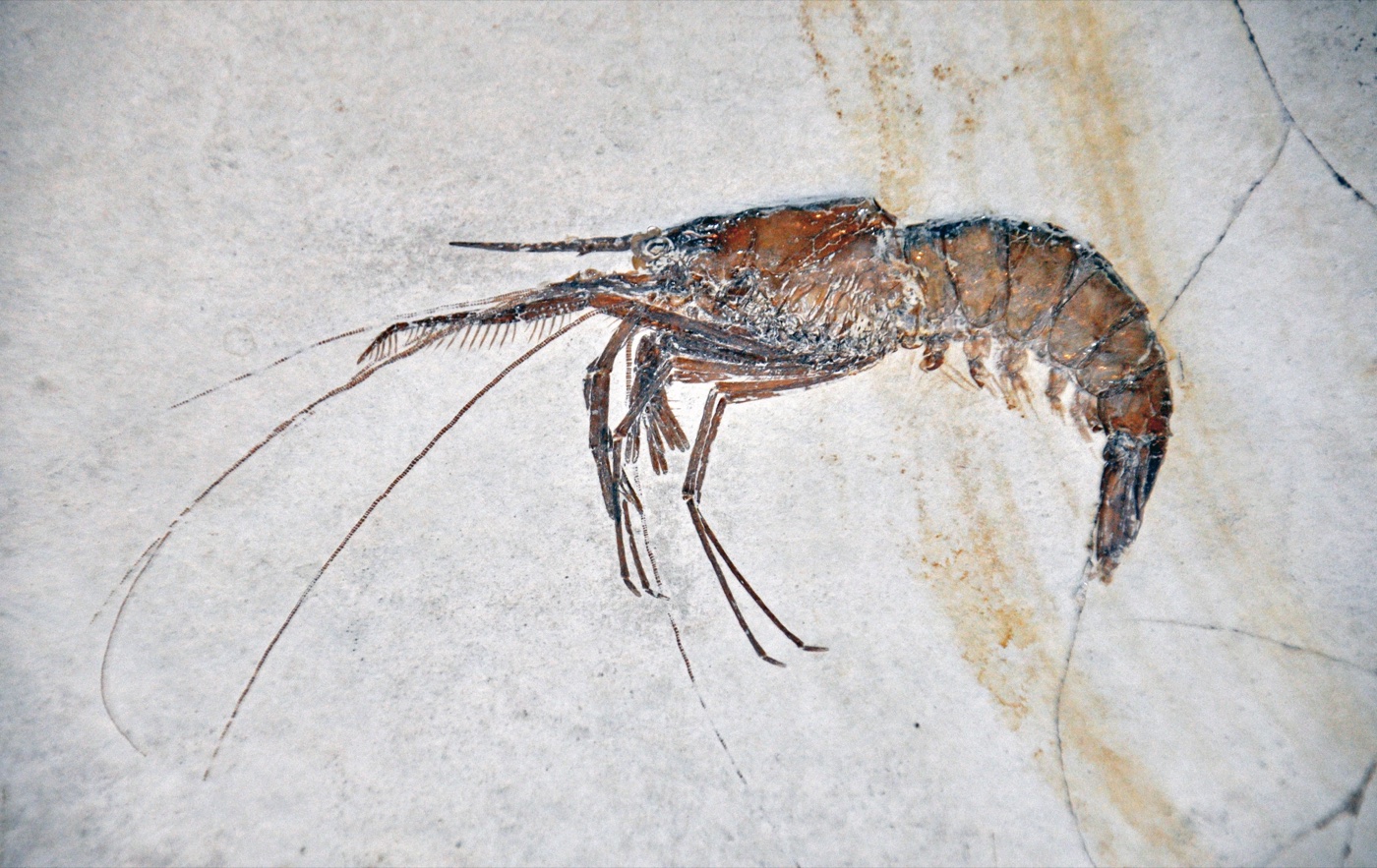 Europe
Germany ↗
Solnhofen–Eichstätt
Fine Jurassic limestone preserves feathered dinosaurs, marine animals and traces of movement. Their shared burial place need not mean a shared habitat or a single cause of death.
150 Ma → Today