
How do ancient soils and teeth reveal different aspects of vegetation change?
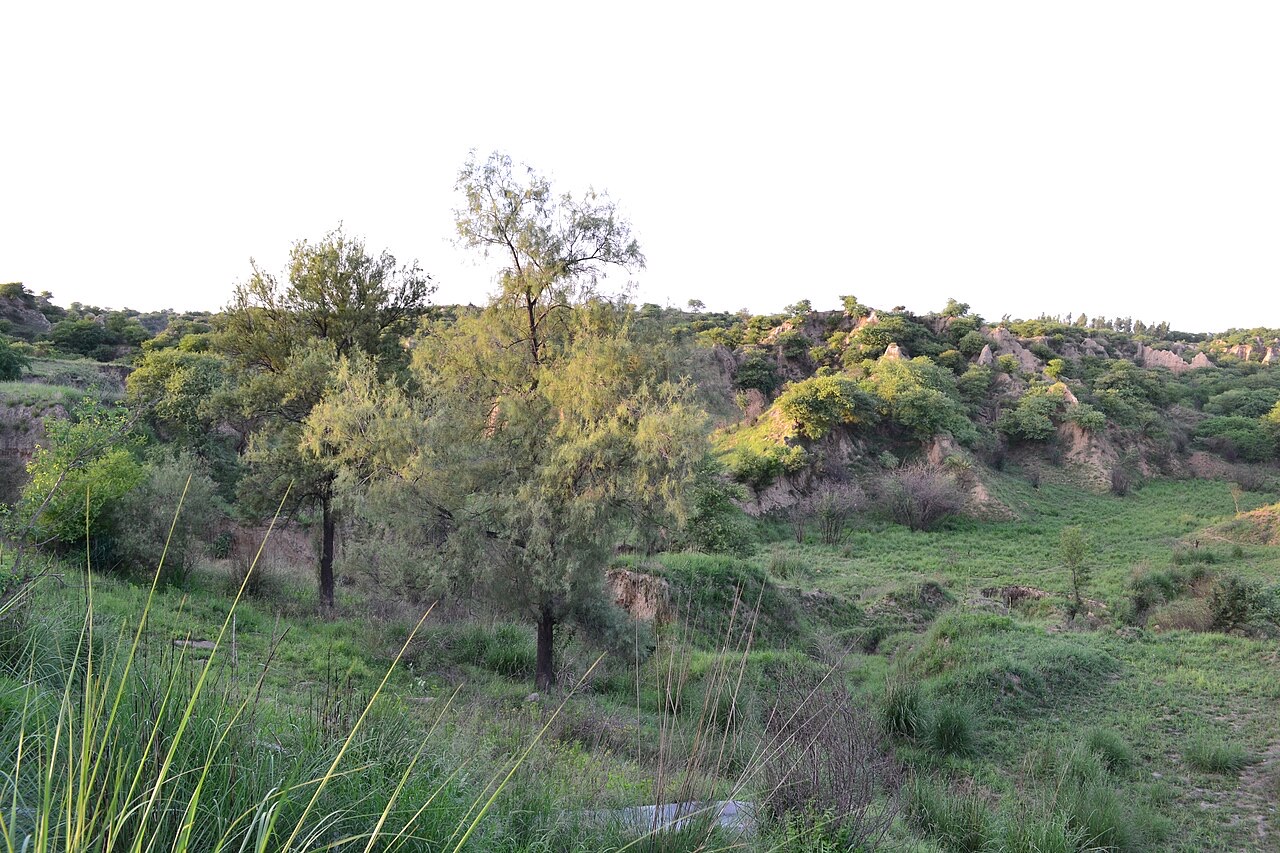
The Siwalik rocks of Pakistan’s Potwar Plateau accumulated as rivers carried sediment into the Himalayan foreland. Channels migrated, floodwaters spread mud, and soils developed on surfaces between episodes of burial. This repeated construction produced a long terrestrial record. It also created a strong sampling filter: many fossil localities occur in smaller channel fills within floodplain deposits rather than in every part of the ancient landscape equally.
The older snapshot selects the Middle Miocene Chinji interval, when C3 plants supplied much of the regional biomass. C3 includes trees, shrubs and some grasses, so the isotope signal alone does not prove an unbroken forest. Sivapithecus fossils and other mammals add ecological and evolutionary information. Their presence belongs within a varied floodplain setting, and their relationship to living apes must be assessed from anatomy rather than inferred from a forest label.
By the latest Miocene, soil carbonates record a pronounced expansion of C4 vegetation. Tooth enamel provides an independent view of what herbivores ate and shows that some animals used C4 resources before those plants dominated the wider floodplain signal. The two archives need not change at exactly the same time because they sample different processes and spatial scales. Climate seasonality, atmospheric conditions and vegetation ecology all enter explanations of the transition; a single isotope curve does not demonstrate one exclusive cause. Potwar is valuable precisely because fossil mammals, soils, river deposits and magnetic chronology can be compared across a long sequence rather than compressed into one universal switch from forest to grassland.
[1] [2] [3] [4] [5]Time windows and evidence
Older ages are on the left. Bars span the dated intervals. A dot marks a single age.
- Chinji floodplains with C3 vegetation 11.4–12.7 Ma
- C4 plants expand across the floodplain 6–7.4 Ma
- Chinji Formation Sivapithecus localities 11.4–12.7 Ma
- Potwar palaeosol-carbonate isotope sequence 6–7.4 Ma
- Potwar herbivore tooth-enamel isotope record 6–9.4 Ma
Researched windowsEvidence records
12 Ma · interval 11.4–12.7 Ma
Chinji floodplains with C3 vegetation
The selected Chinji interval includes documented Sivapithecus-bearing localities on the Potwar Plateau. Ancient soils and regional isotope evidence indicate a predominantly C3 vegetation background. Forest is shorthand for the wooded component of a heterogeneous floodplain, not an inference that all C3 plants were trees. Channels, better drained surfaces and wetter depressions offered different habitats. The age bounds follow the fossil-bearing interval discussed in the literature rather than the full duration of the Chinji Formation.
[4] [1] [3]Locate this time in the atlas ↗Observed
Fossil mammals and palaeosols occur within river and floodplain sediments.
Reconstructed
Wooded and other C3-dominated habitats formed part of the floodplain mosaic.
Uncertain
Canopy density and local habitat proportions cannot be read directly from carbon isotopes.
Evidence windows overlapping this state: 1. Overlap does not establish exact coexistence.
6.8 Ma · interval 6–7.4 Ma
C4 plants expand across the floodplain
Late Miocene palaeosol carbonates record a marked shift toward C4-dominated biomass, while herbivore enamel tracks dietary use of those resources. The grasses expanded across a floodplain crossed by rivers. Patches of trees and shrubs could have persisted even where the regional isotope signal shifted toward C4 plants. The 7.4–6 Ma window captures the main ecological transition without implying that every locality changed simultaneously or that all woody plants disappeared.
[1] [2] [5]Locate this time in the atlas ↗Observed
Soil-carbonate and enamel carbon-isotope values shift toward greater C4 contributions.
Reconstructed
Warm-season grasses became more important across a changing floodplain mosaic.
Uncertain
Different archives sample different areas and times; the drivers were not necessarily singular.
Evidence windows overlapping this state: 2. Overlap does not establish exact coexistence.
geochemistry · Potwar Siwaliks ↗
Potwar palaeosol-carbonate isotope sequence
Carbonate formed in ancient Siwalik soils preserves carbon-isotope information related to the vegetation supplying soil carbon dioxide. The late Miocene sequence shows a pronounced change toward C4-dominated biomass. Because the carbonate formed within soils, it provides a different environmental sample from transported animal bones. Interpretation nevertheless depends on soil processes, preservation and the relationship between the measured carbonate and atmospheric or plant-derived carbon, so it is not a direct inventory of plant species.
geochemistry · Potwar Siwaliks ↗
Potwar herbivore tooth-enamel isotope record
Isotopic measurements of fossil herbivore enamel from the Potwar sequence record the carbon sources consumed during tooth formation. C4 plants appear in some diets before the major floodplain shift recorded by soils. This offset is informative rather than automatically contradictory: selective feeders can use a resource before it becomes regionally dominant. Enamel therefore supplies a dietary perspective on vegetation change, while the identities, feeding behaviour and preservation of sampled animals influence how broadly that perspective can be generalized.
What this story cannot resolve
The marker represents the Potwar record in Pakistan, not the entire transnational Siwalik belt. C3 and C4 denote photosynthetic pathways rather than exact vegetation types.
Keep these ideas handy
Climate proxy
A measured feature of a natural archive used to infer some aspect of past climate. Explore the idea ↗
Taphonomy
Studying what happens between an organism’s life, death, burial, preservation and eventual discovery. Explore the idea ↗
Sedimentary basin
An area in which sediment can accumulate and be preserved over time. Explore the idea ↗
Evolutionary tree
A branching hypothesis of relationships among organisms, inferred from shared evidence rather than arranged as a ladder of progress. Explore the idea ↗
The evidence notebook
body fossil · Potwar Siwaliks ↗
Chinji Formation Sivapithecus localities
Sivapithecus-bearing localities in the Chinji Formation document Miocene apes on the Potwar Plateau. Their placement in a magnetically calibrated terrestrial succession gives the fossils a regional temporal framework. Teeth and jaws preserve anatomical characters useful for evolutionary comparisons, while surrounding sediments provide environmental context. The named formation contains multiple localities and generations, so the selected interval should not be treated as one community that lived together or as a continuous record of one population.
geochemistry · Potwar Siwaliks ↗
Potwar palaeosol-carbonate isotope sequence
Carbonate formed in ancient Siwalik soils preserves carbon-isotope information related to the vegetation supplying soil carbon dioxide. The late Miocene sequence shows a pronounced change toward C4-dominated biomass. Because the carbonate formed within soils, it provides a different environmental sample from transported animal bones. Interpretation nevertheless depends on soil processes, preservation and the relationship between the measured carbonate and atmospheric or plant-derived carbon, so it is not a direct inventory of plant species.
geochemistry · Potwar Siwaliks ↗
Potwar herbivore tooth-enamel isotope record
Isotopic measurements of fossil herbivore enamel from the Potwar sequence record the carbon sources consumed during tooth formation. C4 plants appear in some diets before the major floodplain shift recorded by soils. This offset is informative rather than automatically contradictory: selective feeders can use a resource before it becomes regionally dominant. Enamel therefore supplies a dietary perspective on vegetation change, while the identities, feeding behaviour and preservation of sampled animals influence how broadly that perspective can be generalized.
Follow the evidence
Sources & credits
- Development of Asian monsoon revealed by marked ecological shift during the latest Miocene in northern Pakistan ↗
Quade et al.; Nature · 1989
Use, credit & modifications
Reference only; original factual synthesis. No third-party prose or media reproduced.
Credit: Quade et al.; Nature — Development of Asian monsoon revealed by marked ecological shift during the latest Miocene in northern Pakistan. Original educational synthesis; rounded age envelopes distinguish teaching windows from analytical errors. No media licence asserted for this reference. Photograph rights are documented separately.
- Carbon isotopic evidence for the emergence of C4 plants in the Neogene from Pakistan and Kenya ↗
Morgan et al.; Nature · 1994
Use, credit & modifications
Reference only; original factual synthesis. No third-party prose or media reproduced.
Credit: Morgan et al.; Nature — Carbon isotopic evidence for the emergence of C4 plants in the Neogene from Pakistan and Kenya. Original educational synthesis; rounded age envelopes distinguish teaching windows from analytical errors. No media licence asserted for this reference. Photograph rights are documented separately.
- Floodplains and paleosols in the Siwalik Miocene sequence: implications for taphonomy and paleoecology of faunas ↗
Paleontological Society Special Publications · Not stated
Use, credit & modifications
Reference only; original factual synthesis. No third-party prose or media reproduced.
Credit: Paleontological Society Special Publications — Floodplains and paleosols in the Siwalik Miocene sequence: implications for taphonomy and paleoecology of faunas. Original educational synthesis; rounded age envelopes distinguish teaching windows from analytical errors. No media licence asserted for this reference. Photograph rights are documented separately.
- First record of the Miocene hominoid Sivapithecus from Kutch, Gujarat state, western India ↗
Bhandari et al.; PLOS ONE · 2018
Use, credit & modifications
Reference only; original factual synthesis. No third-party prose or media reproduced.
Credit: Bhandari et al.; PLOS ONE — First record of the Miocene hominoid Sivapithecus from Kutch, Gujarat state, western India. Original educational synthesis; rounded age envelopes distinguish teaching windows from analytical errors. No media licence asserted for this reference. Photograph rights are documented separately.
- Causal evidence between monsoon and evolution of rhizomyine rodents ↗
Kimura et al.; Scientific Reports · 2015
Use, credit & modifications
Reference only; original factual synthesis. No third-party prose or media reproduced.
Credit: Kimura et al.; Scientific Reports — Causal evidence between monsoon and evolution of rhizomyine rodents. Original educational synthesis; rounded age envelopes distinguish teaching windows from analytical errors. No media licence asserted for this reference. Photograph rights are documented separately.
Follow the connections
 Asia
Nepal / China / India ↗
The Tethyan Himalaya
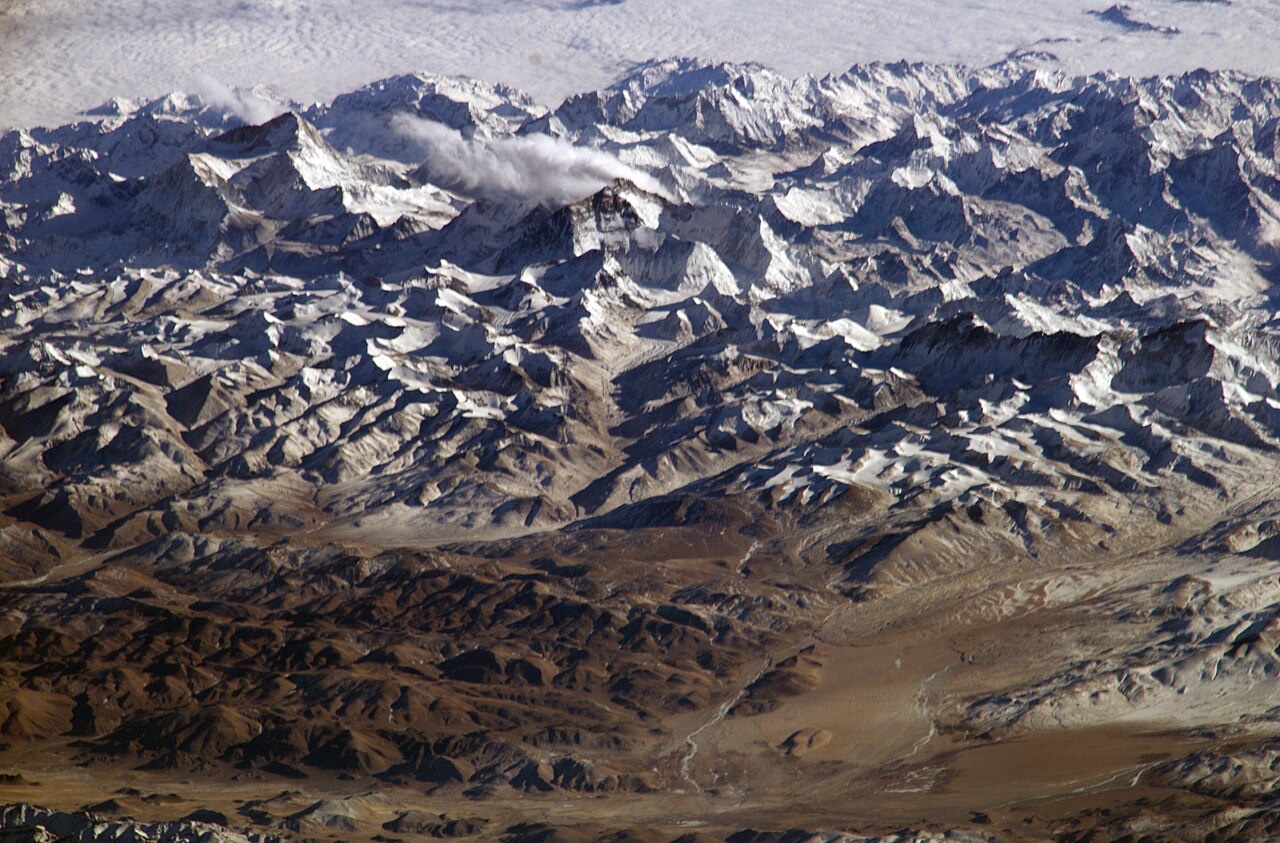
Marine fossils north of Everest belong to a sedimentary history later transformed by India–Asia convergence, deformation and uplift.
52 Ma → Today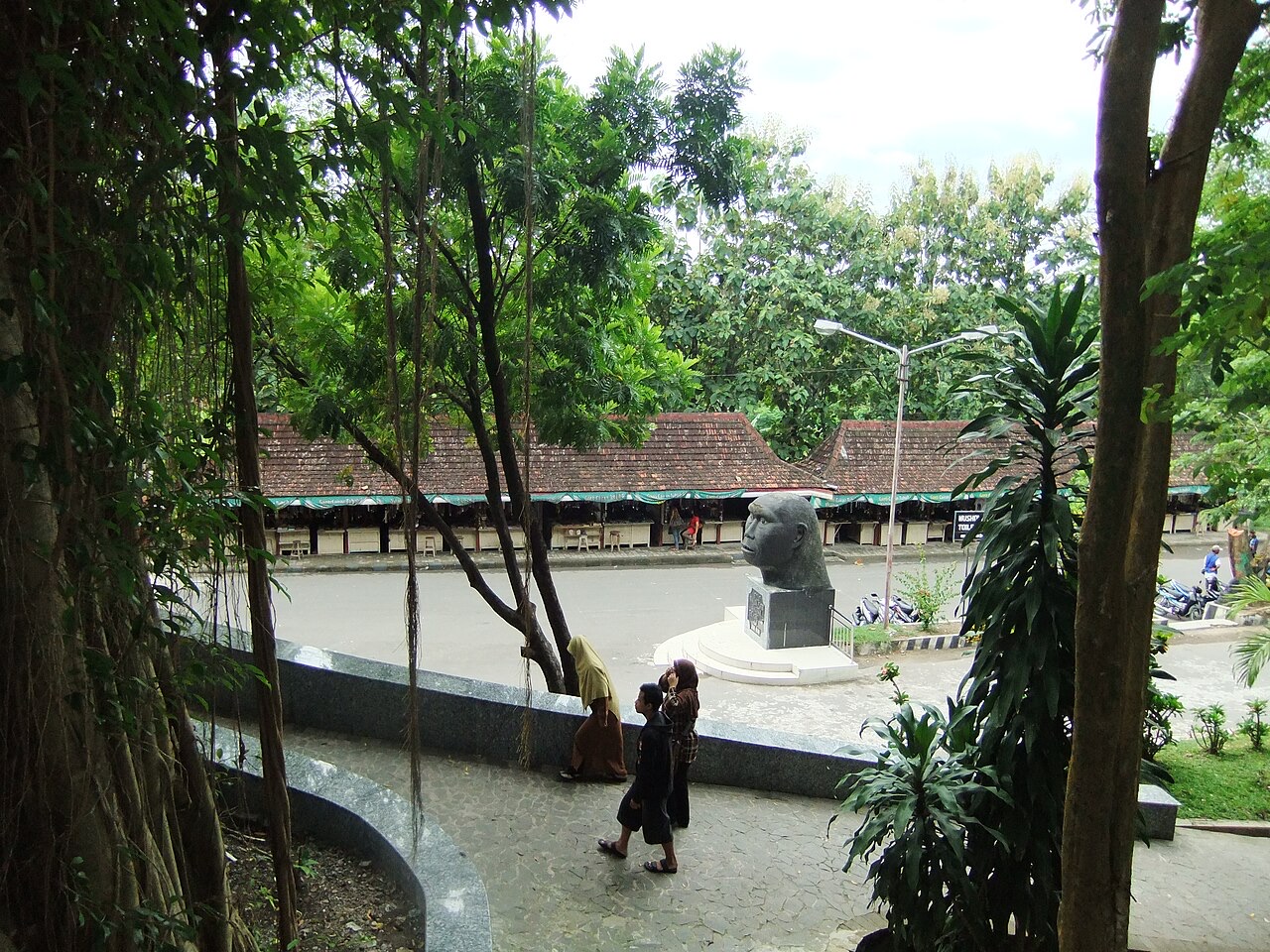 Asia
Indonesia ↗
Sangiran
Swampy deposits, river sediments and Homo erectus fossils record the growth of a terrestrial landscape amid Java’s volcanoes.
1.6 Ma → 1.1 Ma