
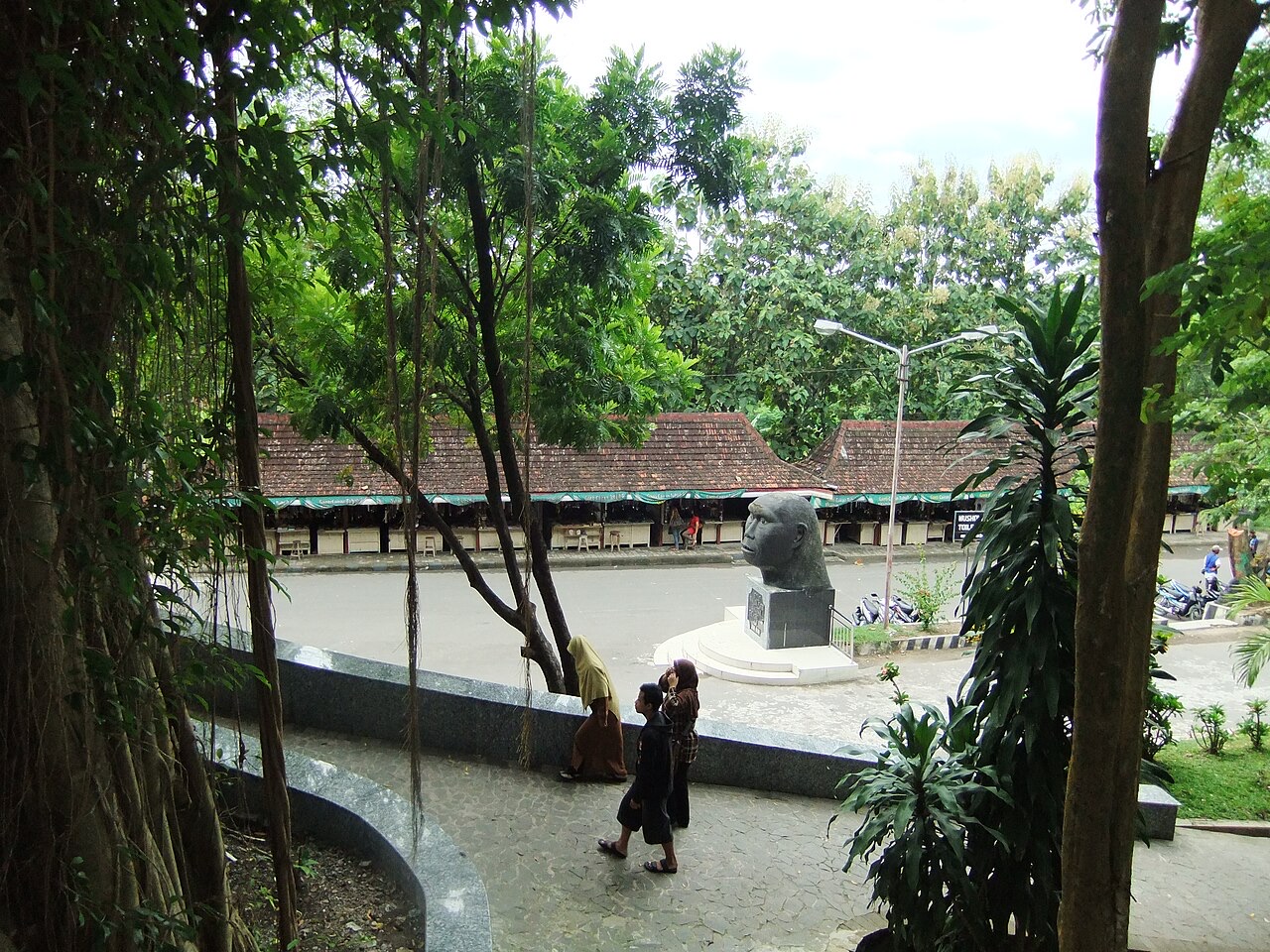
How can a changing island landscape complicate the age of a fossil?
Sangiran is a landscape of sedimentary layers rather than one archaeological floor. As parts of Java emerged, shallow marine and waterlogged environments gave way to more persistent land and rivers. Volcanic material entered this changing basin repeatedly. Later deformation and erosion exposed the succession in the Sangiran dome, making fossils accessible while also moving some objects out of their original geological positions.
The older snapshot follows the wetland transition in the Sangiran, or Pucangan, succession. Its numerical age is deliberately broad because published chronologies disagree. Zircon dating has supported an earliest hominin occurrence near 1.3 million years ago, whereas cosmogenic burial dating and a different correlation place the transition substantially earlier. These are competing interpretations of a difficult sedimentary archive, not two independent dates that should simply be averaged. The younger state follows the more river-dominated Bapang, also called Kabuh, deposits.
Homo erectus fossils, including the well-preserved Sangiran 17 cranium, show that early humans lived in this region. Their anatomy and the environmental evidence answer different questions: a skull establishes a particular kind of hominin, while channel deposits and associated animal remains help describe its surroundings. Neither establishes an exact migration route. The changing mixture of forest, open ground and water would have mattered to movement and food acquisition, but the history cannot be reduced to a single environmental trigger. Sangiran is especially valuable because it exposes the uncertainty behind a timeline as well as the fossils placed on it.
[1] [2] [3] [4] [5]Time windows and evidence
Older ages are on the left. Bars span the dated intervals. A dot marks a single age.
- Wetlands during the emergence of land 1.3–1.9 Ma
- Rivers across the Bapang landscape 0.7–1.3 Ma
- Bukuran creek succession 1.3–1.9 Ma
- Sangiran 17 cranium 1–1.3 Ma
- Grenzbank conglomeratic boundary 0.9–1.9 Ma
Researched windowsEvidence records
1.6 Ma · interval 1.3–1.9 Ma
Wetlands during the emergence of land
The upper Sangiran succession records a transition from shallow marine conditions toward swampy and terrestrial settings. Lake is used here for the freshwater wetland component, not a uniform deep lake across the dome. The 1.9–1.3 Ma envelope deliberately spans contrasting published chronological models; it is not a measured duration or an analytical error bar. Sediments and their order establish environmental change more securely than one precise numerical date.
[3] [2]Locate this time in the atlas ↗Observed
Fine sediments and volcanic layers underlie the river-dominated Bapang deposits.
Reconstructed
A low-lying landscape with waterlogged habitats as terrestrial conditions expanded.
Uncertain
The chronology of the earliest hominin-bearing levels remains disputed.
Evidence windows overlapping this state: 2. Overlap does not establish exact coexistence.
sediment · Sangiran ↗
Bukuran creek succession
At Bukuran creek, sampled sedimentary sections expose the transition investigated in competing Sangiran chronologies. Quartz burial dating measures the history of grains shielded from cosmic radiation, while zircon methods date different aspects of volcanic material. The named section connects laboratory measurements to actual stratigraphy. Its importance is methodological: interpreting a numerical age requires knowing whether sediment was freshly supplied or recycled, and how the sampled bed relates to the hominin-bearing horizons.
sediment · Sangiran ↗
Grenzbank conglomeratic boundary
The Grenzbank is a distinctive conglomeratic interval at the base of the Bapang succession. Its coarse material and stratigraphic position make it an important link between environmental reconstruction and numerical dating. Researchers have used it in different chronological frameworks, producing divergent ages for related hominin-bearing levels. The interval documents sediment transport and a transition toward the better developed river landscapes above; it is not a sharply dated island-wide event that can be applied without checking local sections.
1.1 Ma · interval 0.7–1.3 Ma
Rivers across the Bapang landscape
Bapang sediments preserve channels, transported volcanic material and many of Sangiran’s hominin fossils. This broad window includes the Smithsonian’s 1.3–1.0 Ma assignment for Sangiran 17 and younger deposits in the regional succession. River is an environmental interpretation of the sediments, rather than an assertion that every fossil died in a channel. Reworked sediment and fossils can carry an older history than the bed in which they are finally buried.
[1] [3] [4]Locate this time in the atlas ↗Observed
Fluvial sands and conglomerates contain vertebrate remains.
Reconstructed
Rivers crossed an increasingly terrestrial basin near active volcanic sources.
Uncertain
Correlation and redeposition limit the precision of individual fossil ages.
Evidence windows overlapping this state: 2. Overlap does not establish exact coexistence.
body fossil · Sangiran ↗
Sangiran 17 cranium
Sangiran 17, discovered in 1969, is an unusually complete Homo erectus cranium from Java. The Smithsonian assigns it an age between 1.3 and 1.0 million years. Its preserved face and braincase make it valuable for anatomical comparisons within early Homo. The specimen provides evidence of a population in the region, but its anatomy does not specify the vegetation around the individual or establish the route by which its ancestors reached the island.
sediment · Sangiran ↗
Grenzbank conglomeratic boundary
The Grenzbank is a distinctive conglomeratic interval at the base of the Bapang succession. Its coarse material and stratigraphic position make it an important link between environmental reconstruction and numerical dating. Researchers have used it in different chronological frameworks, producing divergent ages for related hominin-bearing levels. The interval documents sediment transport and a transition toward the better developed river landscapes above; it is not a sharply dated island-wide event that can be applied without checking local sections.
What this story cannot resolve
The modern marker denotes the dome. Overlapping age envelopes represent a disputed chronology, not continuous occupation or a precise first arrival.
Keep these ideas handy
Stratigraphy
Studying the order, relationships and distribution of rock layers and the events they preserve. Explore the idea ↗
Radiometric dating
Estimating the time of a geological event from radioactive decay and the isotopic composition of a suitable material. Explore the idea ↗
Taphonomy
Studying what happens between an organism’s life, death, burial, preservation and eventual discovery. Explore the idea ↗
Uncertainty & reconstruction limits
Explicit limits on what evidence and models allow us to infer, including uncertainty in age, identity, place and process. Explore the idea ↗
The evidence notebook
sediment · Sangiran ↗
Bukuran creek succession
At Bukuran creek, sampled sedimentary sections expose the transition investigated in competing Sangiran chronologies. Quartz burial dating measures the history of grains shielded from cosmic radiation, while zircon methods date different aspects of volcanic material. The named section connects laboratory measurements to actual stratigraphy. Its importance is methodological: interpreting a numerical age requires knowing whether sediment was freshly supplied or recycled, and how the sampled bed relates to the hominin-bearing horizons.
body fossil · Sangiran ↗
Sangiran 17 cranium
Sangiran 17, discovered in 1969, is an unusually complete Homo erectus cranium from Java. The Smithsonian assigns it an age between 1.3 and 1.0 million years. Its preserved face and braincase make it valuable for anatomical comparisons within early Homo. The specimen provides evidence of a population in the region, but its anatomy does not specify the vegetation around the individual or establish the route by which its ancestors reached the island.
sediment · Sangiran ↗
Grenzbank conglomeratic boundary
The Grenzbank is a distinctive conglomeratic interval at the base of the Bapang succession. Its coarse material and stratigraphic position make it an important link between environmental reconstruction and numerical dating. Researchers have used it in different chronological frameworks, producing divergent ages for related hominin-bearing levels. The interval documents sediment transport and a transition toward the better developed river landscapes above; it is not a sharply dated island-wide event that can be applied without checking local sections.
Follow the evidence
Sources & credits
- Sangiran Early Man Site ↗
UNESCO World Heritage Centre · Not stated
Use, credit & modifications
Reference only; original factual synthesis. No third-party prose or media reproduced.
Credit: UNESCO World Heritage Centre — Sangiran Early Man Site. Original educational synthesis; rounded age envelopes distinguish teaching windows from analytical errors. No media licence asserted for this reference. Photograph rights are documented separately.
- Age control of the first appearance datum for Javanese Homo erectus in the Sangiran area ↗
Matsu’ura et al.; Science · 2020-01-10
Use, credit & modifications
Reference only; original factual synthesis. No third-party prose or media reproduced.
Credit: Matsu’ura et al.; Science — Age control of the first appearance datum for Javanese Homo erectus in the Sangiran area. Original educational synthesis; rounded age envelopes distinguish teaching windows from analytical errors. No media licence asserted for this reference. Photograph rights are documented separately.
- Javanese Homo erectus on the move in SE Asia circa 1.8 Ma ↗
Husson et al.; Scientific Reports · 2022-11-08
Use, credit & modifications
Reference only; original factual synthesis. No third-party prose or media reproduced.
Credit: Husson et al.; Scientific Reports — Javanese Homo erectus on the move in SE Asia circa 1.8 Ma. Original educational synthesis; rounded age envelopes distinguish teaching windows from analytical errors. No media licence asserted for this reference. Photograph rights are documented separately.
- Sangiran 17 ↗
Smithsonian National Museum of Natural History · Not stated
Use, credit & modifications
Reference only; original factual synthesis. No third-party prose or media reproduced.
Credit: Smithsonian National Museum of Natural History — Sangiran 17. Original educational synthesis; rounded age envelopes distinguish teaching windows from analytical errors. No media licence asserted for this reference. Photograph rights are documented separately.
- Dietary strategies of Pleistocene Pongo sp. and Homo erectus on Java ↗
Nature Ecology & Evolution · 2023
Use, credit & modifications
Reference only; original factual synthesis. No third-party prose or media reproduced.
Credit: Nature Ecology & Evolution — Dietary strategies of Pleistocene Pongo sp. and Homo erectus on Java. Original educational synthesis; rounded age envelopes distinguish teaching windows from analytical errors. No media licence asserted for this reference. Photograph rights are documented separately.
Follow the connections
 Asia
Indonesia ↗
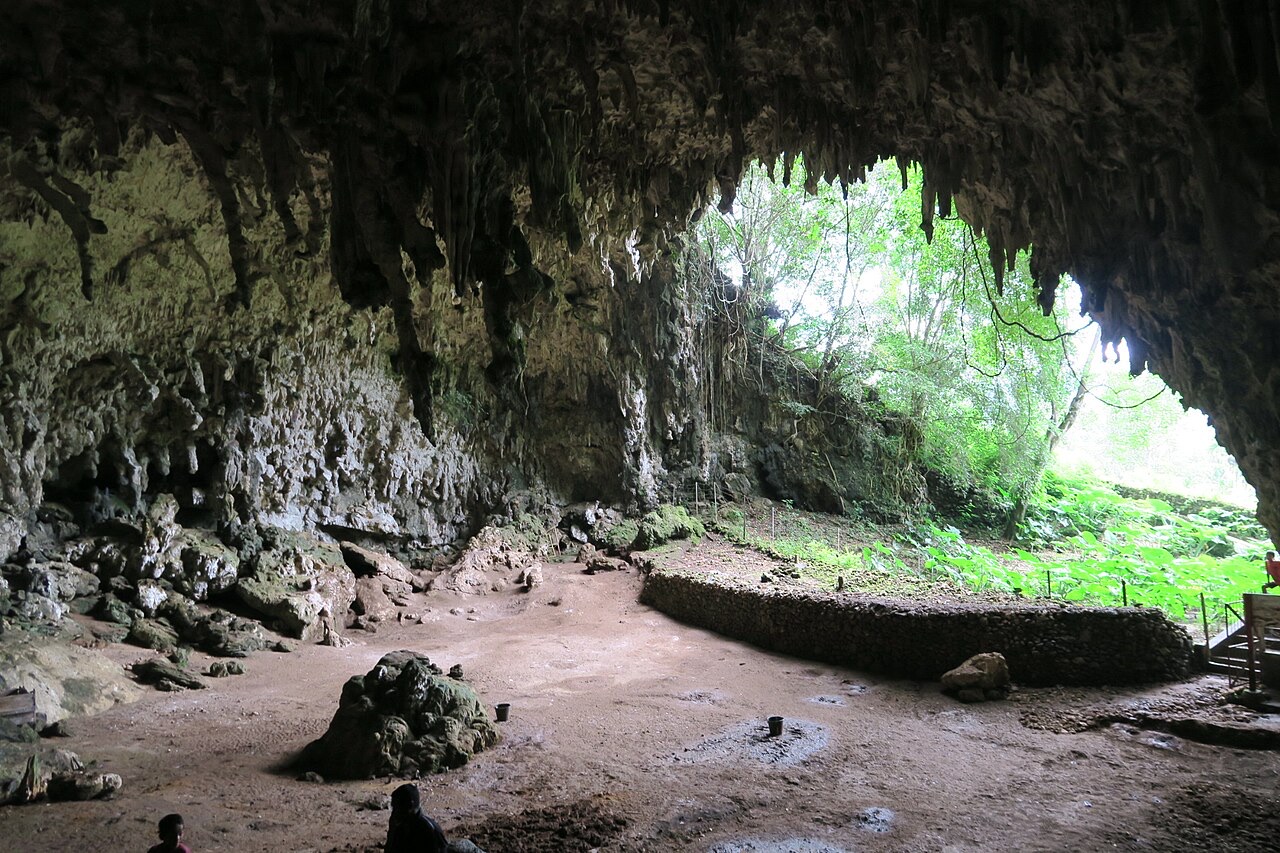
Flores: Mata Menge & Liang Bua
Middle Pleistocene stream deposits and much younger cave sediments preserve different chapters in the history of small-bodied hominins on Flores.
0.7 Ma → 0.08 Ma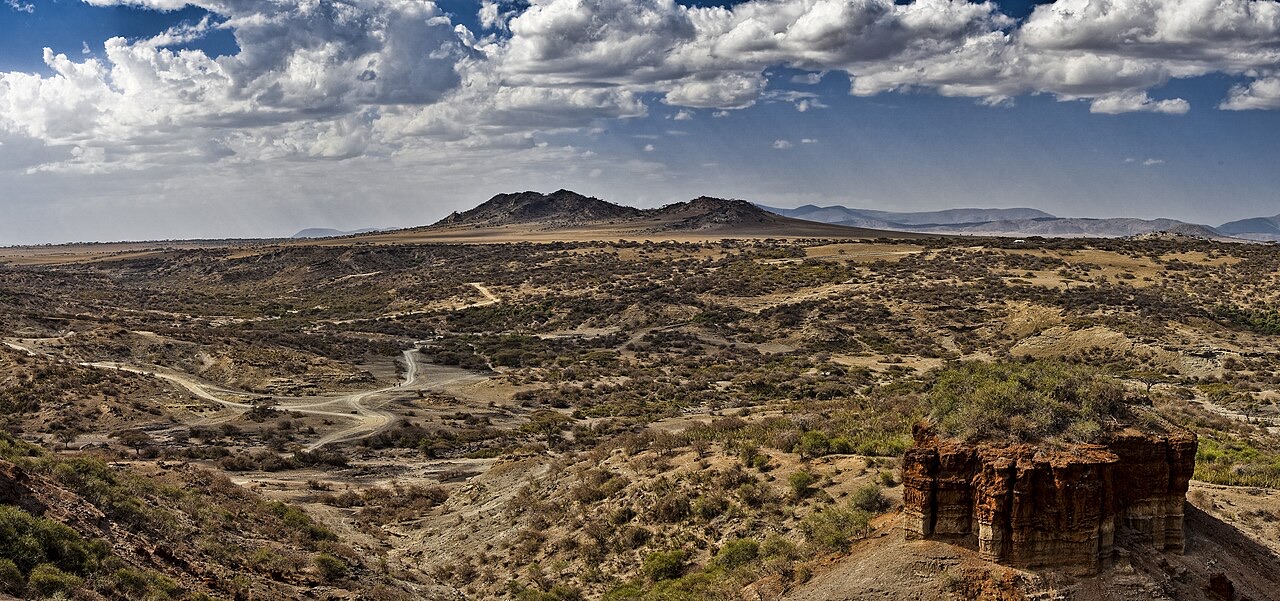 Africa
Tanzania ↗
Olduvai Gorge
Post-eruption rivers at Ewass Oldupa and younger spring-fed woodland at FLK Zinj reveal local habitat changes within an Early Pleistocene rift basin.
2.03 Ma → 1.84 Ma