
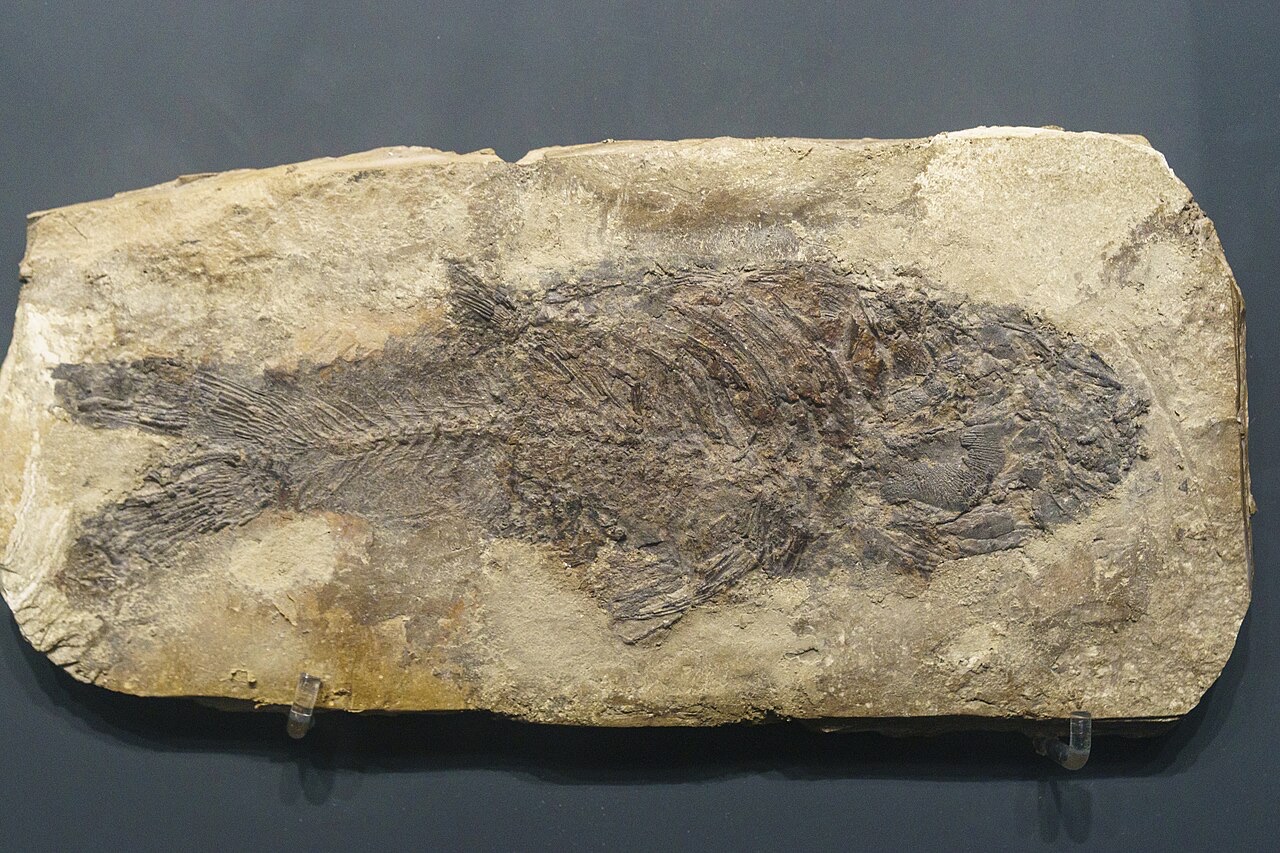
Why can a quiet lake preserve a more detailed community than the surrounding land?
Shanwang’s exceptional fossils come from a small lake basin associated with volcanism in eastern China. Basalts beneath, within and above the sedimentary succession provide chronological constraints, while the lake deposits preserve a different kind of evidence: organisms that lived in the water or arrived from the surrounding land. The older snapshot represents the underlying volcanic landscape, not the age of every fossil subsequently buried above it.
Fine lake sediment and abundant diatom remains created conditions in which delicate biological structures could survive. Leaves, insects and fish are especially informative, but their preservation is selective. A leaf can be carried from the shore, an insect blown onto the water, and a fish buried where it lived. Counting all three as equivalent samples of one community would ignore the different routes by which they entered the deposit.
Plant leaves and pollen indicate a wooded, relatively humid regional environment, while diatom assemblages and sedimentary layering describe conditions in the lake itself. The two perspectives can be compared without assuming they represent exactly the same area. Fine lamination offers the possibility of high-resolution chronology, but interpreting a couplet as an annual layer requires evidence rather than visual regularity alone. Radiometric estimates also differ from some older biostratigraphic assignments, so the lake snapshot uses a broad Early to Middle Miocene envelope. Shanwang demonstrates that exceptional preservation is not a transparent photograph of the past: it is a carefully filtered archive whose biological detail becomes most useful when joined to sedimentology and independent age control.
[1] [2] [3] [4] [5]Time windows and evidence
Older ages are on the left. Bars span the dated intervals. A dot marks a single age.
- Basalts beneath the lake succession 18.5–23.5 Ma
- The diatom-rich Shanwang lake 16–18 Ma
- Niushan basalt beneath Shanwang 18.5–23.5 Ma
- Shanwang laminated diatomaceous shale 16–18 Ma
- Parrotia leaves with feeding traces 16–18 Ma
Researched windowsEvidence records
21 Ma · interval 18.5–23.5 Ma
Basalts beneath the lake succession
Basalts of the underlying Niushan Formation record an older volcanic phase. A published argon age of 21.0 ± 2.5 Ma provides the broad envelope used here; this analytical uncertainty is not a measured eruption duration. The basalt establishes a geological context and older limit for the overlying Shanwang sedimentary record. Local volcanic activity continued at other stratigraphic levels, so the older state should not be interpreted as the only eruption that affected the basin.
[1]Locate this time in the atlas ↗Observed
Dated Niushan basalt lies below the Shanwang fossil-bearing succession.
Reconstructed
Volcanic construction preceded the selected lake ecosystem.
Uncertain
Large age uncertainty and different volcanic units limit precision.
Evidence windows overlapping this state: 1. Overlap does not establish exact coexistence.
17 Ma · interval 16–18 Ma
The diatom-rich Shanwang lake
The Shanwang Formation contains fine lacustrine shale rich in diatoms and unusually well-preserved fossils. Basalt ages around 17–18 Ma and other chronological work place the lake in the Early to Middle Miocene; the rounded 18–16 Ma window accommodates differing correlations. The water body received remains from surrounding forest as well as aquatic organisms. Its fossil assemblage therefore combines local lake life with a selectively transported terrestrial sample, rather than preserving every habitat in equal proportion.
[1] [2] [3] [4]Locate this time in the atlas ↗Observed
Laminated diatomaceous sediment contains aquatic and terrestrial fossils.
Reconstructed
A relatively quiet lake lay within a wooded volcanic landscape.
Uncertain
Annual-layer interpretations, duration and older published age schemes require caution.
Evidence windows overlapping this state: 2. Overlap does not establish exact coexistence.
body fossil · Shanwang ↗
Shanwang laminated diatomaceous shale
Diatom remains make up a conspicuous component of the finely layered Shanwang lake sediment. Their abundance and assemblage changes provide evidence about aquatic conditions, while the lamination records repeated sedimentary contrasts. Recent work has investigated the duration represented by these layers. The record is valuable because it combines biological and physical observations, but interpreting all laminae as yearly deposits requires independent checks for missing layers, multiple events per year and changes in accumulation rate.
trace fossil · Shanwang ↗
Parrotia leaves with feeding traces
Shanwang leaves attributed to Parrotia include specialized feeding damage studied in comparison with living plants. The leaf preserves a plant body, while the damage records an ecological interaction. Together they extend the record beyond a list of taxa toward relationships among organisms. The material also illustrates selective preservation: only some leaves entered the lake, survived transport and were collected. Similar-looking damage can have more than one maker, so identifying a particular insect requires more evidence than the outline of a feeding trace.
What this story cannot resolve
The modern marker denotes the Shanwang basin. Volcanic-rock ages constrain but do not directly date each fossil; the lake window is broader than any single layer.
Keep these ideas handy
Exceptional preservation
Preservation that retains normally lost features such as soft tissues. Geologists call a deposit rich in such fossils a Konservat-Lagerstätte. Explore the idea ↗
Taphonomy
Studying what happens between an organism’s life, death, burial, preservation and eventual discovery. Explore the idea ↗
Radiometric dating
Estimating the time of a geological event from radioactive decay and the isotopic composition of a suitable material. Explore the idea ↗
Climate proxy
A measured feature of a natural archive used to infer some aspect of past climate. Explore the idea ↗
The evidence notebook
radiometric · Shanwang ↗
Niushan basalt beneath Shanwang
Argon dating of Niushan basalt beneath the Shanwang Formation provides a measured constraint on the older volcanic foundation. The published value of 21.0 ± 2.5 Ma includes a large full external uncertainty. Its stratigraphic position is therefore as important as its central numerical value: lake deposits above the basalt must postdate that local unit, but the date alone cannot identify when the first lake formed or how long each sedimentary layer took to accumulate.
body fossil · Shanwang ↗
Shanwang laminated diatomaceous shale
Diatom remains make up a conspicuous component of the finely layered Shanwang lake sediment. Their abundance and assemblage changes provide evidence about aquatic conditions, while the lamination records repeated sedimentary contrasts. Recent work has investigated the duration represented by these layers. The record is valuable because it combines biological and physical observations, but interpreting all laminae as yearly deposits requires independent checks for missing layers, multiple events per year and changes in accumulation rate.
trace fossil · Shanwang ↗
Parrotia leaves with feeding traces
Shanwang leaves attributed to Parrotia include specialized feeding damage studied in comparison with living plants. The leaf preserves a plant body, while the damage records an ecological interaction. Together they extend the record beyond a list of taxa toward relationships among organisms. The material also illustrates selective preservation: only some leaves entered the lake, survived transport and were collected. Similar-looking damage can have more than one maker, so identifying a particular insect requires more evidence than the outline of a feeding trace.
Follow the evidence
Sources & credits
- New 40Ar/39Ar dating results from the Shanwang Basin, eastern China ↗
Physics of the Earth and Planetary Interiors · 2011
Use, credit & modifications
Reference only; original factual synthesis. No third-party prose or media reproduced.
Credit: Physics of the Earth and Planetary Interiors — New 40Ar/39Ar dating results from the Shanwang Basin, eastern China. Original educational synthesis; rounded age envelopes distinguish teaching windows from analytical errors. No media licence asserted for this reference. Photograph rights are documented separately.
- The Shanwang fossil biota in eastern China: a Miocene Konservat-Lagerstätte in lacustrine deposits ↗
Yang and Yang; Lethaia · 1994
Use, credit & modifications
Reference only; original factual synthesis. No third-party prose or media reproduced.
Credit: Yang and Yang; Lethaia — The Shanwang fossil biota in eastern China: a Miocene Konservat-Lagerstätte in lacustrine deposits. Original educational synthesis; rounded age envelopes distinguish teaching windows from analytical errors. No media licence asserted for this reference. Photograph rights are documented separately.
- Paleoecology of a Miocene flora from the Shanwang formation ↗
Liu and Leopold; Palynology · 1992
Use, credit & modifications
Reference only; original factual synthesis. No third-party prose or media reproduced.
Credit: Liu and Leopold; Palynology — Paleoecology of a Miocene flora from the Shanwang formation. Original educational synthesis; rounded age envelopes distinguish teaching windows from analytical errors. No media licence asserted for this reference. Photograph rights are documented separately.
- A Chronological Study of the Miocene Shanwang Diatomaceous Shale in Shandong Province ↗
Minerals · 2024
Use, credit & modifications
Reference only; original factual synthesis. No third-party prose or media reproduced.
Credit: Minerals — A Chronological Study of the Miocene Shanwang Diatomaceous Shale in Shandong Province. Original educational synthesis; rounded age envelopes distinguish teaching windows from analytical errors. No media licence asserted for this reference. Photograph rights are documented separately.
- A case of long-term herbivory: specialized feeding trace on Parrotia plant species ↗
Royal Society Open Science · 2020
Use, credit & modifications
Reference only; original factual synthesis. No third-party prose or media reproduced.
Credit: Royal Society Open Science — A case of long-term herbivory: specialized feeding trace on Parrotia plant species. Original educational synthesis; rounded age envelopes distinguish teaching windows from analytical errors. No media licence asserted for this reference. Photograph rights are documented separately.
Follow the connections
 Asia
China ↗
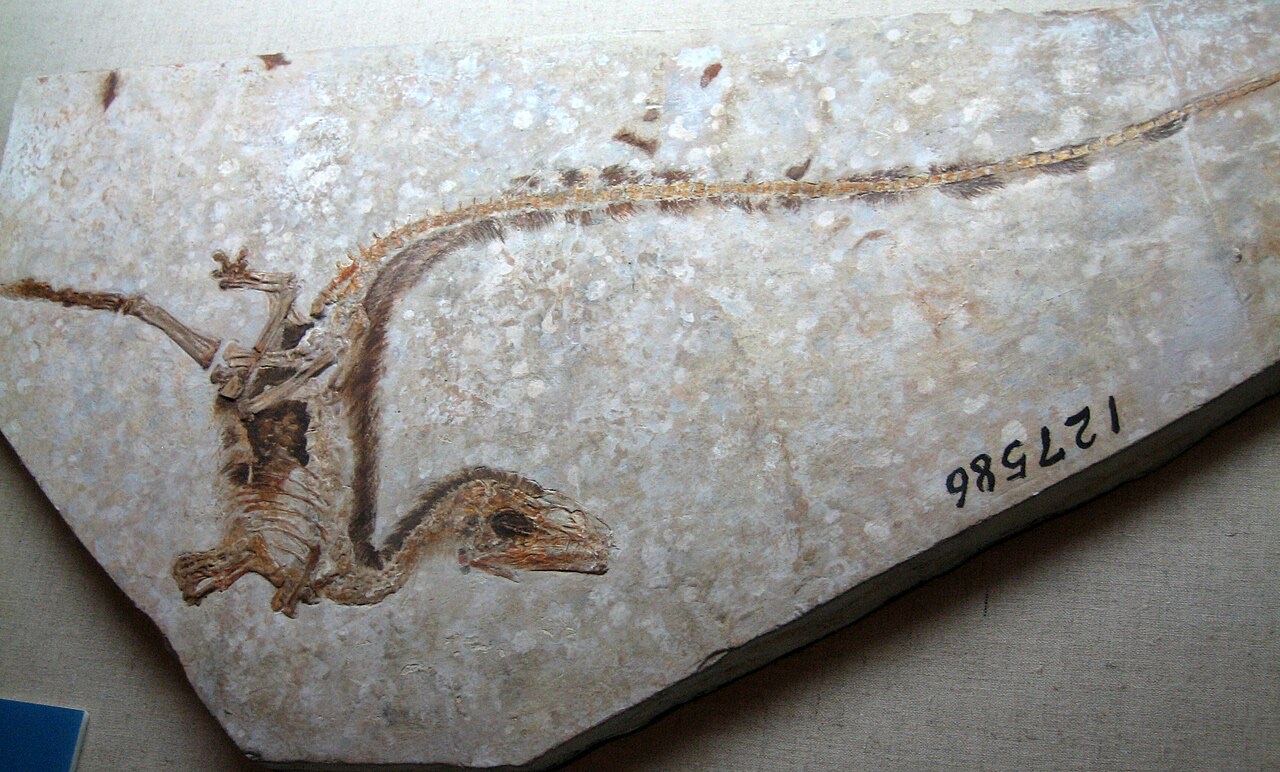
Jehol lake country
The Yixian and Jiufotang formations preserve different Early Cretaceous windows into northeastern China’s lake and terrestrial ecosystems.
125 Ma → 120 Ma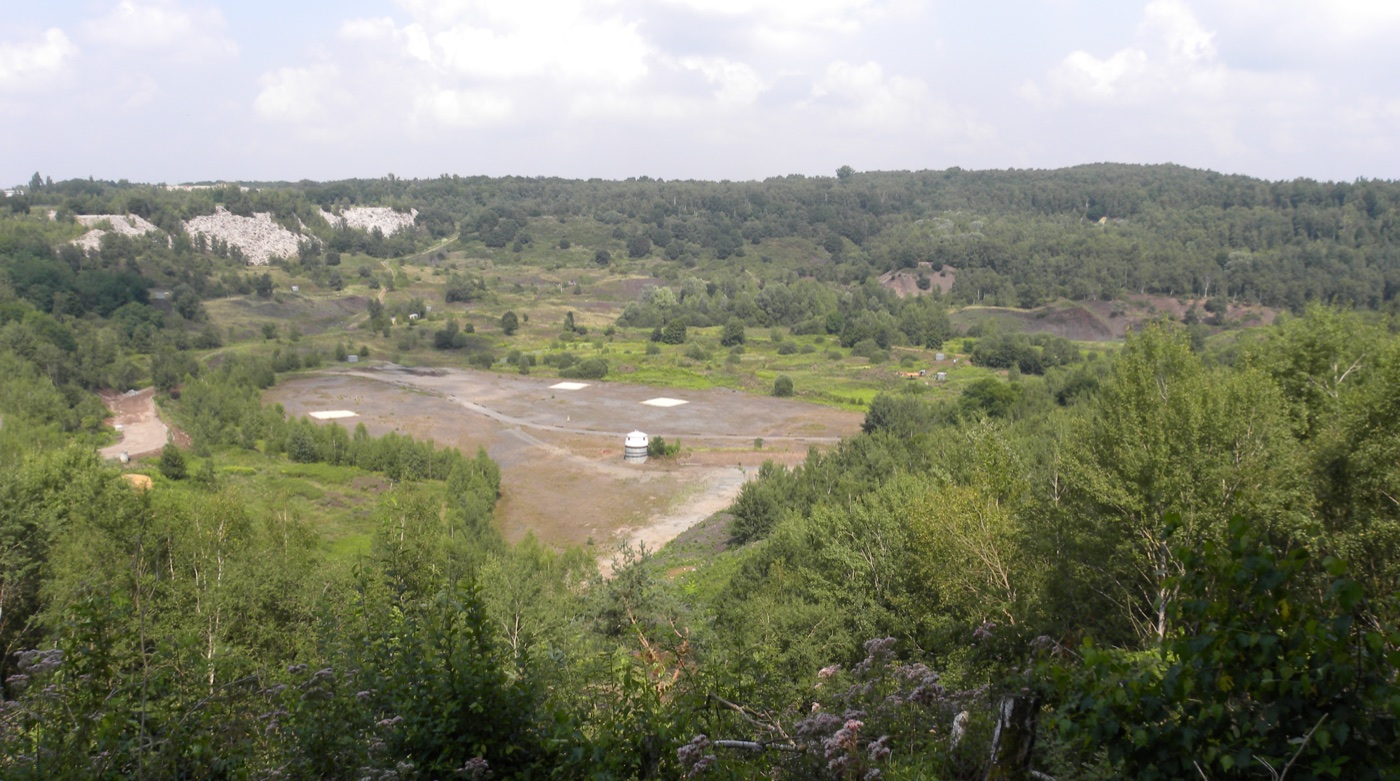 Europe
Germany ↗
Messel
Eocene lake mud captured remains from water, air and surrounding forest. Exceptional preservation makes Messel rich in detail, while the lake’s selective archive keeps the whole ecosystem partly out of reach.
48 Ma → Today