
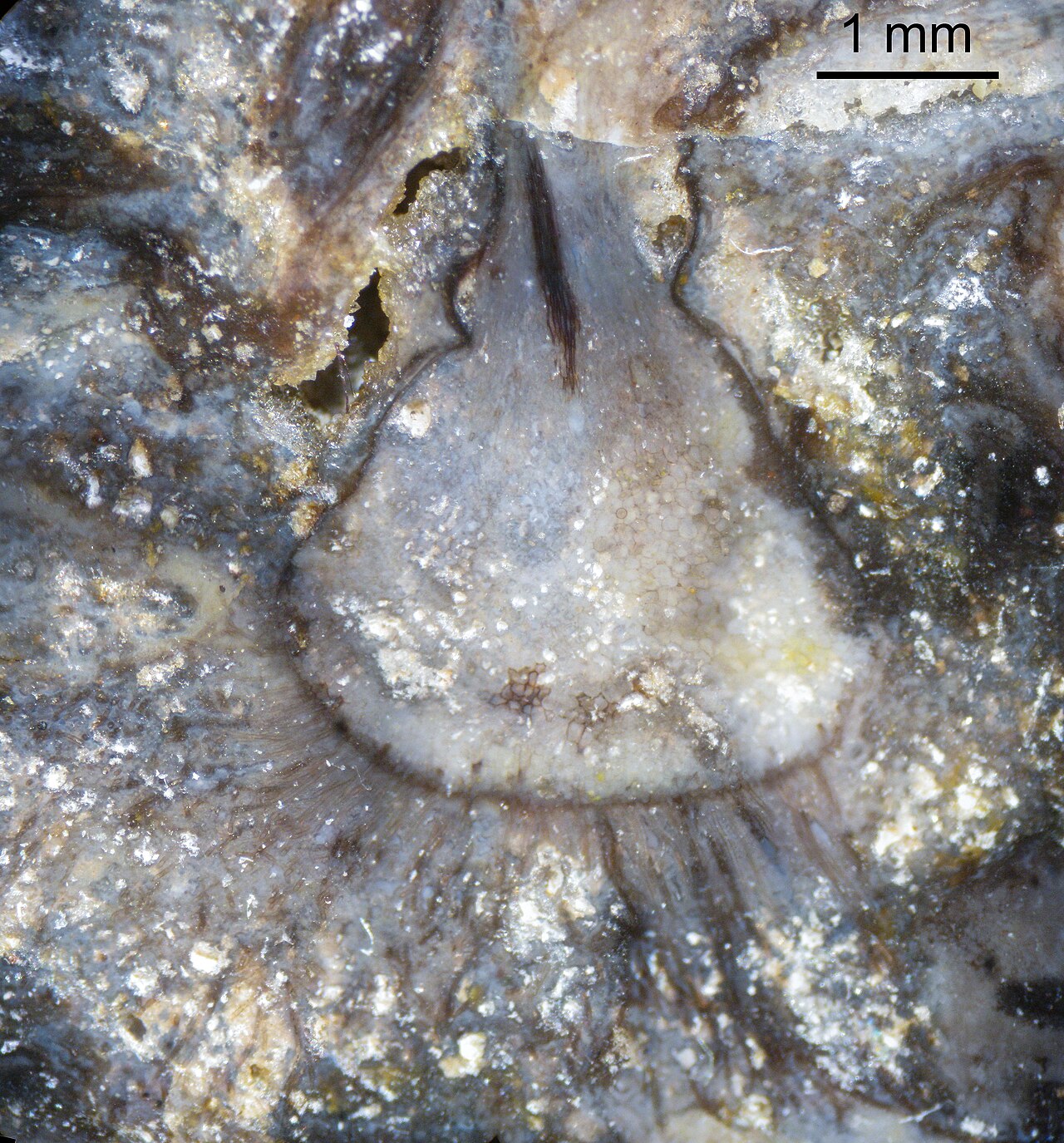
What can the inside of a fossil plant reveal that its outline cannot?
A dark piece of Rhynie chert can look unremarkable until it is cut and examined. Within the silica-rich rock, early land plants retain cellular details that are absent from most flattened fossils. This unusual preservation turns questions about shape into questions about organization: how an axis was built, where reproductive structures developed, and how one plant differed from another. The rock is both an ecosystem archive and a record of the mineralization that made the archive possible.
The ancient setting involved hot springs and wet ground within a terrestrial basin. Silica-bearing waters interacted with a community of plants and smaller organisms, preserving repeated local episodes. The selected age is approximately 410 million years, with a broad window that accommodates differing published estimates. The scene is not a modern forest placed in the Devonian. Its vegetation includes small early land plants with architectures unlike familiar flowering plants.
Rhynia and Horneophyton illustrate that variety. Their broadly simple-looking axes conceal important differences in internal and reproductive structures. Reading those differences requires comparing sections and specimens, rather than turning one slice into a complete organism by assumption. Fungi and other small life forms also contributed to the ecosystem, reminding us that terrestrial colonization involved communities and interactions rather than plants acting alone.
The second window is explicitly present-day: field investigation and prepared specimens make the buried record accessible. Modern farmland and laboratory slides are not surviving Devonian habitats. Comparing ancient preservation with modern observation explains why the evidence is exceptionally detailed yet geographically selective. A hot-spring wetland captures organisms able to live near that system and remains delivered to it; it cannot serve as an unbiased sample of all early land life.
[1] [2] [3]Time windows and evidence
Older ages are on the left. Bars span the dated intervals. A dot marks a single age.
- Silica mineralizes a wetland community 404–414 Ma
- A buried archive becomes observable Today
- Rhynia’s preserved tissues 404–414 Ma
- Horneophyton’s distinctive body plan 404–414 Ma
- The chert-bearing hot-spring succession 404–414 Ma
Researched windowsEvidence records
410 Ma · interval 404–414 Ma
Silica mineralizes a wetland community
Hydrothermal waters supplied silica to wet terrestrial settings occupied by early land plants. Repeated mineralization helped preserve organisms at cellular resolution. The volcanic label describes the hydrothermal association, not a scene of plants growing inside lava. The broad numerical window brackets differing published age estimates rather than specifying the lifespan of the hot springs. Preservation and living ecology must be distinguished when interpreting the community.
[1] [2] [3]Locate this time in the atlas ↗Observed
Plant tissues occur within chert in a hydrothermal sedimentary succession.
Reconstructed
Silica-rich waters mineralized parts of a terrestrial wetland ecosystem.
Uncertain
Different radiometric estimates and ecological filtering limit precision.
Evidence windows overlapping this state: 3. Overlap does not establish exact coexistence.
body fossil · Rhynie Chert ↗
Rhynia’s preserved tissues
Rhynia gwynne-vaughanii is represented by silicified axes with internal anatomy. Sections through the rock reveal tissue arrangements that a flattened surface impression would miss. These observations help distinguish superficially similar early land plants. The evidence is especially valuable for reconstructing organization, but a preserved stem section is not a complete measurement of the physiology or appearance of a living stand.
body fossil · Rhynie Chert ↗
Horneophyton’s distinctive body plan
Horneophyton lignieri preserves a different combination of structures from Rhynia, including its basal swollen region and reproductive organs. The chert allows those features to be studied at a fine scale. Distinct anatomical combinations challenge any picture of early land vegetation as one uniform primitive plant. They do not imply that the hot-spring community included every plant type then living on land.
sediment · Rhynie Chert ↗
The chert-bearing hot-spring succession
Chert layers occur within a sedimentary succession affected by hydrothermal fluids. Silica mineralization helped preserve organisms and fine cellular structures before they were entirely destroyed. The repeated layers record episodes within an evolving local system rather than one instant when an entire continent was fossilized. Field relationships connect spectacular microscope images to the geological setting in which preservation occurred.
Today · interval Today
A buried archive becomes observable
Today the Rhynie area is a terrestrial landscape in which subsurface beds and collected specimens are investigated through fieldwork and microscopy. This modern context explains access to the ancient record; it does not imply that the fossil plants still live here. A section through polished chert offers a different kind of observation from a regional map. Modern coordinates identify the source area, while individual museum and research specimens may now be elsewhere.
[1] [3]Locate this time in the atlas ↗Observed
The chert has been sampled through field investigations and prepared sections.
Reconstructed
The ancient wetland is reconstructed by combining anatomy and geological context.
Uncertain
The fossil-bearing beds are not continuously exposed at the surface.
Evidence windows overlapping this state: 0. Overlap does not establish exact coexistence.
No curated evidence record overlaps this window. The full notebook for this region appears below.
What this story cannot resolve
Only the older state describes the fossil community. The present-day state is an explicit observation context. Published ages differ, and the wetland flora is not representative of every Early Devonian land environment.
Keep these ideas handy
Exceptional preservation
Preservation that retains normally lost features such as soft tissues. Geologists call a deposit rich in such fossils a Konservat-Lagerstätte. Explore the idea ↗
Fossilization
The varied processes by which remains or traces of past life enter the geological record. Explore the idea ↗
Sampling bias
Differences between the history of life and the subset preserved, exposed, collected, identified and published. Explore the idea ↗
The evidence notebook
body fossil · Rhynie Chert ↗
Rhynia’s preserved tissues
Rhynia gwynne-vaughanii is represented by silicified axes with internal anatomy. Sections through the rock reveal tissue arrangements that a flattened surface impression would miss. These observations help distinguish superficially similar early land plants. The evidence is especially valuable for reconstructing organization, but a preserved stem section is not a complete measurement of the physiology or appearance of a living stand.
body fossil · Rhynie Chert ↗
Horneophyton’s distinctive body plan
Horneophyton lignieri preserves a different combination of structures from Rhynia, including its basal swollen region and reproductive organs. The chert allows those features to be studied at a fine scale. Distinct anatomical combinations challenge any picture of early land vegetation as one uniform primitive plant. They do not imply that the hot-spring community included every plant type then living on land.
sediment · Rhynie Chert ↗
The chert-bearing hot-spring succession
Chert layers occur within a sedimentary succession affected by hydrothermal fluids. Silica mineralization helped preserve organisms and fine cellular structures before they were entirely destroyed. The repeated layers record episodes within an evolving local system rather than one instant when an entire continent was fossilized. Field relationships connect spectacular microscope images to the geological setting in which preservation occurred.
Follow the evidence
Sources & credits
- The Rhynie chert Lagerstätte: an Early Devonian hot-spring ecosystem frozen in time ↗
Paläontologische Zeitschrift · 2026
Use, credit & modifications
Reference only; no source text, figures or photographs reproduced. Original educational synthesis.
Credit: Paläontologische Zeitschrift. Facts synthesized in original language; ages expressed as explicit teaching windows rather than exact dates of all specimens. No source asset reuse; territorial asset permissions not applicable.
- Organs and tissues of Rhynie chert plants ↗
Philosophical Transactions of the Royal Society B · 2018
Use, credit & modifications
Reference only; no source text, figures or photographs reproduced. Original educational synthesis.
Credit: Philosophical Transactions of the Royal Society B. Facts synthesized in original language; ages expressed as explicit teaching windows rather than exact dates of all specimens. No source asset reuse; territorial asset permissions not applicable.
- Rhynie, Aberdeenshire ↗
Geological Conservation Review / Scottish Geology Trust · Not stated
Use, credit & modifications
Reference only; no source text, figures or photographs reproduced. Original educational synthesis.
Credit: Geological Conservation Review / Scottish Geology Trust. Facts synthesized in original language; ages expressed as explicit teaching windows rather than exact dates of all specimens. No source asset reuse; territorial asset permissions not applicable.
Follow the connections
 North America
Canada ↗
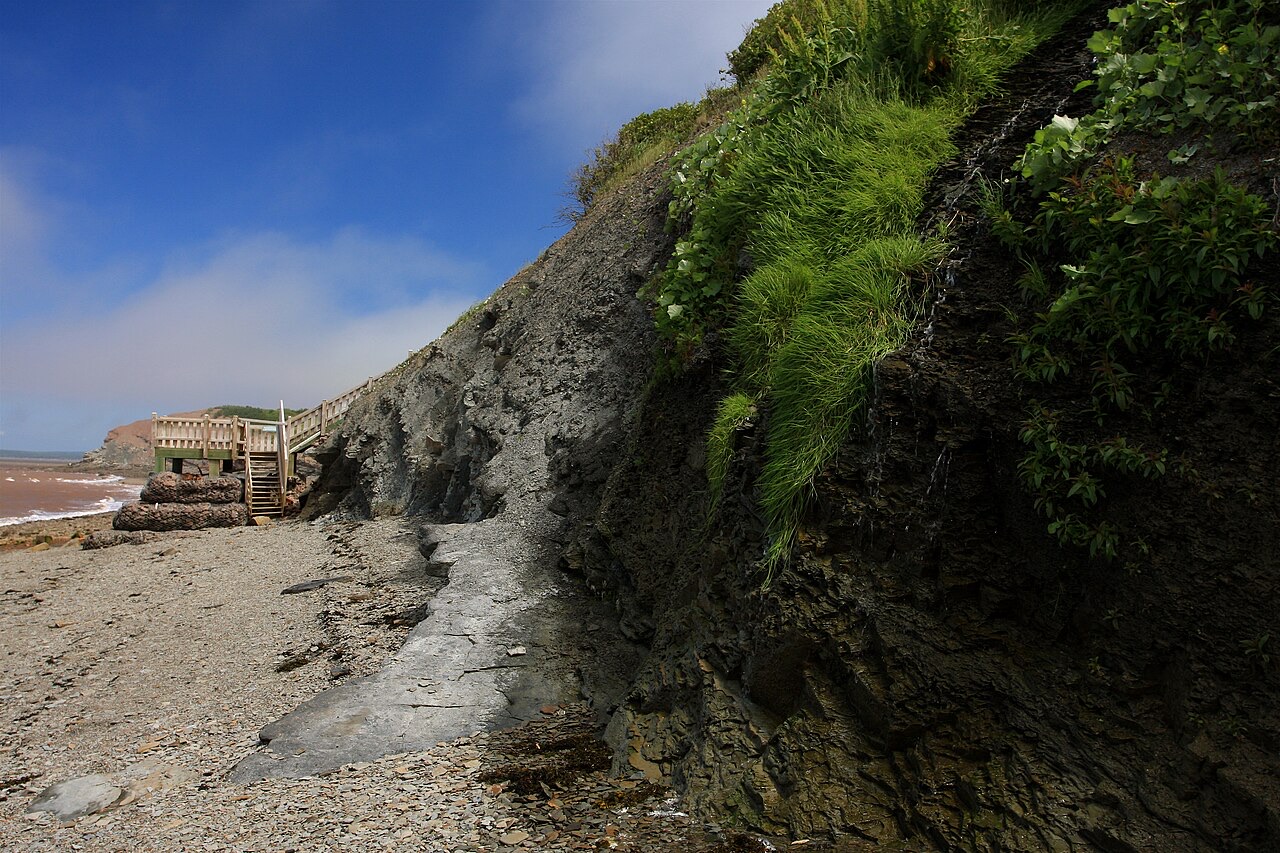
Joggins Fossil Cliffs
Carboniferous coastal forests, rivers and wetland communities survive in the rocks of a modern tidal cliff. Upright trees preserve the spatial context of an ecosystem as well as its organisms.
315 Ma → Today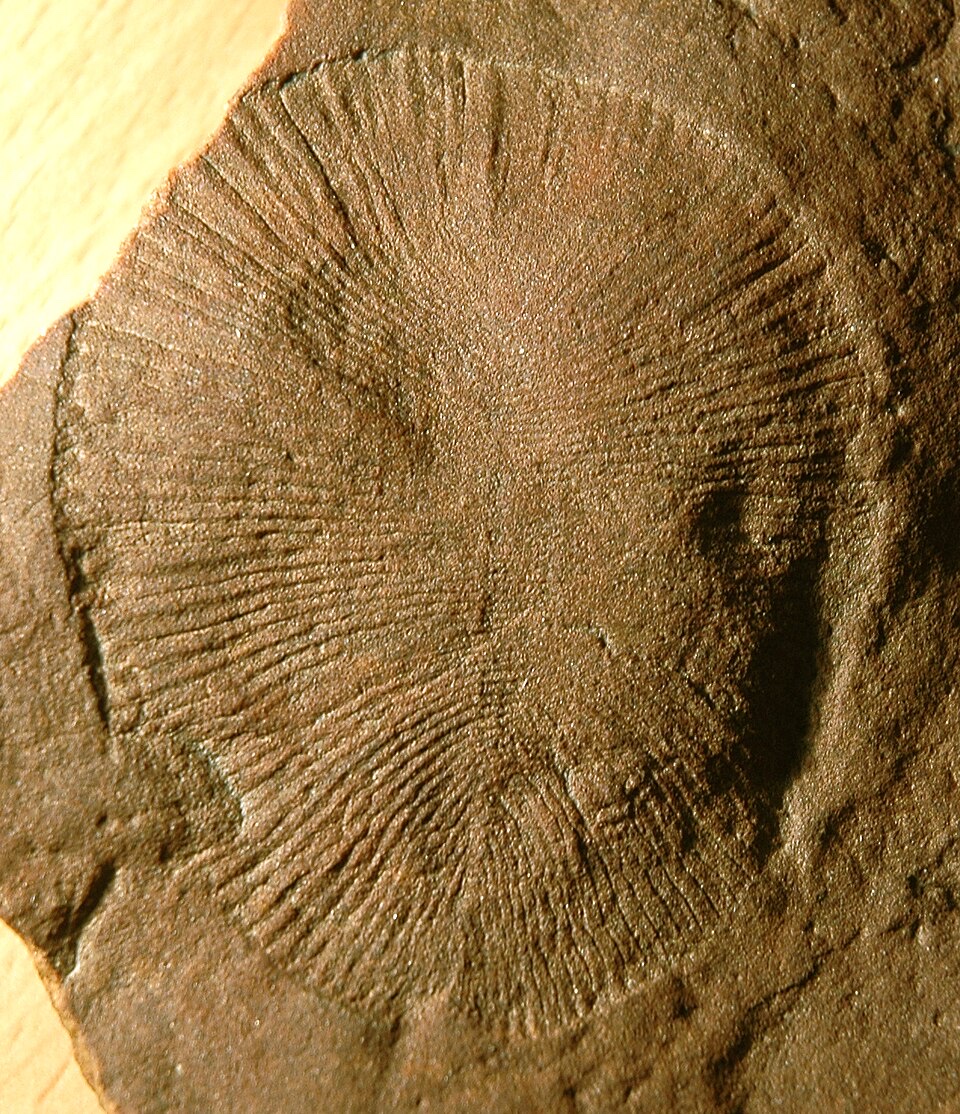 Oceania
Australia ↗
Ediacara & Nilpena
South Australian bedding surfaces record soft-bodied Ediacaran organisms and the patchiness of life on an ancient marine floor.
555 Ma → Today