
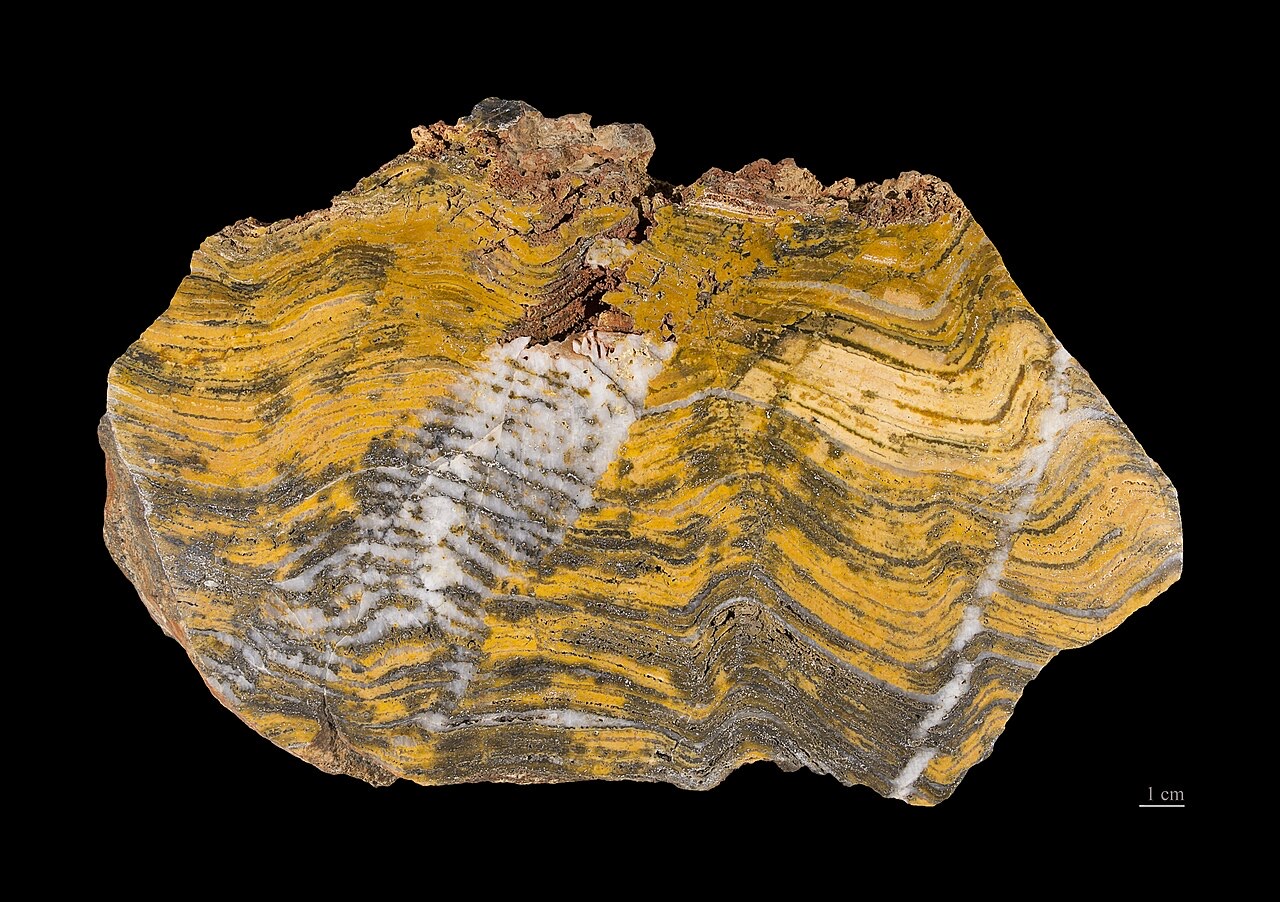
How can a layered rock distinguish microbial activity from mineral growth?
In the eastern Pilbara, a fossil can be a relationship between layers rather than a recognizable animal. The Dresser Formation preserves sedimentary rocks within an ancient volcanic and hydrothermal setting. Some silica-rich deposits have been interpreted as the remains of hot springs exposed at the surface. Their importance comes from the association of mineral textures, finely layered structures and possible microbial fabrics. The proposed habitat was a small part of a changing caldera system, where marine water, groundwater and hot fluids could all leave different signatures.
The younger Strelley Pool Formation asks a related question at a larger scale. Domes, cones and other layered structures occur across a former shallow-water platform. Their distribution, internal fabrics and relationship to surrounding sediment strengthen a microbial interpretation. Looking at one attractive shape alone would provide a weaker test: crystals, currents and sediment settling can also produce organized patterns. The strongest case combines the architecture of the deposit with microscopic observations and its geological setting.
Carbonaceous microscopic structures from Strelley Pool add another kind of evidence. Investigators have described cell-like walls and associated pyrite, and proposed sulphur-based metabolisms. Those interpretations involve more than simply finding carbon in an old rock. Researchers must test whether the structures formed with the sediment, whether later fluids introduced material, and whether non-living processes could reproduce the features. No individual observation identifies the first organism or establishes where life originated.
These two snapshots are separated by tens of millions of years and summarize different outcrops. The marker belongs to modern Western Australia. It does not assign the Pilbara an invented Archean latitude or draw a confident global shoreline. The useful comparison is between locally reconstructed habitats and the evidence supporting them, with the wider geography left unresolved.
[1] [2] [3] [4] [5] [6]Time windows and evidence
Older ages are on the left. Bars span the dated intervals. A dot marks a single age.
- Hydrothermal habitats in the Dresser caldera 3,470–3,490 Ma
- Layered communities on the Strelley platform 3,350–3,430 Ma
- Dresser Formation silica terraces 3,470–3,490 Ma
- Strelley Pool stromatolites at Trendall Ridge 3,350–3,430 Ma
- Strelley Pool carbonaceous microstructures 3,350–3,430 Ma
Researched windowsEvidence records
3,480 Ma · interval 3,470–3,490 Ma
Hydrothermal habitats in the Dresser caldera
Around 3.48 billion years ago, the Dresser volcanic system contained interacting hydrothermal and sedimentary environments. Geyserite-like silica, terrace fabrics and stromatolitic structures have been interpreted as evidence for microbial communities in exposed hot-spring settings. Geochemical work also identifies marine and hydrothermal influences elsewhere in the succession. This state represents that local habitat hypothesis within a varied caldera, rather than a single environment covering the entire formation. The 3,490–3,470 Ma display window is a rounded teaching envelope around the published approximate age, not a measured duration of one spring.
[1] [2]Locate this time in the atlas ↗Observed
Silica-rich laminated deposits, sinter-like textures and stromatolitic structures occur within the Dresser Formation.
Reconstructed
Locally inhabited hydrothermal surfaces within a volcanic system that also experienced marine influences.
Uncertain
The origin of individual textures and the distribution of exposed versus submerged settings require multiple tests; no global position is reconstructed.
Evidence windows overlapping this state: 1. Overlap does not establish exact coexistence.
3,430 Ma · interval 3,350–3,430 Ma
Layered communities on the Strelley platform
The studied Strelley Pool stromatolite reef is about 3,430 million years old. At Trendall Ridge, different shapes of layered mounds occupy different parts of a shallow-water carbonate platform. Their arrangement and internal layering help test whether microbial mats contributed to growth. The broader interval describes the formation across multiple localities. Carbon-rich microscopic structures reported from sandstone are a separate clue to possible life.
[3] [4] [5] [6]Locate this time in the atlas ↗Observed
Domes, cones and other layered structures occur within distinct sedimentary environments on the studied platform.
Reconstructed
Microbial communities influenced sediment accumulation in shallow-water habitats.
Uncertain
Recrystallization can obscure original structures. The formation-wide age interval covers multiple localities and separate lines of evidence.
Evidence windows overlapping this state: 2. Overlap does not establish exact coexistence.
trace fossil · Pilbara ↗
Strelley Pool stromatolites at Trendall Ridge
The Strelley Pool outcrops around Trendall Ridge preserve several forms of laminated accretionary structure. Their arrangement across platform environments provides a more demanding test of biological influence than the outline of an isolated dome. Detailed studies combine large-scale morphology with preserved sedimentary fabrics, while acknowledging recrystallization and mineral precipitation. The fossils here are structures attributed to the activity of microbial communities, not skeletons of named animals. The broad age range belongs to the formation and is not a direct date on an individual mound.
body fossil · Pilbara ↗
Strelley Pool carbonaceous microstructures
Microscopic structures in Strelley Pool sandstones were described as hollow, carbonaceous forms with cell-like walls, groupings and associated pyrite. The study combined microscopy with chemical and isotope measurements to interpret them as microbial remains, with sulphur-based metabolism proposed from the associated minerals. This is a separate evidence type from the macroscopic stromatolite shapes. The proposed identification is presented as an interpretation supported by several tests, rather than treating every microscopic sphere or carbon-bearing patch as a cell.
What this story cannot resolve
A broad modern regional marker, not an ancient coordinate. Dresser and Strelley Pool are different successions; their age windows do not describe continuous occupation or identify the origin of life. Strelley Pool numerical age assignments vary among publications and local sections.
Keep these ideas handy
Stromatolites
Layered structures produced through interactions among microbial communities, sediment and mineral precipitation. Explore the idea ↗
Deep time & Ma
Ma means millions of years before the present; Ga means billions of years before the present. One Ga equals 1,000 Ma. Explore the idea ↗
Uncertainty & reconstruction limits
Explicit limits on what evidence and models allow us to infer, including uncertainty in age, identity, place and process. Explore the idea ↗
The evidence notebook
sediment · Pilbara ↗
Dresser Formation silica terraces
Silica-rich deposits in the Dresser Formation include finely laminated, terrace-like and geyserite-like textures. Their association with stromatolitic structures and possible microbial fabrics led investigators to propose an inhabited terrestrial hot-spring field within the volcanic system. More recent geochemical work emphasizes the coexistence of marine, exposed and hydrothermal influences. The record is therefore useful for testing a local habitat, without requiring every Dresser bed to have formed on land. Its age is displayed as a broad envelope around approximately 3.48 billion years.
trace fossil · Pilbara ↗
Strelley Pool stromatolites at Trendall Ridge
The Strelley Pool outcrops around Trendall Ridge preserve several forms of laminated accretionary structure. Their arrangement across platform environments provides a more demanding test of biological influence than the outline of an isolated dome. Detailed studies combine large-scale morphology with preserved sedimentary fabrics, while acknowledging recrystallization and mineral precipitation. The fossils here are structures attributed to the activity of microbial communities, not skeletons of named animals. The broad age range belongs to the formation and is not a direct date on an individual mound.
body fossil · Pilbara ↗
Strelley Pool carbonaceous microstructures
Microscopic structures in Strelley Pool sandstones were described as hollow, carbonaceous forms with cell-like walls, groupings and associated pyrite. The study combined microscopy with chemical and isotope measurements to interpret them as microbial remains, with sulphur-based metabolism proposed from the associated minerals. This is a separate evidence type from the macroscopic stromatolite shapes. The proposed identification is presented as an interpretation supported by several tests, rather than treating every microscopic sphere or carbon-bearing patch as a cell.
Follow the evidence
Sources & credits
- Earliest signs of life on land preserved in ca. 3.5 Ga hot spring deposits ↗
Djokic et al.; Nature Communications · 2017-05-09; corrected 2017-08-16
Use, credit & modifications
Reference only. No third-party prose, figures or media reproduced in the regional narrative; original factual synthesis.
Credit: Djokic et al.; Nature Communications — Earliest signs of life on land preserved in ca. 3.5 Ga hot spring deposits. Original educational synthesis. Age envelopes are explicitly rounded teaching intervals, not new analytical uncertainties. No media licence or territorial reuse permission asserted for this reference. Photographs have separate item-level credits.
- Trace elements (REE + Y) reveal marine, subaerial, and hydrothermal controls on an early Archean habitat for life ↗
Djokic et al.; Chemical Geology · 2024
Use, credit & modifications
Reference only. No third-party prose, figures or media reproduced in the regional narrative; original factual synthesis.
Credit: Djokic et al.; Chemical Geology — Trace elements (REE + Y) reveal marine, subaerial, and hydrothermal controls on an early Archean habitat for life. Original educational synthesis. Age envelopes are explicitly rounded teaching intervals, not new analytical uncertainties. No media licence or territorial reuse permission asserted for this reference. Photographs have separate item-level credits.
- Stromatolite reef from the Early Archaean era of Australia ↗
Allwood et al.; Nature · 2006-06-08
Use, credit & modifications
Reference only. No third-party prose, figures or media reproduced in the regional narrative; original factual synthesis.
Credit: Allwood et al.; Nature — Stromatolite reef from the Early Archaean era of Australia. Original educational synthesis. Age envelopes are explicitly rounded teaching intervals, not new analytical uncertainties. No media licence or territorial reuse permission asserted for this reference. Photographs have separate item-level credits.
- Controls on development and diversity of Early Archean stromatolites ↗
Allwood et al.; Proceedings of the National Academy of Sciences · 2009
Use, credit & modifications
Reference only. No third-party prose, figures or media reproduced in the regional narrative; original factual synthesis.
Credit: Allwood et al.; Proceedings of the National Academy of Sciences — Controls on development and diversity of Early Archean stromatolites. Original educational synthesis. Age envelopes are explicitly rounded teaching intervals, not new analytical uncertainties. No media licence or territorial reuse permission asserted for this reference. Photographs have separate item-level credits.
- Microfossils of sulphur-metabolizing cells in 3.4-billion-year-old rocks of Western Australia ↗
Wacey et al.; Nature Geoscience · 2011-08-21
Use, credit & modifications
Reference only. No third-party prose, figures or media reproduced in the regional narrative; original factual synthesis.
Credit: Wacey et al.; Nature Geoscience — Microfossils of sulphur-metabolizing cells in 3.4-billion-year-old rocks of Western Australia. Original educational synthesis. Age envelopes are explicitly rounded teaching intervals, not new analytical uncertainties. No media licence or territorial reuse permission asserted for this reference. Photographs have separate item-level credits.
- Strelley Pool Formation: lithostratigraphic description ↗
Hickman; Geological Survey of Western Australia · 2021-12-22
Use, credit & modifications
Reference only. No third-party prose, figures or media reproduced in the regional narrative; original factual synthesis.
Credit: Hickman; Geological Survey of Western Australia — Strelley Pool Formation: lithostratigraphic description. Original educational synthesis. Age envelopes are explicitly rounded teaching intervals, not new analytical uncertainties. No media licence or territorial reuse permission asserted for this reference. Photographs have separate item-level credits.
Follow the connections
 Oceania
Australia ↗
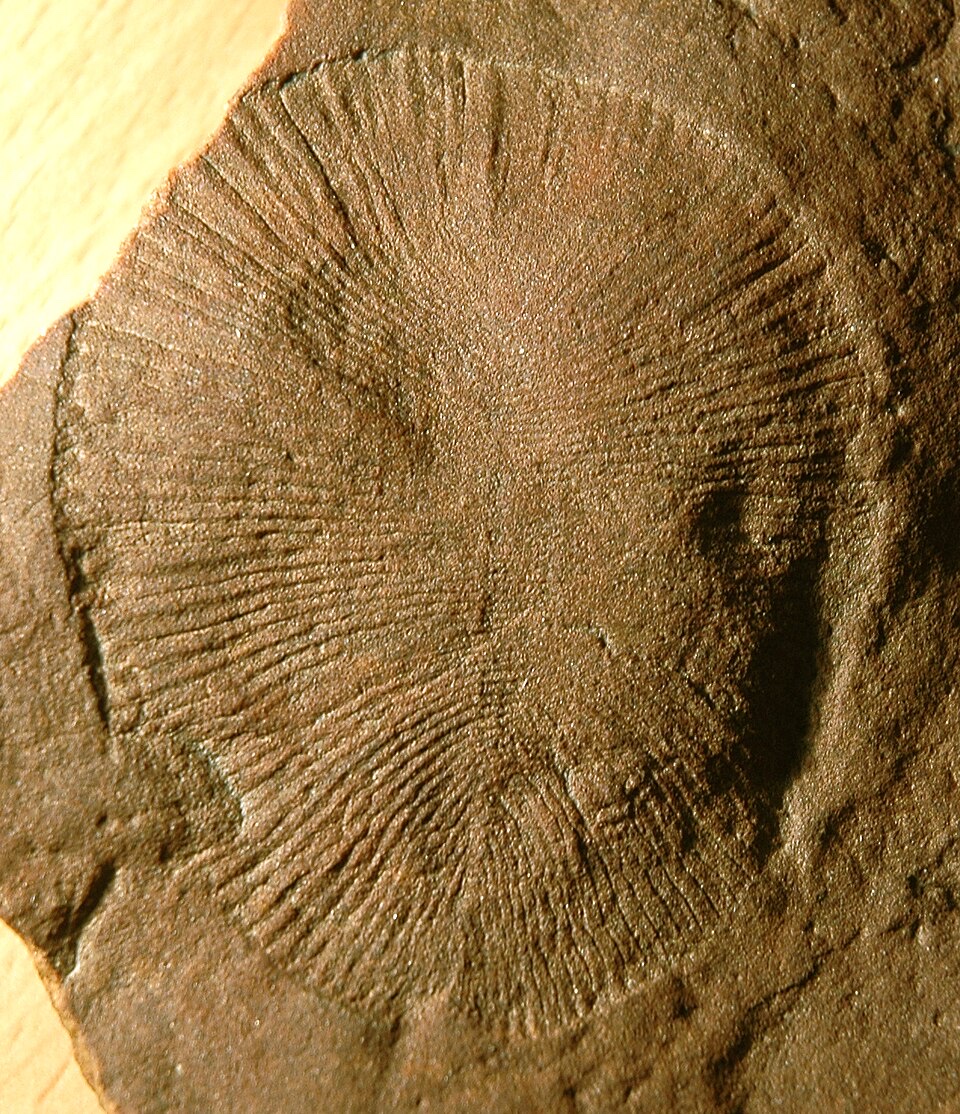
Ediacara & Nilpena
South Australian bedding surfaces record soft-bodied Ediacaran organisms and the patchiness of life on an ancient marine floor.
555 Ma → Today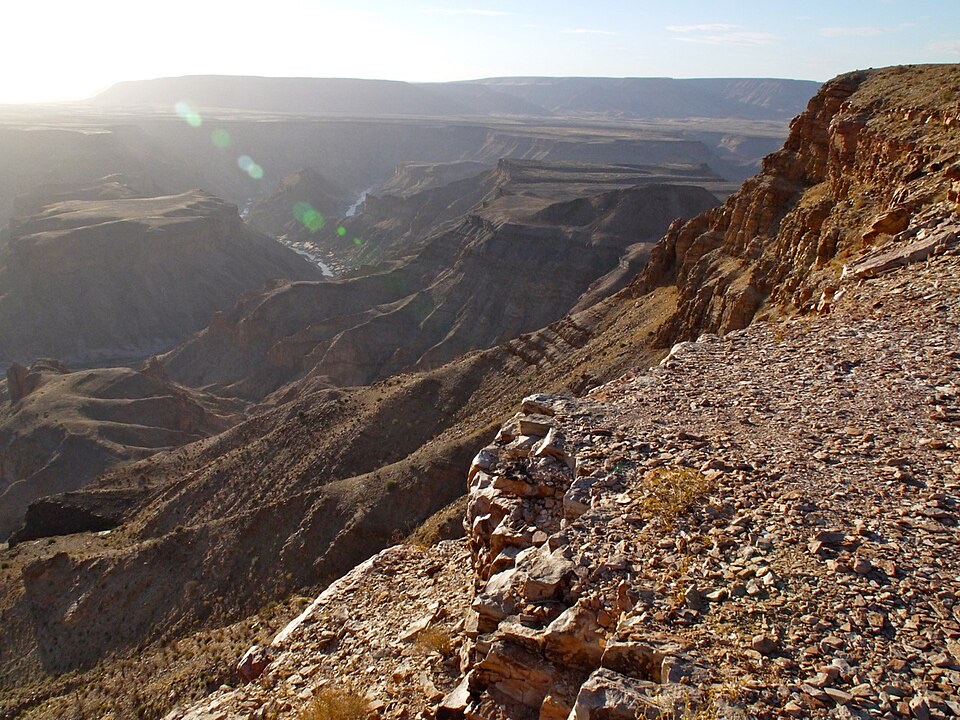 Africa
Namibia ↗
Nama Basin
Late Ediacaran skeletons and younger burrows show two different ways animals began shaping marine habitats in southern Namibia.
548 Ma → 537 Ma