
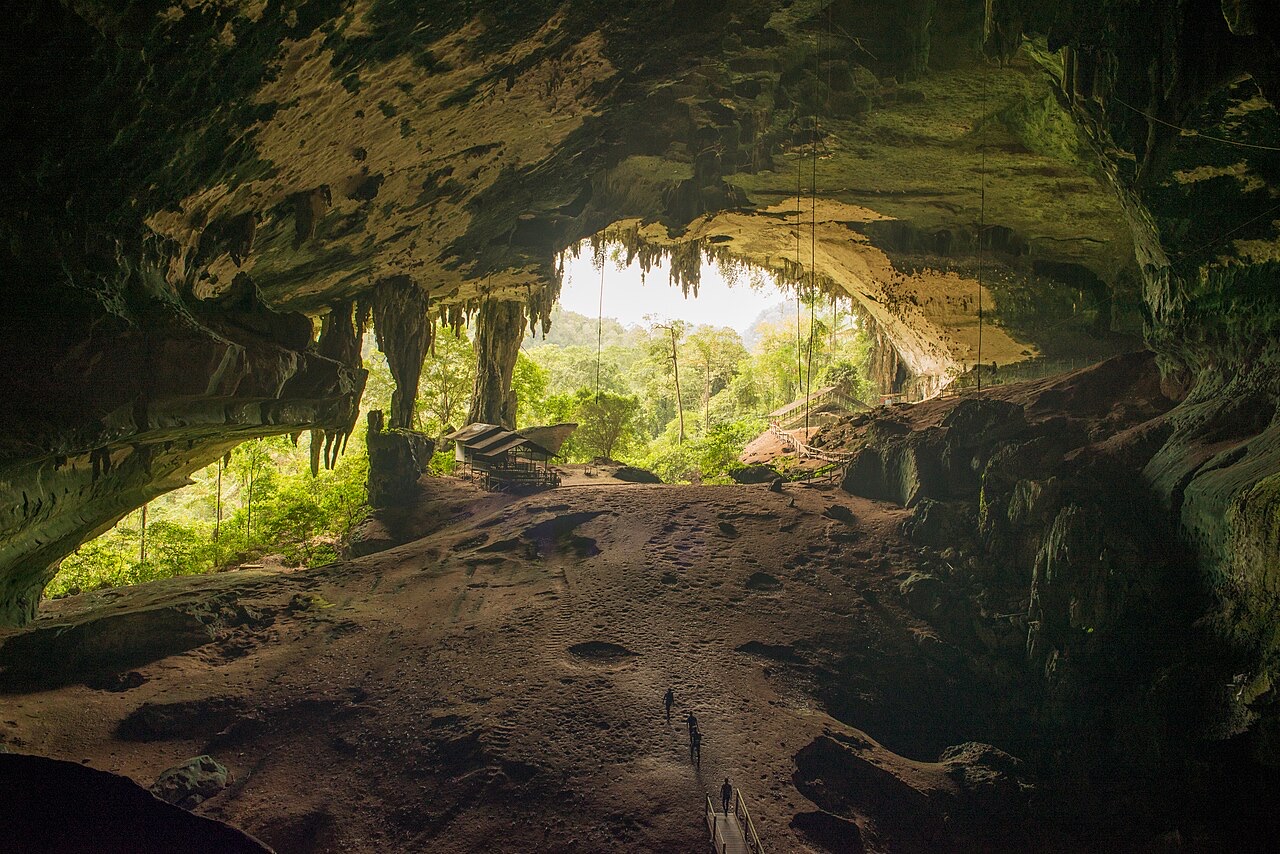
How do cave deposits reveal the habitats people used outside the cave?
The Great Cave at Niah is a sheltered archive of activity in the surrounding landscape. Sediments at its West Mouth contain human remains, stone artefacts, animal bones, charcoal and microscopic plant evidence. These materials entered by different routes: people carried food and tools, water transported particles, and natural biological processes added further remains. Reading them together requires separating the cave’s accumulation history from the habitats outside.
During the Late Pleistocene, pollen and animal evidence indicate a changing mosaic that retained rainforest elements. Cooler or drier episodes did not necessarily replace every forest patch with open savannah. The famous Deep Skull belongs within this wider record of people using tropical resources. Plant processing and hunting evidence challenge the assumption that rainforest was an unusable barrier, but they do not show that every resource was obtained in the same season or by the same group.
In the early Holocene, rising seas flooded parts of the Sunda shelf and altered nearby coastal environments. Tidal swamp forest and taller rainforest became important in the landscape around Niah. Cave deposits record visits, food processing and burial practices, followed by significant breaks and later changes in use. The two snapshots therefore compare documented episodes rather than an uninterrupted residence spanning tens of thousands of years. Niah’s importance lies in the interplay of ecological knowledge, changing habitats and a complicated archaeological record. Its evidence does not justify projecting one modern cultural identity across all the people represented in the caves.
[1] [2] [3] [4]Time windows and evidence
Older ages are on the left. Bars span the dated intervals. A dot marks a single age.
- Late Pleistocene forest foraging 0.035–0.05 Ma
- Rainforest beside advancing coastal wetlands 0.008–0.0115 Ma
- The West Mouth Deep Skull 0.039–0.045 Ma
- Hell Trench pollen and sediments 0.035–0.05 Ma
- Early Holocene West Mouth occupation deposits 0.008–0.0115 Ma
Researched windowsEvidence records
0.042 Ma · interval 0.035–0.05 Ma
Late Pleistocene forest foraging
The older window covers the part of Marine Isotope Stage 3 represented in the West Mouth environmental and archaeological sequence. Pollen, charcoal and fauna indicate a variable forest mosaic rather than a permanently uniform canopy. Human remains and artefacts document presence within this setting. The 50–35 ka interval is a regional teaching window; it neither dates every object identically nor claims to represent the earliest possible occupation of the entire cave complex.
[2] [1] [4]Locate this time in the atlas ↗Observed
Pollen, burnt material, artefacts and vertebrate remains occur in stratified West Mouth deposits.
Reconstructed
People used a landscape that retained forest habitats through climatic changes.
Uncertain
Accumulation, burning and vegetation change had multiple possible causes.
Evidence windows overlapping this state: 2. Overlap does not establish exact coexistence.
body fossil · Niah Caves ↗
The West Mouth Deep Skull
The Deep Skull was recovered from the West Mouth of Niah’s Great Cave in 1958. Its importance rests on human anatomy combined with the context and chronology of the surrounding deposits. The broad 45–39 ka window summarizes the commonly used late Pleistocene placement rather than a direct age for every fragment. Reanalysis of human remains and associated stratigraphy continues to refine interpretations. A single individual does not establish the ancestry or cultural identity of every later cave user.
body fossil · Niah Caves ↗
Hell Trench pollen and sediments
The Hell Trench sequence in the Great Cave’s West Mouth has yielded sedimentological and pollen evidence for changing environments during Marine Isotope Stage 3. Forest taxa occur alongside indicators of disturbance and more open conditions. This evidence helps test whether rainforest persisted locally during cooler phases. Pollen represents a transported and selectively preserved sample of vegetation, so its changing proportions require ecological and depositional interpretation rather than a literal census of trees immediately outside the entrance.
0.01 Ma · interval 0.008–0.0115 Ma
Rainforest beside advancing coastal wetlands
Early Holocene use of the West Mouth, approximately 11.5–8 ka in the published synthesis, coincided with coastal inundation and the development of tidal swamp and high-canopy forest in the surrounding region. Hunted animals and plant-processing evidence indicate continued use of varied resources. The cave was a place of repeated activity rather than a permanently occupied village demonstrated for the entire interval. Later Neolithic burials belong to a separate episode beyond this selected window.
[3] [1]Locate this time in the atlas ↗Observed
Ash-rich occupation deposits, hunted fauna and nearby pollen records document environmental and human activity.
Reconstructed
Foragers used rainforest and increasingly coastal wetland resources.
Uncertain
Visits varied in intensity, and gaps separate different episodes of cave use.
Evidence windows overlapping this state: 1. Overlap does not establish exact coexistence.
What this story cannot resolve
The marker denotes the Great Cave. Selected intervals do not encompass all archaeological discoveries in Niah, and a forest category includes a changing habitat mosaic.
Keep these ideas handy
Taphonomy
Studying what happens between an organism’s life, death, burial, preservation and eventual discovery. Explore the idea ↗
Climate proxy
A measured feature of a natural archive used to infer some aspect of past climate. Explore the idea ↗
Sea level & shorelines
The position of the sea relative to the land, affected by both water-volume changes and movements of the solid Earth. Explore the idea ↗
Sampling bias
Differences between the history of life and the subset preserved, exposed, collected, identified and published. Explore the idea ↗
The evidence notebook
body fossil · Niah Caves ↗
The West Mouth Deep Skull
The Deep Skull was recovered from the West Mouth of Niah’s Great Cave in 1958. Its importance rests on human anatomy combined with the context and chronology of the surrounding deposits. The broad 45–39 ka window summarizes the commonly used late Pleistocene placement rather than a direct age for every fragment. Reanalysis of human remains and associated stratigraphy continues to refine interpretations. A single individual does not establish the ancestry or cultural identity of every later cave user.
body fossil · Niah Caves ↗
Hell Trench pollen and sediments
The Hell Trench sequence in the Great Cave’s West Mouth has yielded sedimentological and pollen evidence for changing environments during Marine Isotope Stage 3. Forest taxa occur alongside indicators of disturbance and more open conditions. This evidence helps test whether rainforest persisted locally during cooler phases. Pollen represents a transported and selectively preserved sample of vegetation, so its changing proportions require ecological and depositional interpretation rather than a literal census of trees immediately outside the entrance.
locality · Niah Caves ↗
Early Holocene West Mouth occupation deposits
Ash, charcoal, worked materials and animal remains record early Holocene activity at the West Mouth. The fauna includes animals associated with forest habitats, while the broader palaeoenvironmental record documents coastal wetland expansion. These different lines of evidence connect human resource use with a landscape altered by rising seas. They support repeated visits and diverse subsistence practices, not a simple transition from foraging to farming at one universal date or an occupation without interruptions.
Follow the evidence
Sources & credits
- The Archaeological Heritage of Niah National Park’s Caves Complex ↗
UNESCO World Heritage Centre · Not stated
Use, credit & modifications
Reference only; original factual synthesis. No third-party prose or media reproduced.
Credit: UNESCO World Heritage Centre — The Archaeological Heritage of Niah National Park’s Caves Complex. Original educational synthesis; rounded age envelopes distinguish teaching windows from analytical errors. No media licence asserted for this reference. Photograph rights are documented separately.
- Modern humans in Sarawak during Oxygen Isotope Stage 3: palaeoenvironmental evidence from the Great Cave of Niah ↗
Hunt et al.; Journal of Archaeological Science · 2007
Use, credit & modifications
Reference only; original factual synthesis. No third-party prose or media reproduced.
Credit: Hunt et al.; Journal of Archaeological Science — Modern humans in Sarawak during Oxygen Isotope Stage 3: palaeoenvironmental evidence from the Great Cave of Niah. Original educational synthesis; rounded age envelopes distinguish teaching windows from analytical errors. No media licence asserted for this reference. Photograph rights are documented separately.
- Foraging-farming transitions at the Niah Caves, Sarawak, Borneo ↗
Barker et al.; Antiquity · 2011
Use, credit & modifications
Reference only; original factual synthesis. No third-party prose or media reproduced.
Credit: Barker et al.; Antiquity — Foraging-farming transitions at the Niah Caves, Sarawak, Borneo. Original educational synthesis; rounded age envelopes distinguish teaching windows from analytical errors. No media licence asserted for this reference. Photograph rights are documented separately.
- Rare Late Pleistocene-early Holocene human mandibles from the Niah Caves ↗
Curnoe et al.; PLOS ONE · 2018
Use, credit & modifications
Reference only; original factual synthesis. No third-party prose or media reproduced.
Credit: Curnoe et al.; PLOS ONE — Rare Late Pleistocene-early Holocene human mandibles from the Niah Caves. Original educational synthesis; rounded age envelopes distinguish teaching windows from analytical errors. No media licence asserted for this reference. Photograph rights are documented separately.
Follow the connections
 Asia
Indonesia ↗
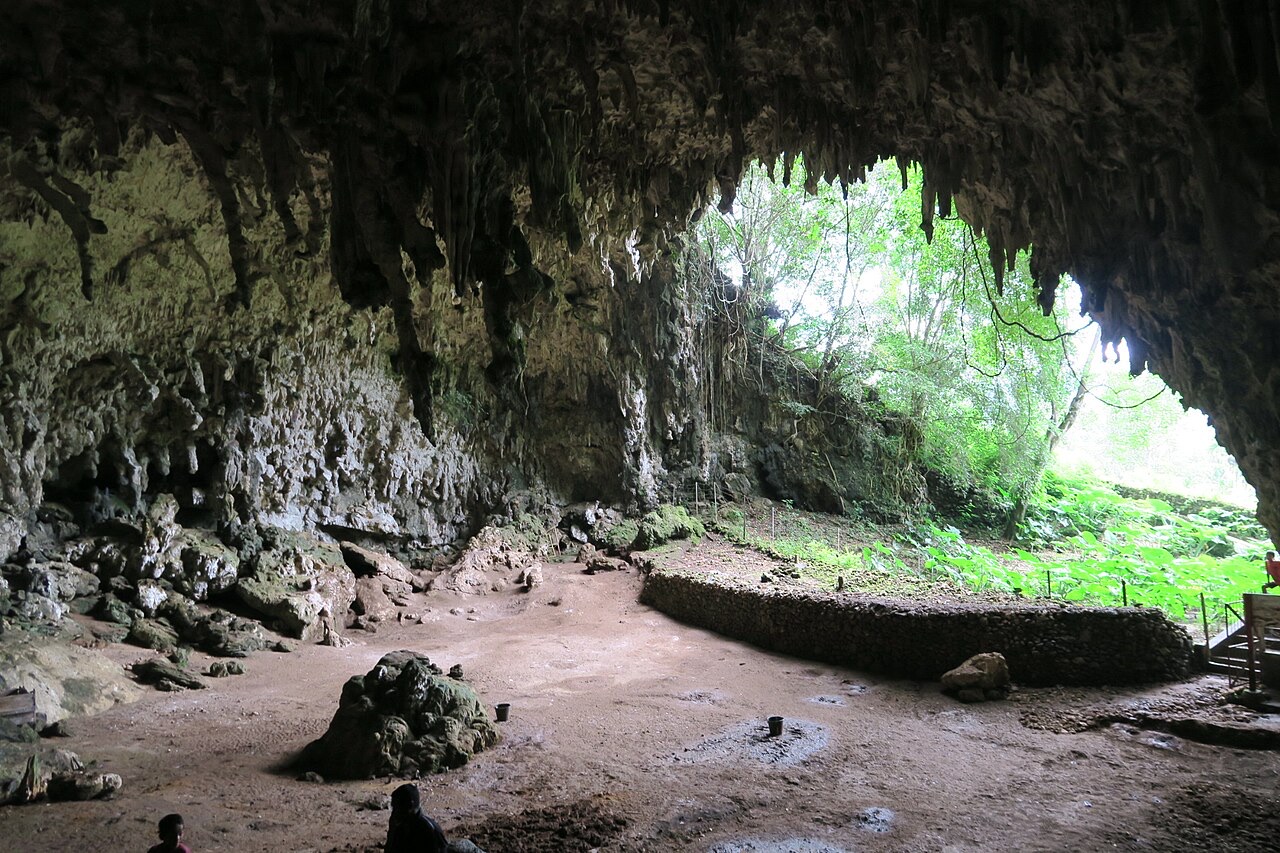
Flores: Mata Menge & Liang Bua
Middle Pleistocene stream deposits and much younger cave sediments preserve different chapters in the history of small-bodied hominins on Flores.
0.7 Ma → 0.08 Ma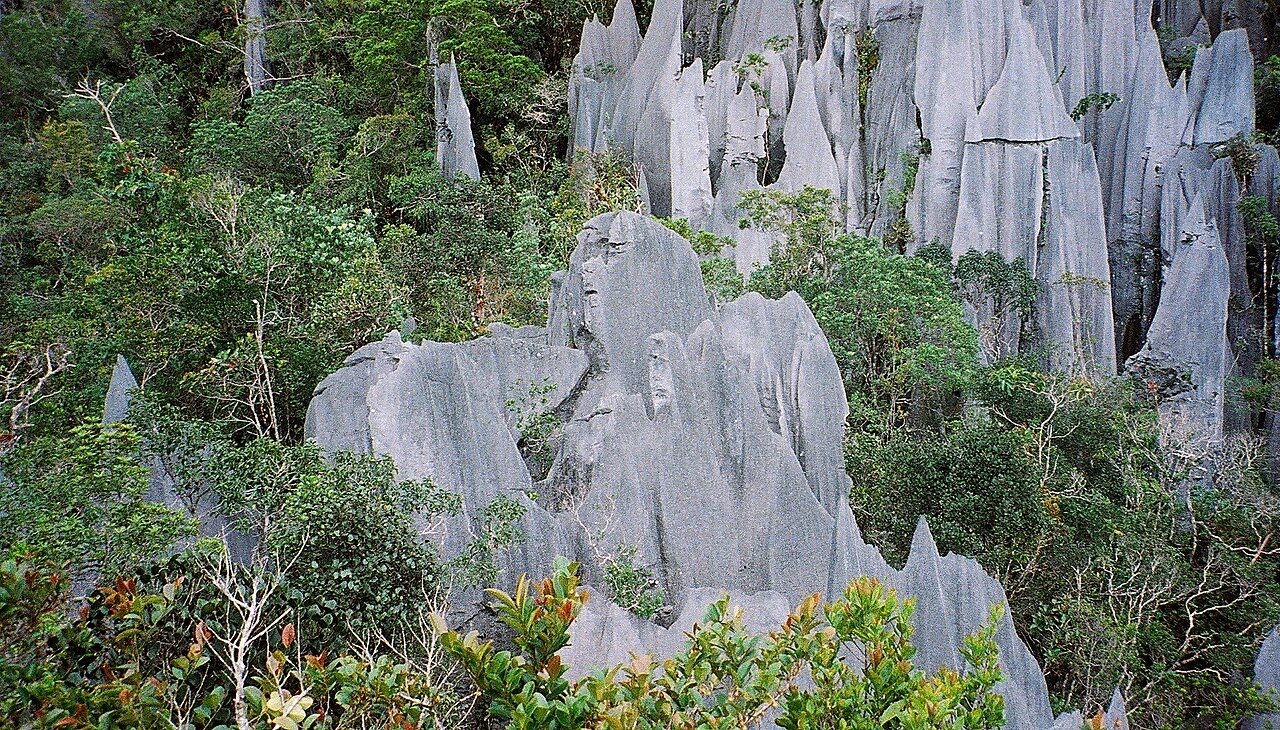 Asia
Malaysia ↗
Gunung Mulu
Melinau marine limestone forms the walls of caves whose younger mineral deposits record tropical environmental change.
28 Ma → 0.015 Ma