
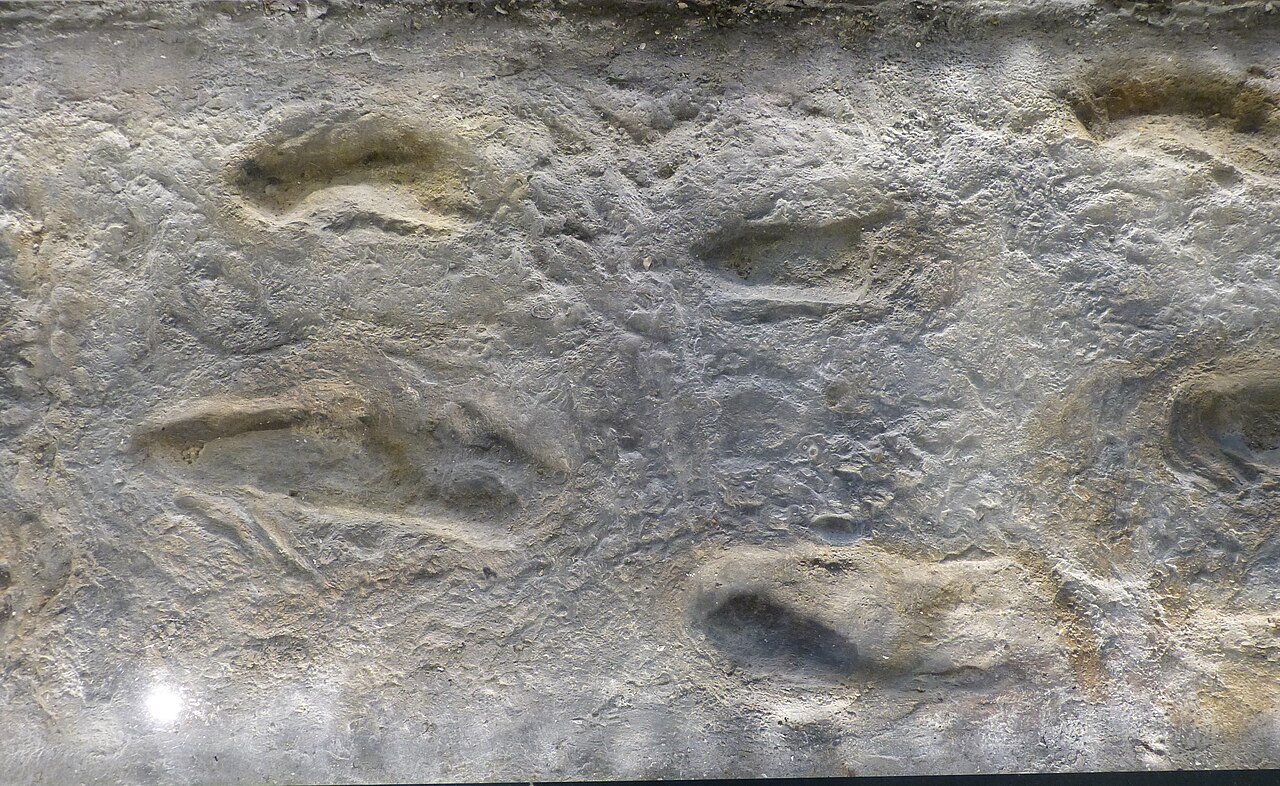
What changes when the record shifts from a moment of walking to a whole fossil assemblage?
Laetoli offers a rare contrast between two scales of evidence. A footprint surface preserves short episodes of movement, while a fossil assemblage samples organisms accumulated over a longer interval. Both belong to the same regional history, but they cannot answer the same questions. The trackway records contact with a particular substrate; the younger mammal record helps reconstruct the wider environment through anatomy and feeding adaptations.
The older window includes the Footprint Tuff and the famous Site G trackways, approximately 3.66 million years old. Hominins crossed damp volcanic ash, leaving direct evidence of bipedal movement. Other tracks and the wider sedimentary succession place that behaviour within a populated terrestrial landscape. Footprints are not portraits, however. Their size and spacing do not by themselves establish sex, kinship, family structure or an exact species identity.
Site A adds a further question. Detailed reassessment of its prints suggested a form of bipedal locomotion differing from the familiar Site G record. That interpretation requires comparative analysis and attention to preservation. The possibility of diversity is scientifically valuable precisely because the footprints do not come with associated complete skeletons that would settle every anatomical and taxonomic question.
About a million years later, the Upper Ndolanya Beds preserved another mammal assemblage. Studies of teeth and functional anatomy support a more open habitat than in the older record, although different proxies emphasize different aspects of the vegetation. A gap separates the two intervals, so the page does not invent a continuous ecological transition. Laetoli demonstrates how behavioural traces, body fossils and dated volcanic layers can be combined while retaining their different resolutions.
[1] [2] [3] [4]Time windows and evidence
Older ages are on the left. Bars span the dated intervals. A dot marks a single age.
- Hominins cross damp volcanic ash 3.63–3.85 Ma
- The more open Ndolanya landscape 2.6–2.7 Ma
- The Site G hominin trackways 3.63–3.85 Ma
- Site A’s contrasting footprints 3.63–3.85 Ma
- Upper Ndolanya ungulate assemblages 2.6–2.7 Ma
Researched windowsEvidence records
3.66 Ma · interval 3.63–3.85 Ma
Hominins cross damp volcanic ash
Volcanic ash settled within a terrestrial landscape and briefly supplied a surface capable of retaining footprints. The track horizon is approximately 3.66 Ma; the wider bracket represents the Upper Laetolil Beds. The scene depicts an ash-covered habitat, not animals walking through an active lava flow. Bipedal tracks establish movement while leaving the makers’ complete anatomy and identities less certain.
[1] [2]Locate this time in the atlas ↗Observed
Hominin and other animal tracks occur in the Footprint Tuff.
Reconstructed
Animals crossed a damp ash surface before it was preserved.
Uncertain
Trackmakers and social relationships are not uniquely identifiable from the impressions.
Evidence windows overlapping this state: 2. Overlap does not establish exact coexistence.
trace fossil · Laetoli ↗
The Site G hominin trackways
Footprints at Site G record bipedal movement across an ash surface. Their approximate age of 3.66 Ma is constrained by the volcanic succession. Tracks provide behavioural evidence that skeletal anatomy alone cannot capture, yet they do not preserve the maker’s complete body or family relationships. Attribution to a particular hominin group depends on comparison and the wider regional record.
trace fossil · Laetoli ↗
Site A’s contrasting footprints
Reanalysis of the Site A footprints found a pattern interpreted as evidence for a different form of hominin bipedal locomotion from the familiar Site G trackways. The conclusion draws on detailed footprint comparisons, not merely their unusual appearance. The site adds a question about locomotor diversity while retaining uncertainty about the taxonomic identity of the maker. It does not identify a newly named species from footprints alone.
2.66 Ma · interval 2.6–2.7 Ma
The more open Ndolanya landscape
The Upper Ndolanya fauna records a more open landscape with grassland or bushland components than the older Laetolil record. The schematic scene includes discontinuous woody vegetation without claiming a measured plant community. Teeth and functional anatomy provide complementary environmental clues. The interval is a rounded bracket around the published 2.66 Ma age, separated from the older beds by a substantial gap.
[2] [3] [4]Locate this time in the atlas ↗Observed
Ungulate assemblages differ from those in the older beds.
Reconstructed
Open-habitat conditions became more important in the later sampled ecosystem.
Uncertain
Different proxies do not yield one precise vegetation map.
Evidence windows overlapping this state: 1. Overlap does not establish exact coexistence.
What this story cannot resolve
The two intervals are separated by a stratigraphic gap. Footprints do not identify a family structure, and the younger open landscape must not be rendered as a continuous closed forest.
Keep these ideas handy
Trace fossils
Preserved evidence of an organism’s activity, such as a footprint, burrow, feeding mark or coprolite. Explore the idea ↗
Climate proxy
A measured feature of a natural archive used to infer some aspect of past climate. Explore the idea ↗
Sampling bias
Differences between the history of life and the subset preserved, exposed, collected, identified and published. Explore the idea ↗
The evidence notebook
trace fossil · Laetoli ↗
The Site G hominin trackways
Footprints at Site G record bipedal movement across an ash surface. Their approximate age of 3.66 Ma is constrained by the volcanic succession. Tracks provide behavioural evidence that skeletal anatomy alone cannot capture, yet they do not preserve the maker’s complete body or family relationships. Attribution to a particular hominin group depends on comparison and the wider regional record.
trace fossil · Laetoli ↗
Site A’s contrasting footprints
Reanalysis of the Site A footprints found a pattern interpreted as evidence for a different form of hominin bipedal locomotion from the familiar Site G trackways. The conclusion draws on detailed footprint comparisons, not merely their unusual appearance. The site adds a question about locomotor diversity while retaining uncertainty about the taxonomic identity of the maker. It does not identify a newly named species from footprints alone.
locality · Laetoli ↗
Upper Ndolanya ungulate assemblages
Mammal teeth and other remains from the Upper Ndolanya Beds record a younger ecological chapter. Analyses of feeding and functional anatomy indicate a greater contribution from open habitats than in the older Laetolil record. Different methods describe that landscape somewhat differently, so no exact percentage of grass cover is assigned here. The key comparison is ecological change across a substantial gap, not continuous transformation captured in every intervening bed.
Follow the evidence
Sources & credits
- Footprint evidence of early hominin locomotor diversity at Laetoli, Tanzania ↗
Nature · 2021
Use, credit & modifications
Reference only; no source text, figures or photographs reproduced. Original educational synthesis.
Credit: Nature. Original synthesis with explicit approximate teaching windows. No source asset reuse; territorial permissions not applicable.
- Stratigraphy, mineralogy and geochemistry of the Upper Laetolil tuffs ↗
Journal of African Earth Sciences · 2019
Use, credit & modifications
Reference only; no source text, figures or photographs reproduced. Original educational synthesis.
Credit: Journal of African Earth Sciences. Original synthesis with explicit approximate teaching windows. No source asset reuse; territorial permissions not applicable.
- Feeding ecology and niche partitioning of the Laetoli ungulate faunas ↗
University of Hamburg / Springer · 2011
Use, credit & modifications
Reference only; no source text, figures or photographs reproduced. Original educational synthesis.
Credit: University of Hamburg / Springer. Original synthesis with explicit approximate teaching windows. No source asset reuse; territorial permissions not applicable.
- Paleoecology of Laetoli, Tanzania ↗
Cambridge University Press · 2022
Use, credit & modifications
Reference only; no source text, figures or photographs reproduced. Original educational synthesis.
Credit: Cambridge University Press. Original synthesis with explicit approximate teaching windows. No source asset reuse; territorial permissions not applicable.
Follow the connections
 Africa
Ethiopia ↗
Hadar & the Afar Rift
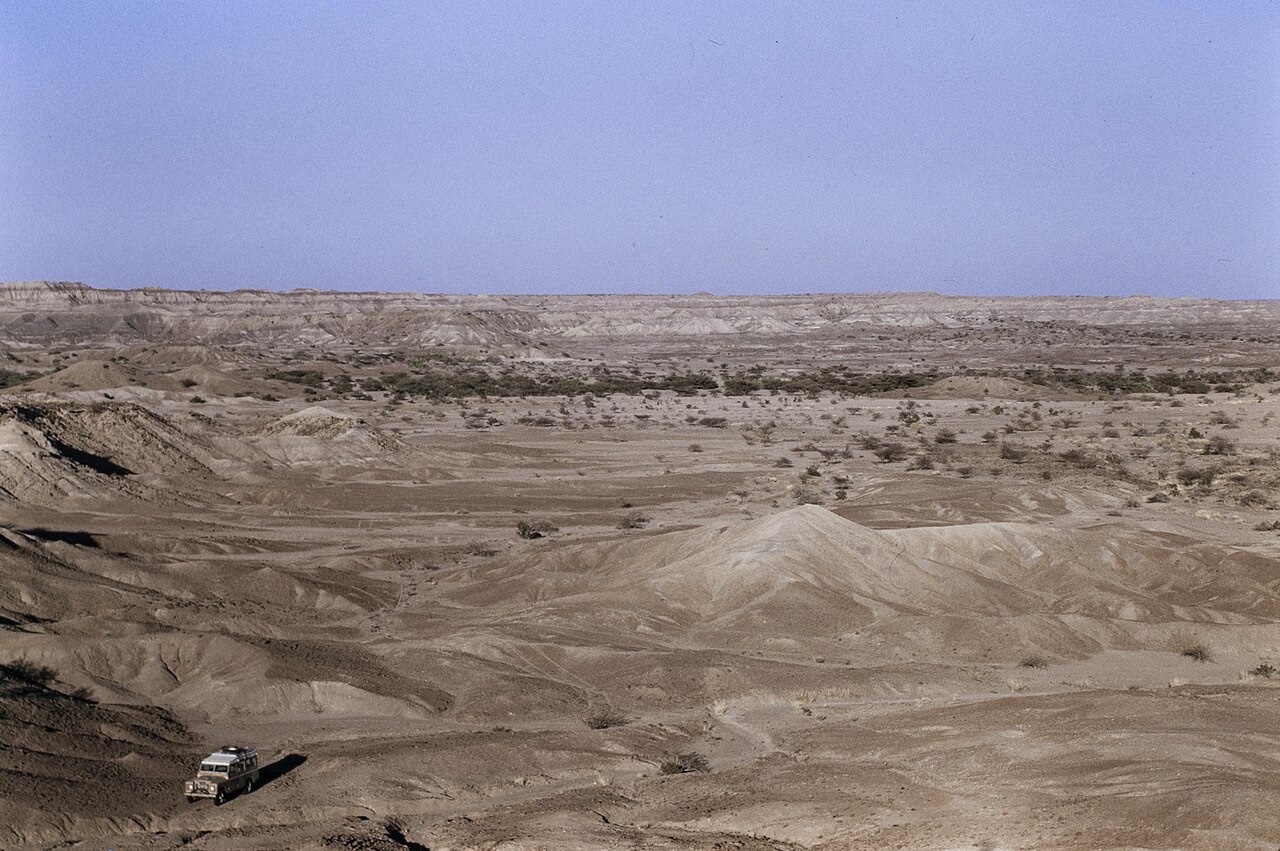
Lucy’s skeleton belongs within a wider Pliocene record of lakes, river margins, pollen and changing vegetation in the Afar basin.
3.2 Ma → Today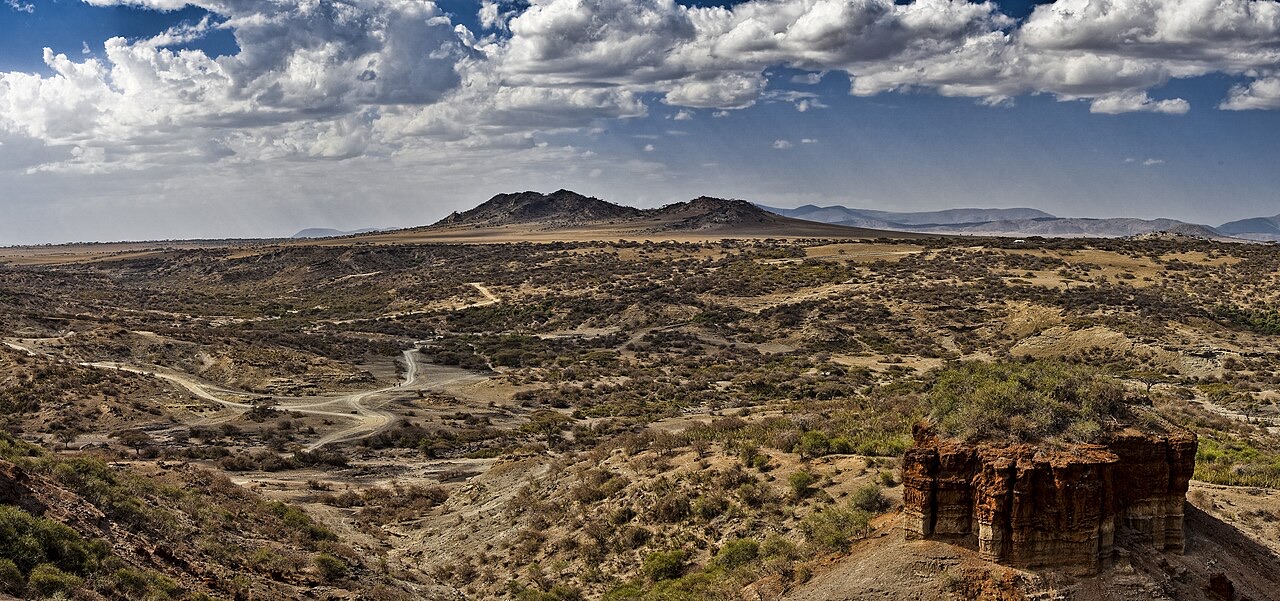 Africa
Tanzania ↗
Olduvai Gorge
Post-eruption rivers at Ewass Oldupa and younger spring-fed woodland at FLK Zinj reveal local habitat changes within an Early Pleistocene rift basin.
2.03 Ma → 1.84 Ma