
What can a famous skeleton tell us—and what must the surrounding sediment supply?
The partial skeleton AL 288-1, often called Lucy or Dinkinesh, comes from Hadar and belongs to Australopithecus afarensis. At about 3.2 million years old, it preserves parts of the pelvis and lower limb that help explain how the individual carried its weight while walking upright. Parts of the upper body retain features relevant to climbing. The skeleton anchors those anatomical questions. Evidence for the surrounding vegetation comes from other parts of the site.
The habitat comes into focus when different evidence is added. Pollen recovered from a sequence of lake-related deposits records grasses, sedges, reeds and trees or shrubs in changing proportions. River transport means pollen can arrive from beyond the immediate shore. Sediment records the water bodies that collected it. Together, these clues favour a variable landscape containing wetter areas and woody vegetation rather than a simple image of uninterrupted open savanna. The sequence matters: an environmental setting can change while a named hominin species persists.
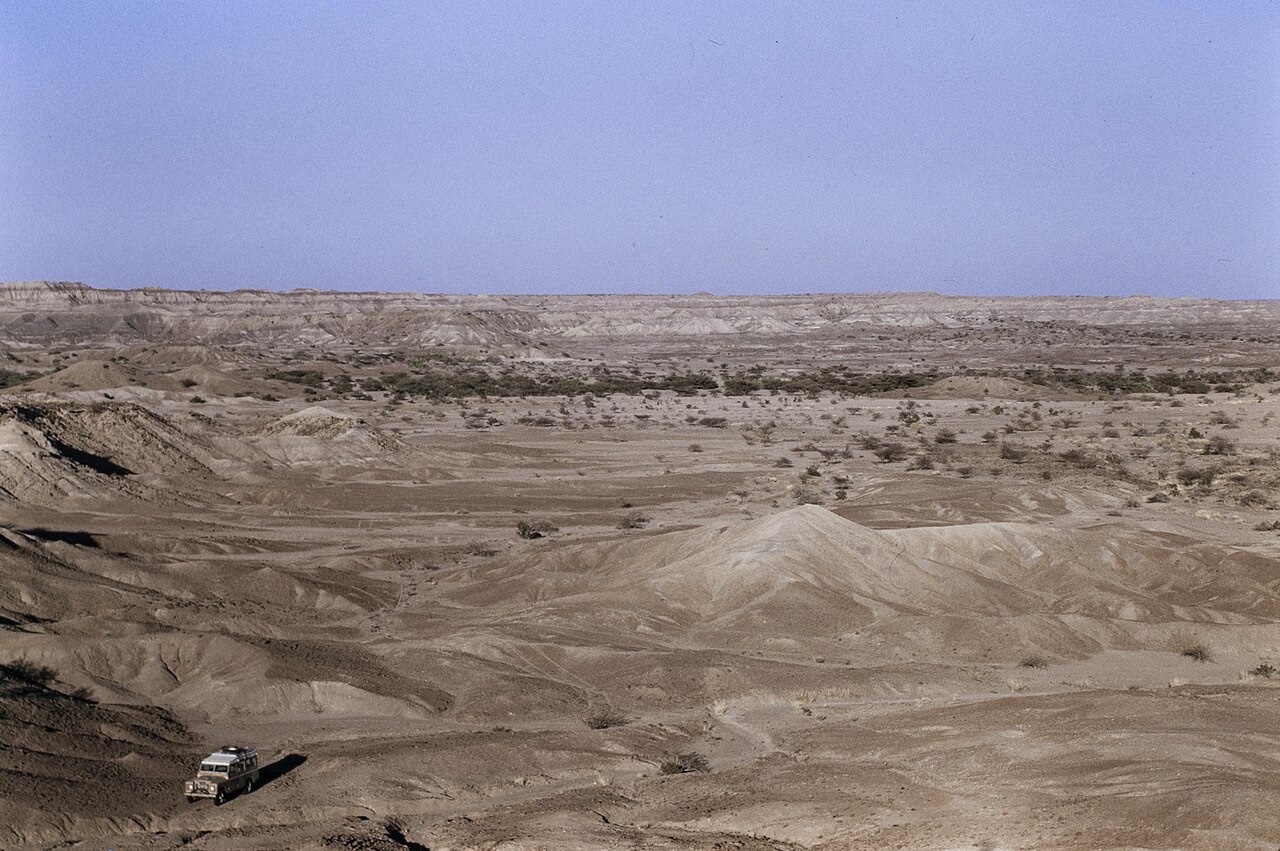
The present Afar landscape exposes portions of that earlier basin in a much drier setting. Erosion is part of why fossils can now be found, but exposed badlands should not be projected directly backward in time. Nor does environmental change automatically demonstrate the cause of a particular evolutionary adaptation. A responsible reconstruction separates anatomy, local vegetation, broader climatic interpretation and proposed evolutionary mechanisms. Our two states contrast the fossil-bearing landscape with its modern setting, leaving the enormous intervening history visibly unfilled.
[1] [2] [3] [4]Time windows and evidence
Older ages are on the left. Bars span the dated intervals. A dot marks a single age.
- Lake margins in a varied Pliocene landscape 2.95–3.4 Ma
- An exposed, arid rift basin Today
- AL 288-1: Lucy / Dinkinesh 3.16–3.22 Ma
- The Hadar Formation pollen sequence 2.95–3.4 Ma
- AL 333: multiple individuals at Hadar 3.15–3.25 Ma
Researched windowsEvidence records
3.2 Ma · interval 2.95–3.4 Ma
Lake margins in a varied Pliocene landscape
Hadar’s sedimentary record includes lake and river-related deposits as well as volcanic horizons useful for dating. Fossil pollen indicates changing combinations of wetland herbs, grasses and woody plants. The scene shows a lake margin as one element of a regional habitat mosaic; it does not suggest that every individual lived at the water’s edge. A single representative age stands for a succession spanning hundreds of thousands of years.
[1] [2]Locate this time in the atlas ↗Observed
Hominin bones, lake sediments and pollen occur in the Hadar Formation.
Reconstructed
Wetlands, wooded areas and more open vegetation varied through time and across the basin.
Uncertain
Pollen is transported and unevenly preserved; a species’ exact preferred habitat cannot be inferred from one assemblage.
Evidence windows overlapping this state: 3. Overlap does not establish exact coexistence.
body fossil · Hadar & the Afar Rift ↗
AL 288-1: Lucy / Dinkinesh
This partial Australopithecus afarensis skeleton from Hadar preserves parts of the pelvis, limbs and other regions of the body. It is especially informative because multiple anatomical clues can be compared within one individual. Features associated with upright walking occur alongside traits relevant to climbing. Its age is rounded here to about 3.2 million years; the illustrated interval is educational, not a new statistical confidence interval.
locality · Hadar & the Afar Rift ↗
The Hadar Formation pollen sequence
Pollen sampled from successive sediment horizons allows an environmental comparison through time. Aquatic and wetland plants indicate local water margins, while other grains may have arrived from a wider catchment. Changes in the assemblage offer evidence of changing vegetation without turning every percentage into a map of plant cover. This sequence is therefore a companion to hominin fossils, rather than scenery inferred from their appearance.
locality · Hadar & the Afar Rift ↗
AL 333: multiple individuals at Hadar
The AL 333 assemblage contains remains of multiple Australopithecus afarensis individuals. Its value is different from that of a single associated skeleton: it samples variation within a local fossil population. Nicknames suggesting a family should not be mistaken for evidence of kinship. The collection can inform anatomical comparisons, while the circumstances that brought individuals into the deposit require a separate taphonomic argument.
Today · interval Today
An exposed, arid rift basin
Today the Afar region provides an exposed setting for investigating Pliocene sediment. The contrast with the older state highlights environmental change without implying that the intervening millions of years followed a simple drying trend. This modern locator scene is not a fossil ecosystem reconstruction. The ancient evidence cards remain records of the older deposits, even though the rocks containing them are accessible in the present landscape.
[3] [5]Locate this time in the atlas ↗Observed
Modern Hadar is much drier than the habitats inferred from its Pliocene pollen.
Reconstructed
Present erosion reveals parts of an older sedimentary archive.
Uncertain
A modern-to-Pliocene contrast does not specify the timing or causes of every intervening change.
Evidence windows overlapping this state: 0. Overlap does not establish exact coexistence.
No curated evidence record overlaps this window. The full notebook for this region appears below.
What this story cannot resolve
Coordinates are a rounded modern regional locator. Hominin anatomy does not establish direct ancestry to living people or a single environmental cause of human evolution.
Keep these ideas handy
Taphonomy
Studying what happens between an organism’s life, death, burial, preservation and eventual discovery. Explore the idea ↗
Radiometric dating
Estimating the time of a geological event from radioactive decay and the isotopic composition of a suitable material. Explore the idea ↗
Climate proxy
A measured feature of a natural archive used to infer some aspect of past climate. Explore the idea ↗
The evidence notebook
body fossil · Hadar & the Afar Rift ↗
AL 288-1: Lucy / Dinkinesh
This partial Australopithecus afarensis skeleton from Hadar preserves parts of the pelvis, limbs and other regions of the body. It is especially informative because multiple anatomical clues can be compared within one individual. Features associated with upright walking occur alongside traits relevant to climbing. Its age is rounded here to about 3.2 million years; the illustrated interval is educational, not a new statistical confidence interval.
locality · Hadar & the Afar Rift ↗
The Hadar Formation pollen sequence
Pollen sampled from successive sediment horizons allows an environmental comparison through time. Aquatic and wetland plants indicate local water margins, while other grains may have arrived from a wider catchment. Changes in the assemblage offer evidence of changing vegetation without turning every percentage into a map of plant cover. This sequence is therefore a companion to hominin fossils, rather than scenery inferred from their appearance.
locality · Hadar & the Afar Rift ↗
AL 333: multiple individuals at Hadar
The AL 333 assemblage contains remains of multiple Australopithecus afarensis individuals. Its value is different from that of a single associated skeleton: it samples variation within a local fossil population. Nicknames suggesting a family should not be mistaken for evidence of kinship. The collection can inform anatomical comparisons, while the circumstances that brought individuals into the deposit require a separate taphonomic argument.
Follow the evidence
Sources & credits
- Australopithecus afarensis ↗
Smithsonian Institution Human Origins Program · Not stated
Use, credit & modifications
Reference only. No third-party prose, figures, photographs or datasets reproduced; factual interpretation written originally for this atlas.
Credit: Smithsonian Institution Human Origins Program — Australopithecus afarensis. Original educational synthesis; geological ages rounded into explicitly labelled teaching intervals. No licensed media incorporated; no territorial reuse permission asserted.
- High-resolution vegetation and climate change associated with Pliocene Australopithecus afarensis ↗
Bonnefille et al.; PNAS · 2004
Use, credit & modifications
Reference only. No third-party prose, figures, photographs or datasets reproduced; factual interpretation written originally for this atlas.
Credit: Bonnefille et al.; PNAS — High-resolution vegetation and climate change associated with Pliocene Australopithecus afarensis. Original educational synthesis; geological ages rounded into explicitly labelled teaching intervals. No licensed media incorporated; no territorial reuse permission asserted.
- Pliocene pollen data from Hadar, Ethiopia ↗
Bonnefille et al.; USGS Open-File Report 94-023 · 1994
Use, credit & modifications
Reference only. No third-party prose, figures, photographs or datasets reproduced; factual interpretation written originally for this atlas.
Credit: Bonnefille et al.; USGS Open-File Report 94-023 — Pliocene pollen data from Hadar, Ethiopia. Original educational synthesis; geological ages rounded into explicitly labelled teaching intervals. No licensed media incorporated; no territorial reuse permission asserted.
- Australopithecus afarensis ↗
Australian Museum · Not stated
Use, credit & modifications
Reference only. No third-party prose, figures, photographs or datasets reproduced; factual interpretation written originally for this atlas.
Credit: Australian Museum — Australopithecus afarensis. Original educational synthesis; geological ages rounded into explicitly labelled teaching intervals. No licensed media incorporated; no territorial reuse permission asserted.
- How Do We Know Hadar’s Environment Changed? ↗
Smithsonian Institution Human Origins Program · Not stated
Use, credit & modifications
Reference only. No source text, photographs, figures or datasets reproduced. Original factual synthesis.
Credit: Smithsonian Institution Human Origins Program — How Do We Know Hadar’s Environment Changed?. Facts paraphrased into original educational text. No asset reuse requested; territorial permissions not applicable.
Follow the connections
 Oceania
Australia ↗
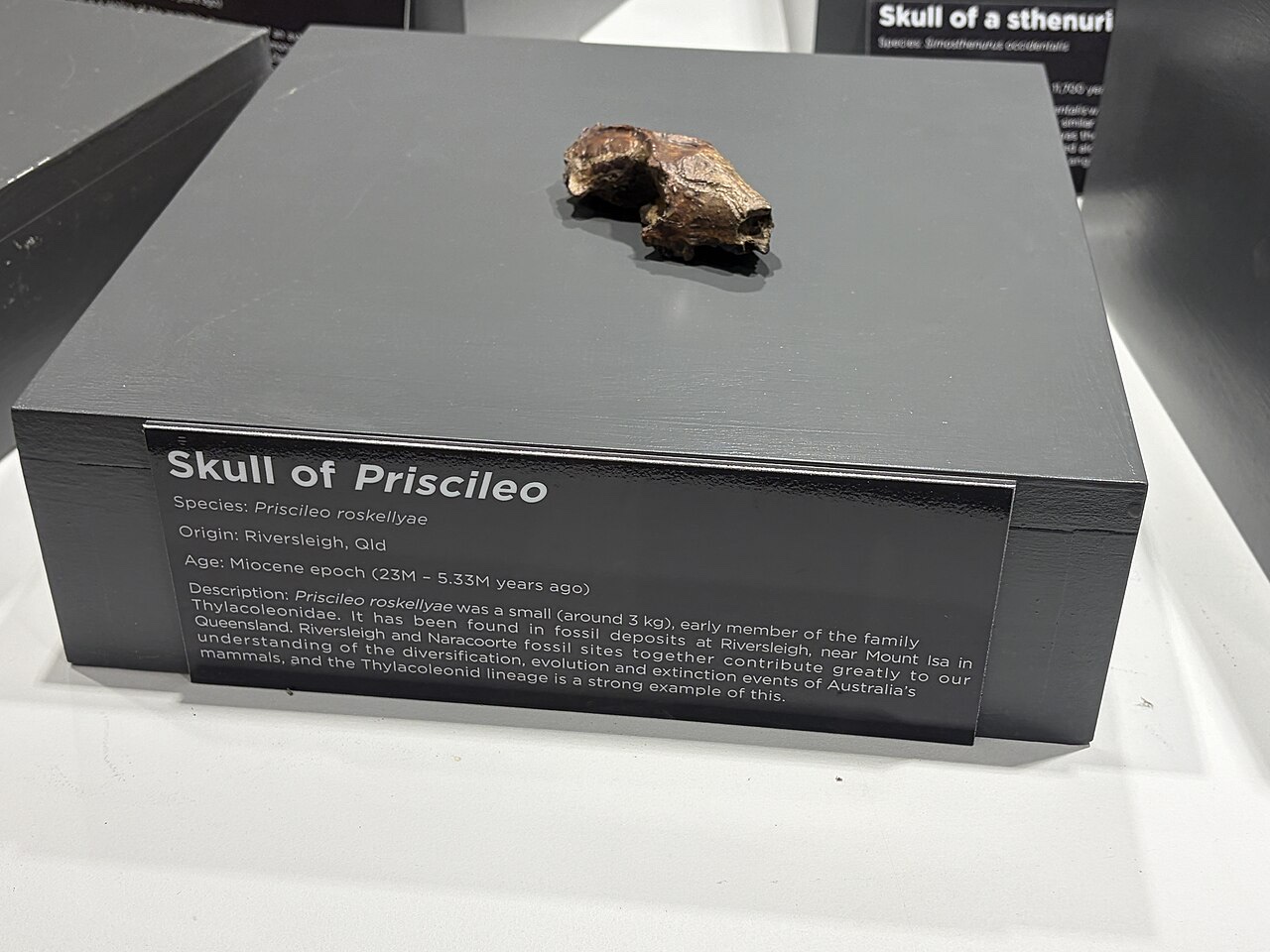
Riversleigh
Riversleigh’s fossil deposits connect wetter Oligocene–Miocene habitats with later faunas, revealing Australian mammals, birds, reptiles and bats.
23 Ma → 2.1 Ma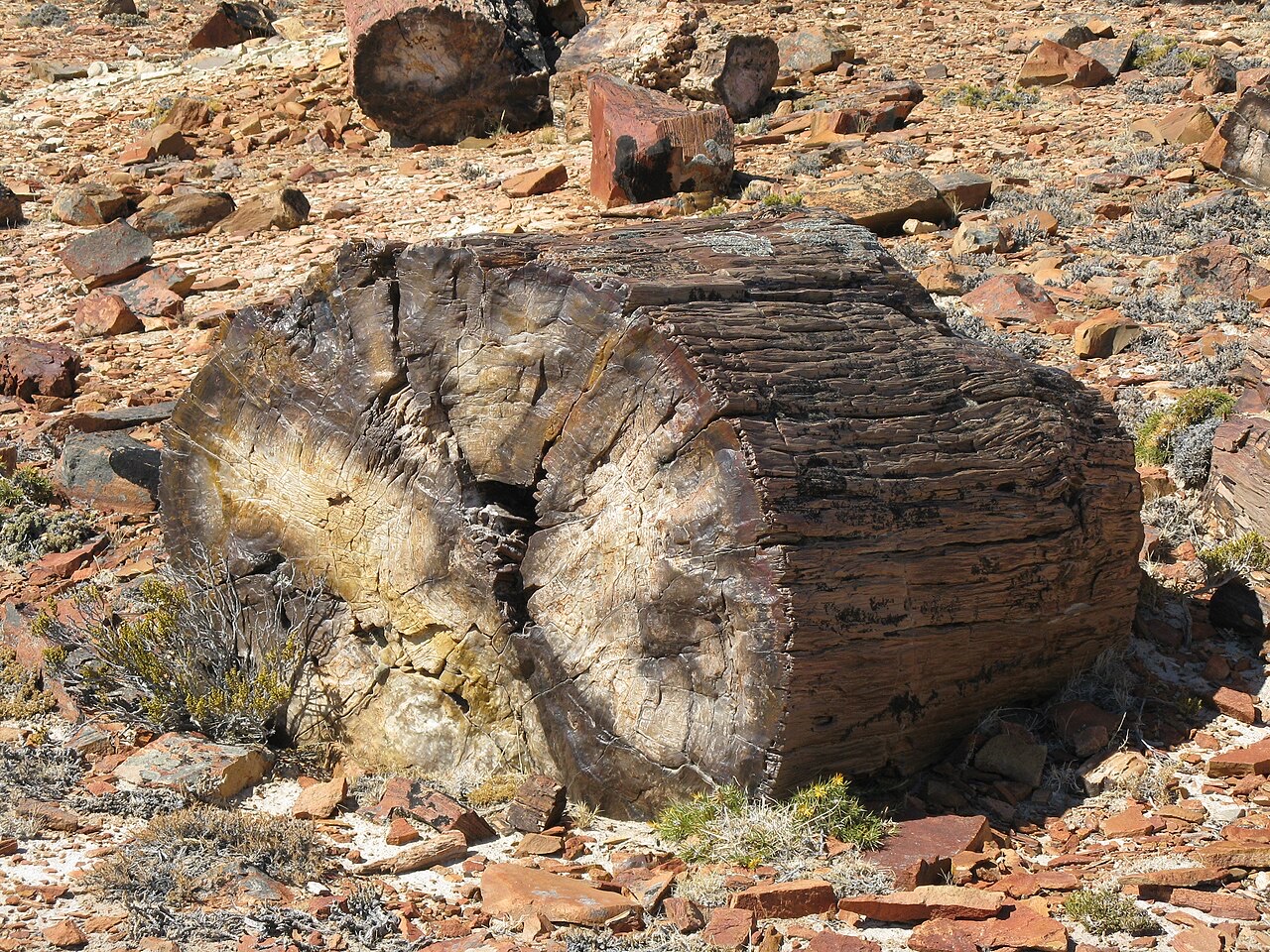 South America
Argentina ↗
Southern Patagonia
Jurassic petrified conifers and Miocene mammals reveal two distinct southern Patagonian ecosystems without treating “forest” as an unchanging habitat.
160 Ma → 17 Ma