
How closely can fossils show that different early humans shared a habitat?
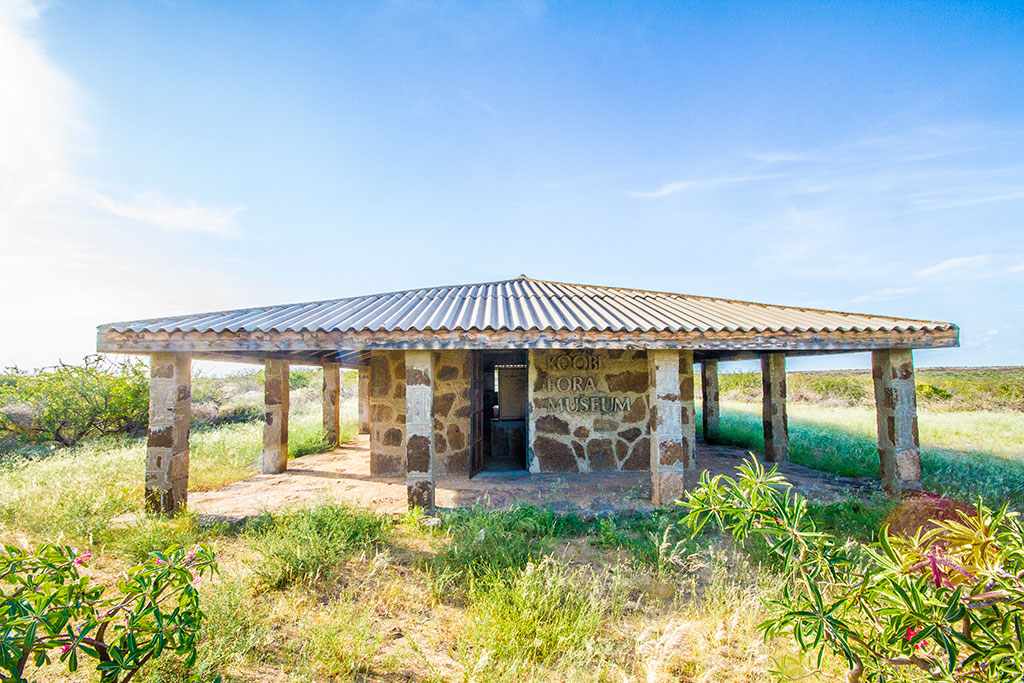
Koobi Fora preserves many kinds of evidence within a changing lake-basin landscape. A skull, a thigh bone and a trackway each sample a different aspect of an animal’s life. They also represent different intervals. Bringing them together can illuminate human evolution, but only if their identities and stratigraphic contexts remain separate. The goal is not to construct one ideal early human from every fragment found in the region.
The older window includes fossils around 1.9 million years old. KNM-ER 1470 is important for its cranial and facial anatomy and is commonly associated with Homo rudolfensis. KNM-ER 1481 is a femur that provides a different kind of information about limb structure and locomotion. These are distinct specimens, not parts of one demonstrated individual. Their comparison helps reveal diversity without requiring a simple ladder from one skull shape to another.
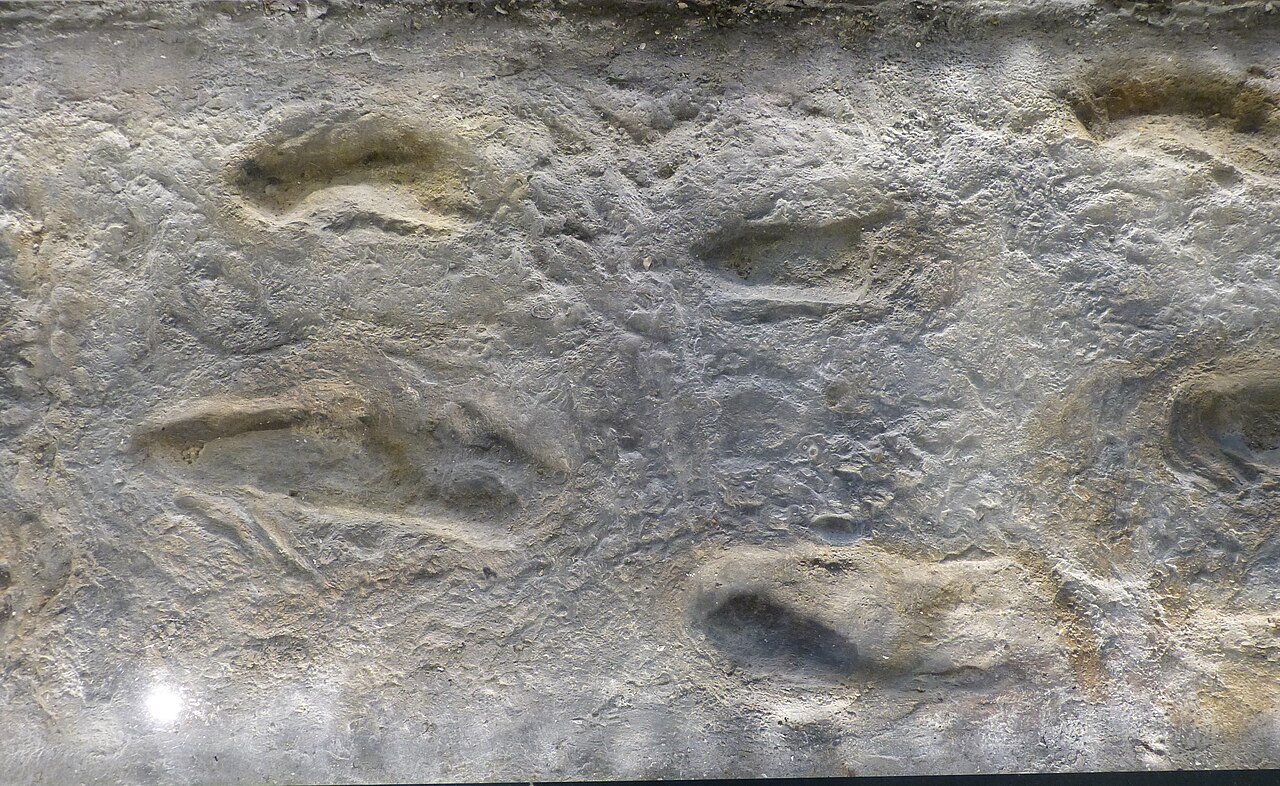
The younger window turns to footprints preserved near the lakeshore. A study of the FE22 surface identified two patterns of bipedal locomotion, interpreted as evidence that different hominins used a shared habitat around 1.5 million years ago. The surface brings the observations much closer in time than fossils separated by a thick succession. Even so, a shared surface does not prove a direct encounter, cooperation or family relationship.
Volcanic layers and sedimentary relationships supply the chronological framework. Their dates must be connected carefully to the fossil-bearing beds, while shorelines and river mouths shifted across the basin. The schematic maps therefore emphasize a lake-margin system without tracing a precise ancient coast. Koobi Fora shows why anatomy, behaviour and geological context become most powerful when combined without pretending that they have identical resolution.
[1] [2] [3] [4]Time windows and evidence
Older ages are on the left. Bars span the dated intervals. A dot marks a single age.
- Early hominins in a lake-basin landscape 1.8–2 Ma
- Different walkers leave tracks on one surface 1.4–1.6 Ma
- KNM-ER 1470’s cranial anatomy 1.8–2 Ma
- The KNM-ER 1481 thigh bone 1.8–1.95 Ma
- Two locomotor patterns on the FE22 surface 1.4–1.6 Ma
Researched windowsEvidence records
1.9 Ma · interval 1.8–2 Ma
Early hominins in a lake-basin landscape
The basin’s terrestrial and lake-margin environments supplied a fossil record of early hominin anatomical variation. Cranial and limb remains provide complementary observations, but are not assembled here as one individual. The broad window brackets specimens near 1.9 Ma rather than claiming simultaneous occurrence in one small habitat. The shore shown is conceptual; lake size and position changed through time.
[1] [2]Locate this time in the atlas ↗Observed
Separate cranial and limb fossils occur in the regional sequence.
Reconstructed
Multiple aspects of early hominin biology can be reconstructed in a changing basin.
Uncertain
Exact population relationships and local habitat preferences remain incompletely resolved.
Evidence windows overlapping this state: 2. Overlap does not establish exact coexistence.
body fossil · Koobi Fora ↗
KNM-ER 1470’s cranial anatomy
The skull KNM-ER 1470 contributes to the anatomical evidence used to distinguish early Homo populations. Differences in facial and dental anatomy matter alongside overall size. A large skull is not, by itself, proof of a male individual or a separate species. Comparisons with other fossils underlie its usual association with Homo rudolfensis, while broader classification remains a scientific discussion.
body fossil · Koobi Fora ↗
The KNM-ER 1481 thigh bone
The femur KNM-ER 1481 provides evidence about the body and locomotion of an early hominin at approximately 1.89 Ma. Limb anatomy can answer questions different from those addressed by a skull. It does not belong to KNM-ER 1470 simply because the specimens were found in the same broad region. Associations among isolated bones must be established rather than assembled into a convenient composite individual.
1.5 Ma · interval 1.4–1.6 Ma
Different walkers leave tracks on one surface
A younger surface preserved hominin footprints interpreted as two distinct locomotor patterns. The approximately 1.5 Ma example provides short-duration behavioural evidence within the broader dated tuff succession. The illustration represents a shallow lakeshore substrate capable of retaining tracks. It does not identify named individuals, demonstrate an encounter or treat every trace as equally diagnostic of species.
[3] [4]Locate this time in the atlas ↗Observed
Contrasting footprint forms occur together on a documented surface.
Reconstructed
Different hominins used the same local habitat within a short interval.
Uncertain
Species attribution is inferred, and precise synchrony within the surface is limited.
Evidence windows overlapping this state: 1. Overlap does not establish exact coexistence.
What this story cannot resolve
The region contains many collection areas. Fossils listed together are not automatically parts of one individual or simultaneous community. Footprint species identifications remain interpretations.
Keep these ideas handy
Trace fossils
Preserved evidence of an organism’s activity, such as a footprint, burrow, feeding mark or coprolite. Explore the idea ↗
Radiometric dating
Estimating the time of a geological event from radioactive decay and the isotopic composition of a suitable material. Explore the idea ↗
Evolutionary tree
A branching hypothesis of relationships among organisms, inferred from shared evidence rather than arranged as a ladder of progress. Explore the idea ↗
The evidence notebook
body fossil · Koobi Fora ↗
KNM-ER 1470’s cranial anatomy
The skull KNM-ER 1470 contributes to the anatomical evidence used to distinguish early Homo populations. Differences in facial and dental anatomy matter alongside overall size. A large skull is not, by itself, proof of a male individual or a separate species. Comparisons with other fossils underlie its usual association with Homo rudolfensis, while broader classification remains a scientific discussion.
body fossil · Koobi Fora ↗
The KNM-ER 1481 thigh bone
The femur KNM-ER 1481 provides evidence about the body and locomotion of an early hominin at approximately 1.89 Ma. Limb anatomy can answer questions different from those addressed by a skull. It does not belong to KNM-ER 1470 simply because the specimens were found in the same broad region. Associations among isolated bones must be established rather than assembled into a convenient composite individual.
trace fossil · Koobi Fora ↗
Two locomotor patterns on the FE22 surface
Footprints from the FE22 surface, approximately 1.5 Ma old, were analysed as evidence for two different patterns of hominin bipedal movement in a shared habitat. A single surface offers unusually close temporal context compared with fossils separated by many layers. Assigning those patterns to named species remains an inference based on regional anatomy and comparative footprints; the impressions do not preserve complete trackmaker skeletons.
Follow the evidence
Sources & credits
- KNM-ER 1470 ↗
Smithsonian Human Origins Program · Not stated
Use, credit & modifications
Reference only; no source text, figures or photographs reproduced. Original educational synthesis.
Credit: Smithsonian Human Origins Program. Original synthesis with explicit approximate teaching windows. No source asset reuse; territorial permissions not applicable.
- KNM-ER 1481 ↗
Smithsonian Human Origins Program · Not stated
Use, credit & modifications
Reference only; no source text, figures or photographs reproduced. Original educational synthesis.
Credit: Smithsonian Human Origins Program. Original synthesis with explicit approximate teaching windows. No source asset reuse; territorial permissions not applicable.
- Footprint evidence for locomotor diversity and shared habitats among early Pleistocene hominins ↗
Science; Liverpool John Moores University repository · 2024
Use, credit & modifications
Reference only; no source text, figures or photographs reproduced. Original educational synthesis.
Credit: Science; Liverpool John Moores University repository. Original synthesis with explicit approximate teaching windows. No source asset reuse; territorial permissions not applicable.
- High-resolution argon geochronology of the Koobi Fora Tuff Complex ↗
Quaternary Geochronology · 2025
Use, credit & modifications
Reference only; no source text, figures or photographs reproduced. Original educational synthesis.
Credit: Quaternary Geochronology. Original synthesis with explicit approximate teaching windows. No source asset reuse; territorial permissions not applicable.
Follow the connections
 Africa
Tanzania ↗
Laetoli
The famous 3.66 Ma ash trackways record behaviour. Younger Upper Ndolanya fossils, around 2.66 Ma, document a different ecological chapter with more open-habitat mammal associations.
3.66 Ma → 2.66 Ma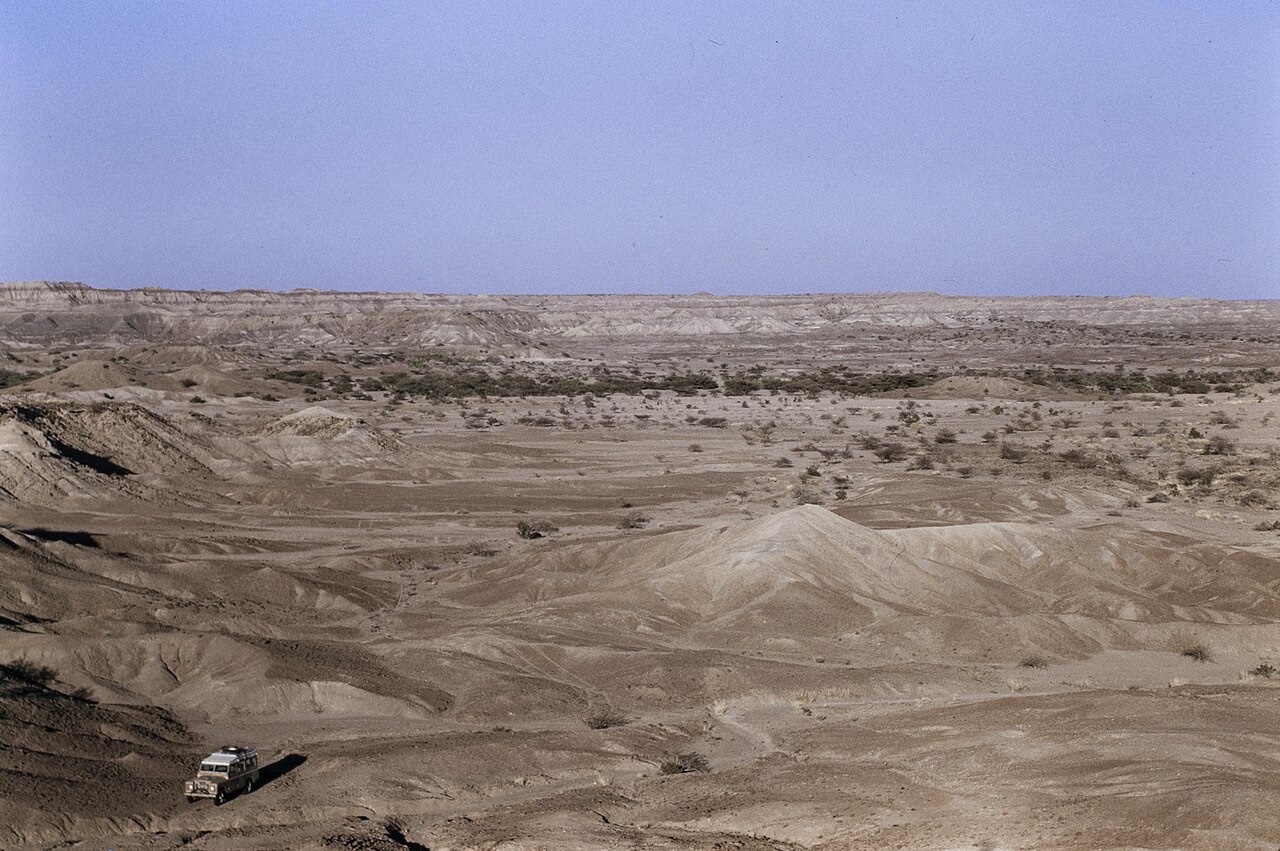 Africa
Ethiopia ↗
Hadar & the Afar Rift
Lucy’s skeleton belongs within a wider Pliocene record of lakes, river margins, pollen and changing vegetation in the Afar basin.
3.2 Ma → Today