
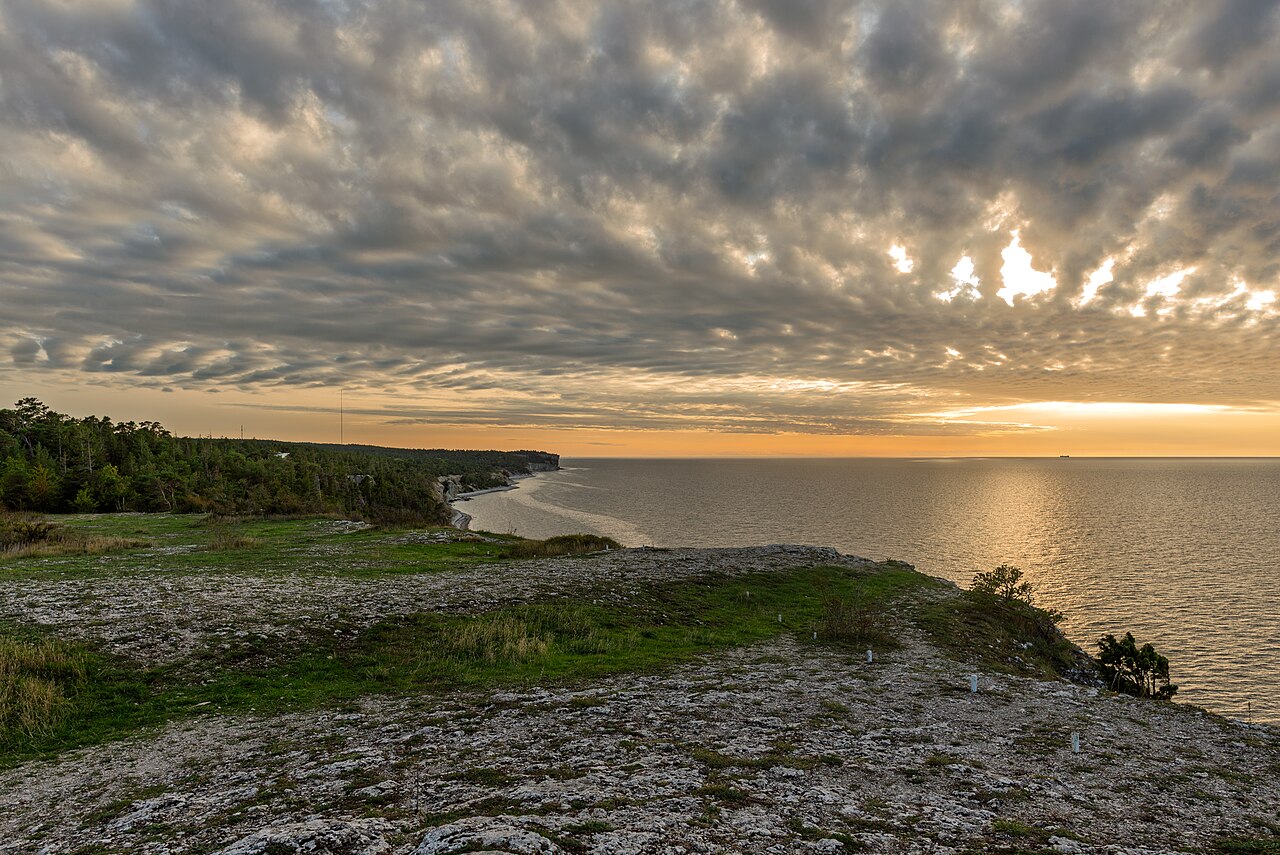
What can a Baltic island reveal about how ancient reefs were constructed?
Gotland’s limestone coast contains the remains of seas much older than the Baltic. The island exposes a succession of Silurian marine rocks, with older units broadly toward the northwest and younger ones toward the southeast. Following that pattern is a journey through deposited sediment, not a claim that the modern shoreline followed the same route. Fossils and the way their surrounding sediment is arranged reveal which parts of this platform supported reefs and which accumulated quieter-water mud.
In the Högklint interval, reef bodies grew within a wider mosaic of carbonate deposits. Calling them coral reefs is convenient but incomplete. Corals lived alongside other builders, and microscopic examination reveals associations between colonial bryozoans and laminated microbial structures. Some organisms supplied skeletons; others bound or accumulated sediment. A reef is therefore both a community and a construction. Identifying its builders requires examining the rock fabric, rather than assuming that every massive limestone had the same origin.
Millions of years later, the Sundre Formation recorded another phase of reef development in southern Gotland. Large masses and sheets of reef limestone contain abundant stromatoporoids, extinct sponges with layered skeletons. Fossil fragments in the surrounding beds help distinguish growth from the redistribution of broken material. Small vertebrate remains and conodont elements add a separate line of evidence for correlating these strata. They help place different outcrops in sequence even when their visible rock types differ.
The modern cliffs and sea stacks are erosional forms cut into these ancient deposits. Their heights are not the measured heights of complete Silurian reefs. Comparing the two intervals shows persistence of reef building alongside changes in the organisms and sedimentary settings involved. It also explains why a reef photograph, a fossil specimen and a geological age estimate answer different questions: appearance, identity and timing must be connected through field context.
[1] [2] [3] [4] [5]Time windows and evidence
Older ages are on the left. Bars span the dated intervals. A dot marks a single age.
- Högklint reef communities 430.6–432.9 Ma
- Stromatoporoid reefs in the south 422.7–425 Ma
- Högklint reef bodies 430.6–432.9 Ma
- Bryozoan–microbial structures at Högklint 430.6–432.9 Ma
- Stromatoporoids of the Sundre Formation 422.7–425 Ma
Researched windowsEvidence records
432 Ma · interval 430.6–432.9 Ma
Högklint reef communities
The Högklint Formation belongs to the Sheinwoodian part of the Silurian. Reef growth occurred on a carbonate platform alongside deposits of broken skeletons and finer sediment. Bryozoan–microbial structures illustrate how organisms other than corals contributed to construction. The numerical window uses the entire Sheinwoodian stage as a broad chronological bracket; it does not imply that the formation lasted for all of it. The representative age is rounded, and the illustrated reef arrangement is schematic.
[2] [3] [5]Locate this time in the atlas ↗Observed
Reef limestone and associated skeletal sediment occur in the Högklint succession.
Reconstructed
A patchy marine platform with reef communities, sediment production and redistribution.
Uncertain
Local reef depths, outlines and durations are not measured by this reconstruction.
Evidence windows overlapping this state: 2. Overlap does not establish exact coexistence.
locality · Gotland ↗
Högklint reef bodies
The Högklint succession preserves reef bodies and the sediment deposited around them. Their geometry matters: a mound of material grown in place records a different process from a bed made from transported fragments. Field relationships let geologists investigate those alternatives. This locality therefore contributes more than a collection of attractive fossils. It preserves the spatial connection between organisms, accumulated sediment and the surrounding marine platform, although erosion now removes part of that original geometry.
sediment · Gotland ↗
Bryozoan–microbial structures at Högklint
A studied occurrence at Högklint contains bryozoans associated with layered microbial carbonate. Such structures, called bryostromatolites, show why reef building cannot be assigned to one familiar animal group. Thin sections reveal relationships that are difficult to recognize in a distant coastal photograph. The association supports an interaction between skeletal colonies and microbial accumulation; its presence does not establish the contribution of each process across every reef on the island.
423 Ma · interval 422.7–425 Ma
Stromatoporoid reefs in the south
The Sundre Formation, of late Ludfordian age, contains substantial reef bodies rich in stromatoporoid sponges. These skeletons helped build raised masses and more laterally extensive accumulations, with debris deposited around them. The selected window brackets the Ludfordian stage rather than dating every reef surface. Correlating Sundre with nearby Hamra strata requires fossil evidence as well as rock type; similar-looking carbonate beds need not have formed everywhere at the same moment.
[4] [2] [5]Locate this time in the atlas ↗Observed
Stromatoporoid-rich bioherms and biostromes, associated debris, and small vertebrate fossils occur in southern Gotland.
Reconstructed
Renewed shallow marine reef development within a changing carbonate platform.
Uncertain
The Hamra–Sundre relationship is locally complex; the snapshot is not an exact island-wide time surface.
Evidence windows overlapping this state: 1. Overlap does not establish exact coexistence.
What this story cannot resolve
The marker represents the island, not one fossil bed. Stage-wide intervals bracket the selected formations and carry geological age uncertainty. Modern coastal relief is not reconstructed Silurian reef topography.
Keep these ideas handy
Facies
The observable characteristics of a rock body that help describe and interpret its depositional setting. Explore the idea ↗
Relative dating
Determining which event came first without necessarily assigning a numerical age. Explore the idea ↗
Sea level & shorelines
The position of the sea relative to the land, affected by both water-volume changes and movements of the solid Earth. Explore the idea ↗
The evidence notebook
locality · Gotland ↗
Högklint reef bodies
The Högklint succession preserves reef bodies and the sediment deposited around them. Their geometry matters: a mound of material grown in place records a different process from a bed made from transported fragments. Field relationships let geologists investigate those alternatives. This locality therefore contributes more than a collection of attractive fossils. It preserves the spatial connection between organisms, accumulated sediment and the surrounding marine platform, although erosion now removes part of that original geometry.
sediment · Gotland ↗
Bryozoan–microbial structures at Högklint
A studied occurrence at Högklint contains bryozoans associated with layered microbial carbonate. Such structures, called bryostromatolites, show why reef building cannot be assigned to one familiar animal group. Thin sections reveal relationships that are difficult to recognize in a distant coastal photograph. The association supports an interaction between skeletal colonies and microbial accumulation; its presence does not establish the contribution of each process across every reef on the island.
body fossil · Gotland ↗
Stromatoporoids of the Sundre Formation
The youngest major reef-bearing succession on Gotland includes abundant stromatoporoid skeletons. These organisms were sponges, despite a superficial resemblance to corals or laminated stones. Their occurrence in substantial reef bodies provides evidence for a different group of framework builders. Adjacent beds containing broken material record another part of the system: skeletons could be damaged and redistributed after growth. Fossil identity and sedimentary arrangement together are more informative than either alone.
Follow the evidence
Sources & credits
- The Silurian coral reefs of Gotland ↗
Swedish Museum of Natural History · 2026-02-26
Use, credit & modifications
Reference only. No text, photographs, figures or datasets from this source are reproduced; the atlas provides original factual synthesis.
Credit: Swedish Museum of Natural History. Original educational synthesis. Numerical intervals are explicitly rounded teaching windows, not measured ages for every fossil. No source asset reused; no territorial asset licence asserted.
- The Dynamic Silurian Earth: Field guide and abstracts ↗
Geological Survey of Sweden; Subcommission on Silurian Stratigraphy · 2005
Use, credit & modifications
Reference only. No text, photographs, figures or datasets from this source are reproduced; the atlas provides original factual synthesis.
Credit: Geological Survey of Sweden; Subcommission on Silurian Stratigraphy. Original educational synthesis. Numerical intervals are explicitly rounded teaching windows, not measured ages for every fossil. No source asset reused; no territorial asset licence asserted.
- Bryozoan-rich stromatolites from the Silurian of Gotland and their relation to climate-related perturbations of the global carbon cycle ↗
Sedimentology; Friedrich-Alexander University Erlangen-Nürnberg · 2021
Use, credit & modifications
Reference only. No text, photographs, figures or datasets from this source are reproduced; the atlas provides original factual synthesis.
Credit: Anna Lene Claussen, Axel Munnecke and Andrej Ernst. Original educational synthesis. Numerical intervals are explicitly rounded teaching windows, not measured ages for every fossil. No source asset reused; no territorial asset licence asserted.
- Vertebrate remains and conodonts in the upper Silurian Hamra and Sundre formations of Gotland, Sweden ↗
GFF / Taylor & Francis · 2019-09-27
Use, credit & modifications
Reference only. No text, photographs, figures or datasets from this source are reproduced; the atlas provides original factual synthesis.
Credit: GFF / Taylor & Francis. Original educational synthesis. Numerical intervals are explicitly rounded teaching windows, not measured ages for every fossil. No source asset reused; no territorial asset licence asserted.
- International Chronostratigraphic Chart, version 2026/06 ↗
International Commission on Stratigraphy · 2026-06
Use, credit & modifications
Reference only. No text, photographs, figures or datasets from this source are reproduced; the atlas provides original factual synthesis.
Credit: International Commission on Stratigraphy. Original educational synthesis. Numerical intervals are explicitly rounded teaching windows, not measured ages for every fossil. No source asset reused; no territorial asset licence asserted.
Follow the connections
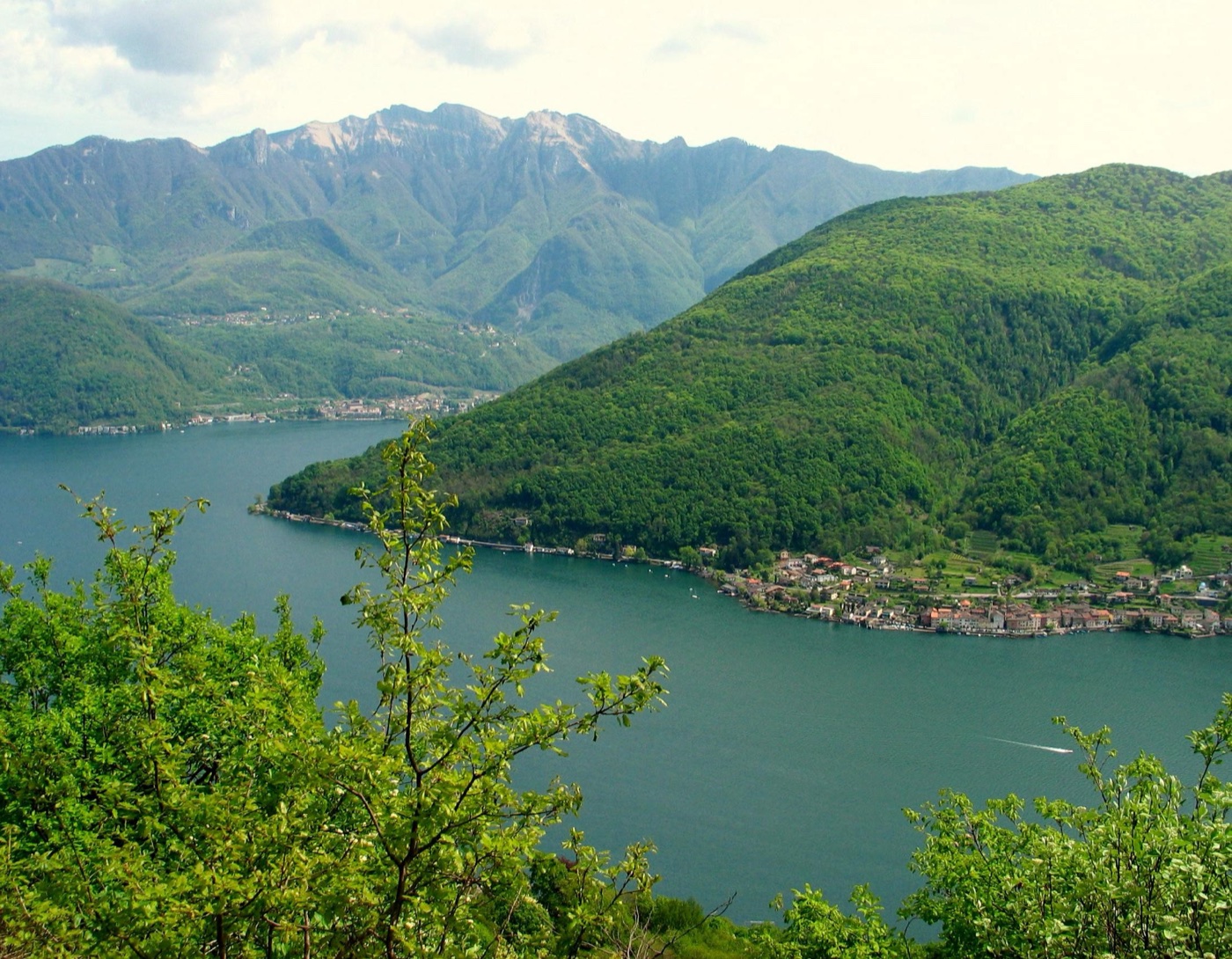 Europe
Switzerland / Italy ↗
Monte San Giorgio, Southern Alps
Middle Triassic marine sediments now form part of the Southern Alpine landscape. Fossils reveal a restricted basin, while the rocks’ present position records a much later geological history.
241 Ma → Today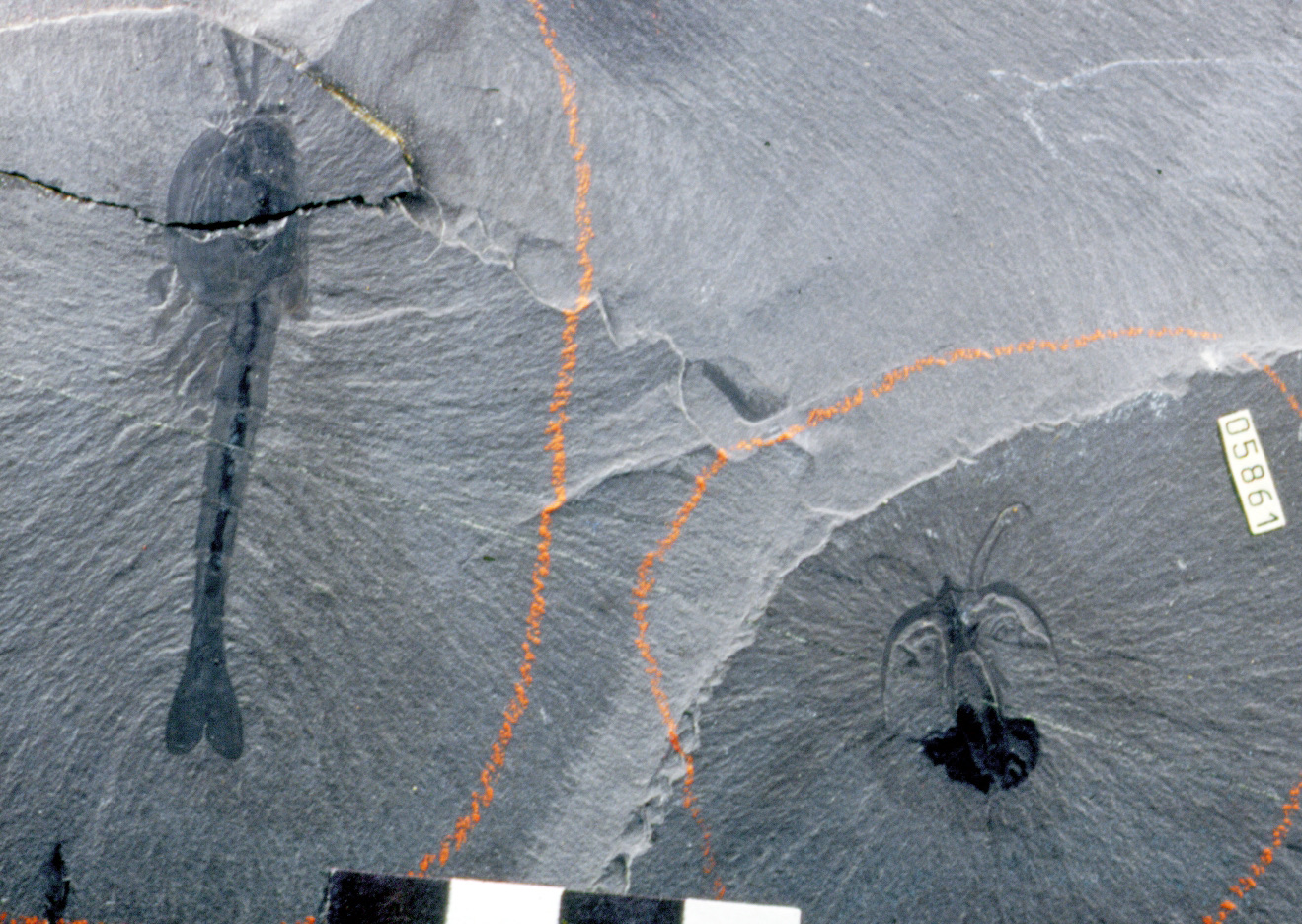 North America
Canada ↗
Burgess Shale
Cambrian mud preserved animals that most fossil sites lose. Today those thin traces are exposed high in the Canadian Rockies, connecting the history of life with the later history of a mountain belt.
508 Ma → Today