
How can one valley preserve both delicate insects and an Ice Age mammoth?
Florissant’s giant petrified stumps are impressive, but some of its most informative fossils fit on a small fragment of shale. Around 34 million years ago, volcanic activity repeatedly interrupted a forested valley. Debris flows buried the bases of redwoods, while a volcanic dam helped create a lake. These processes preserved different parts of the ecosystem in different ways. Upright wood records trees close to where they grew; leaves and insects settling into water can have travelled from the surrounding forest.
Thin lake sediments retained delicate outlines and organic material. Sequoia foliage, cones and pollen complement the large trunks, allowing researchers to compare several parts of the plant rather than identify a forest from wood alone. The combination is valuable because preservation is selective. A lake catches airborne material, floating debris and aquatic organisms in unequal proportions. Its fossil list cannot simply be converted into a census of the living valley.
A second, much younger archive lies in gravel derived from weathered granite. Mammoth jaw and tooth fragments discovered in 1994 belong to the Pleistocene, not the Eocene lake community. Park accounts report an age near 50,000 years and describe the material more conservatively as older than 43,000 years. Near the practical limit of radiocarbon dating, those statements should not be presented as a perfectly exact calendar date.
The comparison follows a lake into a cold terrestrial valley separated by tens of millions of years. It does not imply that the mammoth walked among Florissant’s fossil redwoods, or that glaciers covered the valley itself. Much of the intervening history is absent from these selected deposits. Their juxtaposition illustrates why a fossil’s layer matters as much as its identity.
[1] [2] [3] [4]Time windows and evidence
Older ages are on the left. Bars span the dated intervals. A dot marks a single age.
- A lake beside a redwood forest 34–35 Ma
- A mammoth in the cold valley 0.043–0.05 Ma
- Florissant petrified redwood stumps 34–35 Ma
- Sequoia affinis foliage, specimen FLFO 3661 34–35 Ma
- The 1994 Florissant mammoth jaw and tooth 0.043–0.05 Ma
Researched windowsEvidence records
34.5 Ma · interval 34–35 Ma
A lake beside a redwood forest
Volcanic activity dammed drainage and supplied ash to a lake beside a forest. Leaves, insects and other material became trapped in fine sediment while separate debris flows buried tree bases. The 35–34 million year interval is a rounded late-Eocene envelope; the familiar 34 million year description of the formation is approximate.
[1] [2]Locate this time in the atlas ↗Observed
Paper shales, plant impressions and petrified redwood stumps occur in the Florissant Formation.
Reconstructed
A lake receiving material from a vegetated volcanic landscape.
Uncertain
Individual beds and burial events represent different moments.
Evidence windows overlapping this state: 2. Overlap does not establish exact coexistence.
body fossil · Florissant ↗
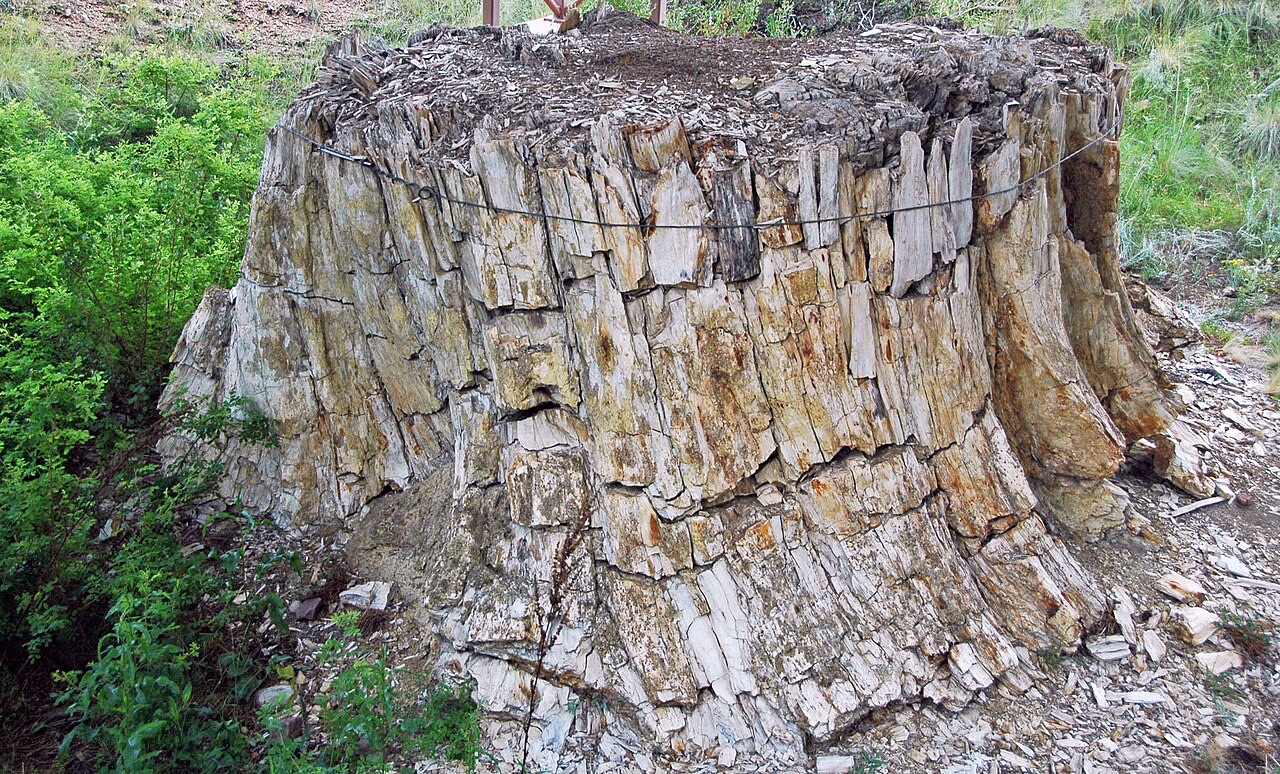
Florissant petrified redwood stumps
Large upright stumps preserve trees buried by volcanic debris flows. Their position offers a different kind of information from a loose branch washed into a lake: the trunks locate portions of a former forest floor. Mineralization preserved woody structure after burial, while erosion later revealed the stumps. The contrast with detached foliage in nearby lake deposits reveals how different burial mechanisms can preserve complementary parts of the same broadly contemporary ecosystem.
body fossil · Florissant ↗
Sequoia affinis foliage, specimen FLFO 3661
The documented foliage impression FLFO 3661 records fine branching and needles of Florissant’s redwood. Other specimens preserve cones and pollen, providing independent plant parts for comparison. The specimen demonstrates how a thin compression fossil complements a massive trunk; it is not the individual trunk pictured elsewhere in this atlas. Connecting the documented fossil with its catalog number allows the identification to be checked independently, without assuming that an educational reconstruction reproduces every original feature.
0.04993 Ma · interval 0.043–0.05 Ma
A mammoth in the cold valley
Much younger gravel records erosion and movement of granite debris into the valley. Mammoth remains found in this material document a terrestrial Pleistocene setting. The river symbol represents valley drainage and sediment movement, including slope-derived gravel; it is not evidence for a large permanent river or a glacier at the fossil locality. The age window summarizes approximate park accounts, not a published confidence interval.
[3] [4]Locate this time in the atlas ↗Observed
Mammoth tooth and jaw fragments occur in gravel above older bedrock.
Reconstructed
A cold valley supporting terrestrial herbivores, with active erosion and drainage.
Uncertain
The reported radiocarbon age approaches the method’s practical limit.
Evidence windows overlapping this state: 1. Overlap does not establish exact coexistence.
What this story cannot resolve
The younger 50–43 thousand year display envelope is an approximate synthesis, not a measured confidence interval. The valley itself was not glaciated.
Keep these ideas handy
Fossilization
The varied processes by which remains or traces of past life enter the geological record. Explore the idea ↗
Exceptional preservation
Preservation that retains normally lost features such as soft tissues. Geologists call a deposit rich in such fossils a Konservat-Lagerstätte. Explore the idea ↗
Relative dating
Determining which event came first without necessarily assigning a numerical age. Explore the idea ↗
The evidence notebook
body fossil · Florissant ↗
Florissant petrified redwood stumps
Large upright stumps preserve trees buried by volcanic debris flows. Their position offers a different kind of information from a loose branch washed into a lake: the trunks locate portions of a former forest floor. Mineralization preserved woody structure after burial, while erosion later revealed the stumps. The contrast with detached foliage in nearby lake deposits reveals how different burial mechanisms can preserve complementary parts of the same broadly contemporary ecosystem.
body fossil · Florissant ↗
Sequoia affinis foliage, specimen FLFO 3661
The documented foliage impression FLFO 3661 records fine branching and needles of Florissant’s redwood. Other specimens preserve cones and pollen, providing independent plant parts for comparison. The specimen demonstrates how a thin compression fossil complements a massive trunk; it is not the individual trunk pictured elsewhere in this atlas. Connecting the documented fossil with its catalog number allows the identification to be checked independently, without assuming that an educational reconstruction reproduces every original feature.
body fossil · Florissant ↗
The 1994 Florissant mammoth jaw and tooth
Jaw and tooth fragments discovered in young gravel establish a separate Pleistocene fossil occurrence. Park interpretations identify a Columbian mammoth and report radiocarbon estimates near the method’s upper useful range. The ridged tooth surface provides evidence about food processing, while the sedimentary position prevents confusion with the far older lake fossils. This occurrence is particularly useful because it demonstrates that one protected area can contain fossil archives separated by tens of millions of years of unrepresented history.
Follow the evidence
Sources & credits
- On Top of a Forest, on the Bottom of a Lake ↗
National Park Service · Not stated
Use, credit & modifications
Reference only. No source text or assets reproduced. Original factual synthesis; no reuse licence asserted.
Credit: National Park Service — On Top of a Forest, on the Bottom of a Lake. Facts synthesized in original educational language. Rounded teaching intervals are distinguished from measured dates. No source assets reused; territorial permissions not applicable.
- Sequoia affinis Reconstruction ↗
National Park Service · Not stated
Use, credit & modifications
Reference only. No source text or assets reproduced. Original factual synthesis; no reuse licence asserted.
Credit: National Park Service — Sequoia affinis Reconstruction. Facts synthesized in original educational language. Rounded teaching intervals are distinguished from measured dates. No source assets reused; territorial permissions not applicable.
- Mammoth Change ↗
National Park Service · Not stated
Use, credit & modifications
Reference only. No source text or assets reproduced. Original factual synthesis; no reuse licence asserted.
Credit: National Park Service — Mammoth Change. Facts synthesized in original educational language. Rounded teaching intervals are distinguished from measured dates. No source assets reused; territorial permissions not applicable.
- Geologic Trail ↗
National Park Service · Not stated
Use, credit & modifications
Reference only. No source text or assets reproduced. Original factual synthesis; no reuse licence asserted.
Credit: National Park Service — Geologic Trail. Facts synthesized in original educational language. Rounded teaching intervals are distinguished from measured dates. No source assets reused; territorial permissions not applicable.
Follow the connections
 North America
United States ↗
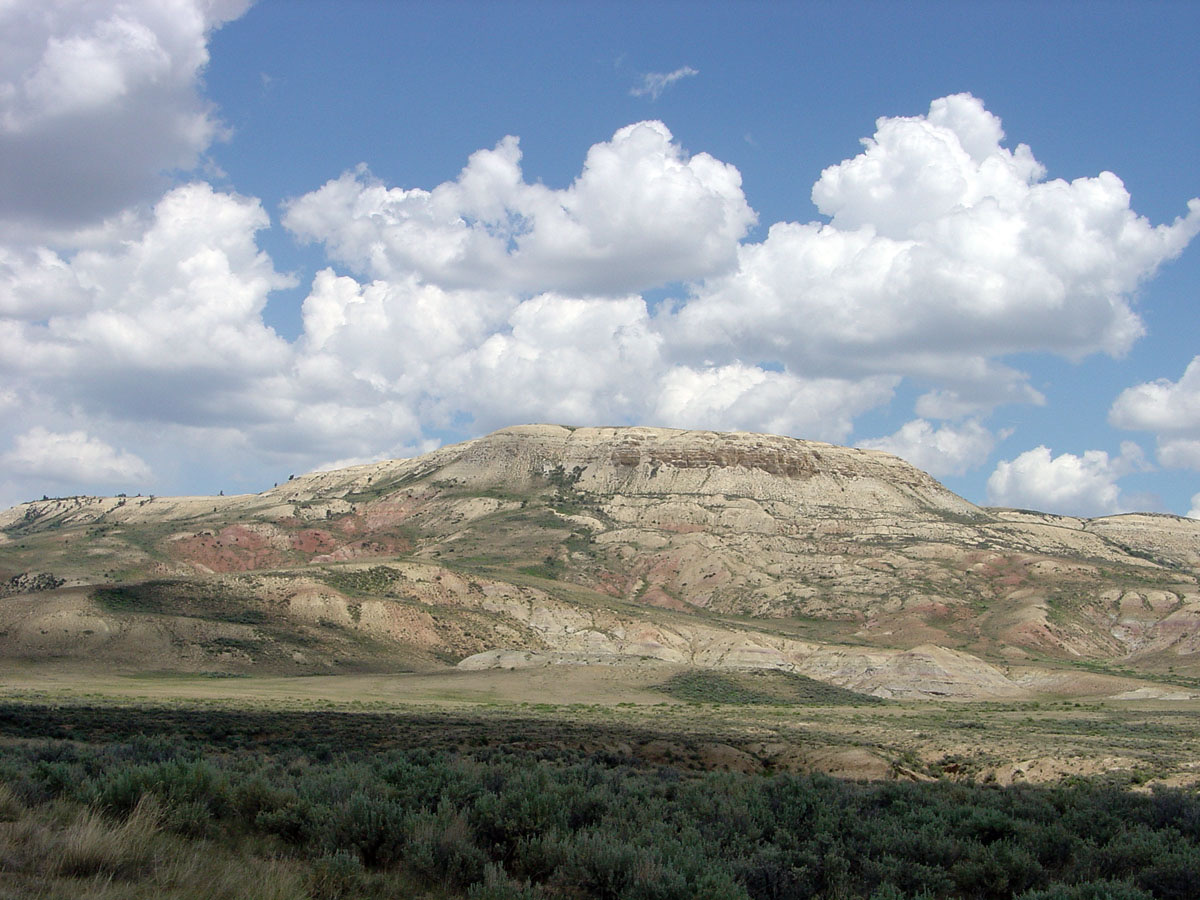
Fossil Lake, Wyoming
The Green River Formation records several Eocene lakes. At Fossil Lake, an expanding lake and its later shrinking, saltier stage left different sediments and different opportunities for preservation.
52 Ma → 51 Ma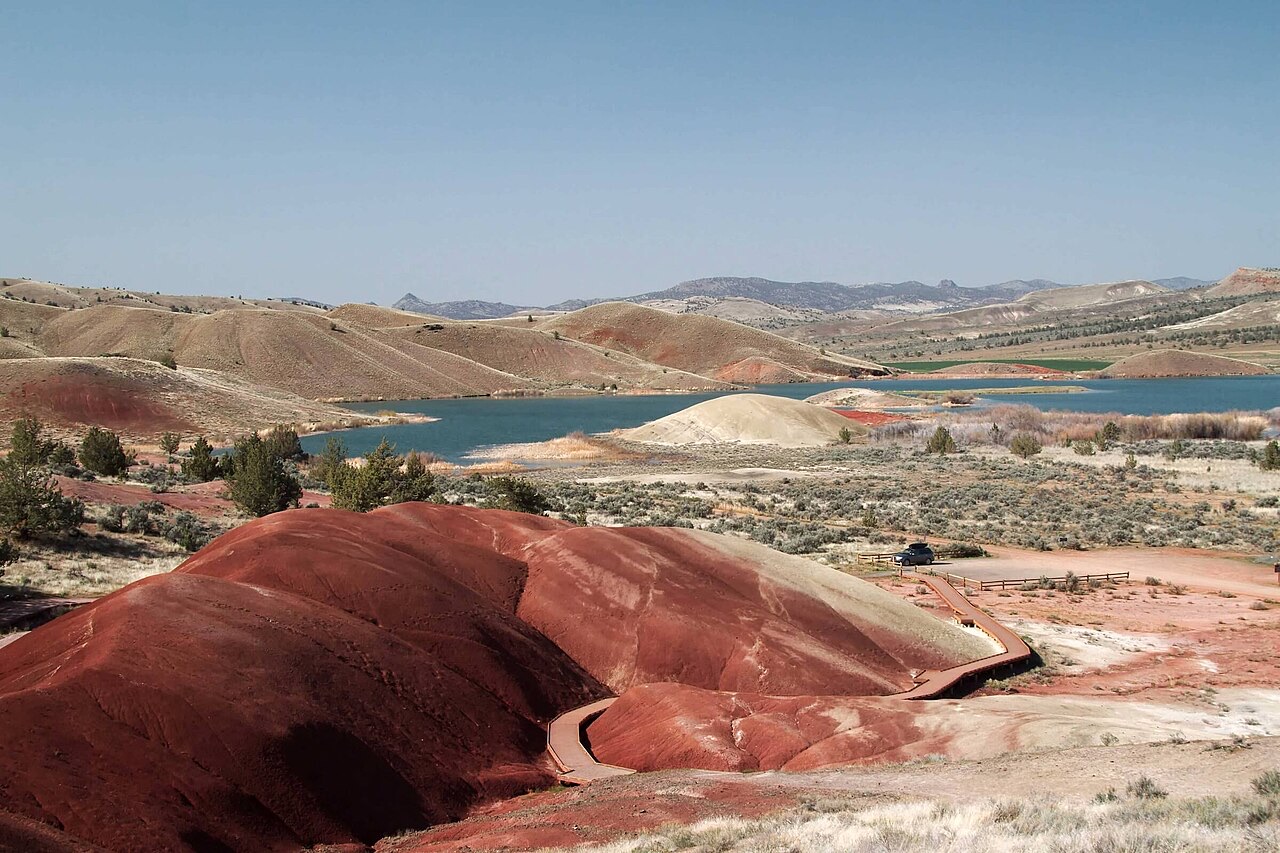 North America
United States ↗
John Day Basin
Separate formations and localities in Oregon preserve Eocene forests, river accumulations and younger Oligocene mammal communities.
44 Ma → 29 Ma