
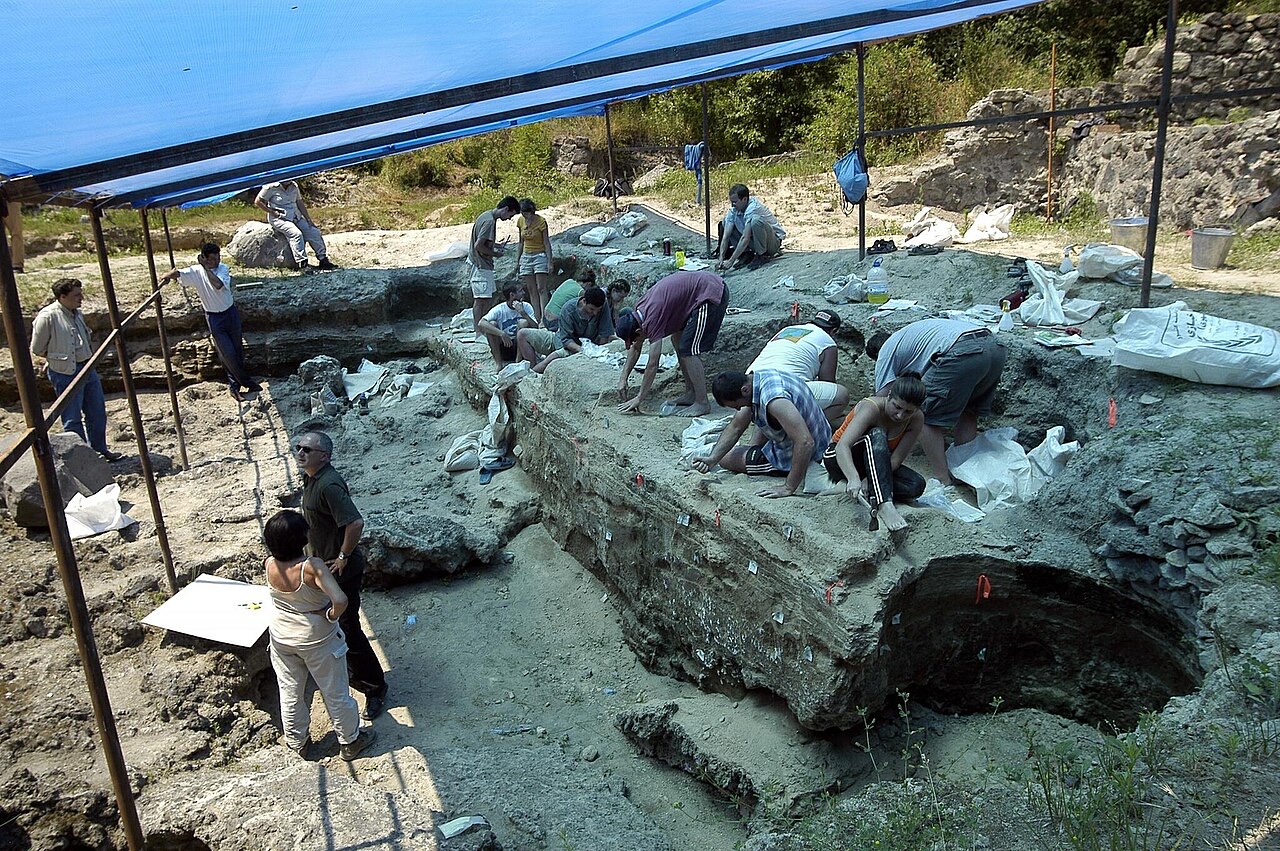
How did a lava surface become a place where early human activity was preserved?
Dmanisi’s famous fossils lie above a much less celebrated geological foundation: a basalt flow in the Mashavera valley. Dating that volcanic rock supplies an older limit for the archaeological deposits resting on it. After the lava cooled, sediment accumulated and surfaces developed on a landscape used repeatedly by animals and hominins. The oldest artefacts and the better-known skull-bearing deposits are not all one occupation floor.
The surrounding landscape combined open areas, wooded habitats and water sources. Small vertebrates provide environmental evidence complementary to the large mammals, while sedimentary structures and soils help explain how material accumulated. Carnivore activity, human actions and natural transport all contributed to the fossil record. A collection of bones and tools in the same broad deposit therefore does not demonstrate one meal, one group or one simultaneous event.
The unusually complete D4500 cranium and associated D2600 mandible show why Dmanisi is central to debates about variation in early Homo. Their anatomy can be compared with other fossils, but deciding how many species that variation represents remains an interpretation rather than an observation supplied by the rock. The site firmly documents early hominins in the southern Caucasus; it does not by itself identify an exact route out of Africa or the first moment any hominin entered Eurasia. Skull 5 illustrates the difficulty: its large face and small braincase occur together, even though either feature in isolation might suggest a different comparison. Finds of other Dmanisi crania and jaws extend the range of forms that researchers need to explain.
[1] [2] [3] [4] [5] [6]Time windows and evidence
Older ages are on the left. Bars span the dated intervals. A dot marks a single age.
- The Mashavera basalt forms the foundation 1.83–1.87 Ma
- Repeated occupation above the lava 1.76–1.85 Ma
- Mashavera basalt below the site 1.83–1.87 Ma
- Stratum A stone artefacts 1.78–1.85 Ma
- D4500 cranium and D2600 mandible 1.76–1.85 Ma
Researched windowsEvidence records
1.85 Ma · interval 1.83–1.87 Ma
The Mashavera basalt forms the foundation
The classic argon age for the Mashavera Basalt at Dmanisi is about 1.85 million years. The 1.87–1.83 million year window surrounds that earlier estimate. A later study dated the uppermost flow at a different excavation block, M5, to about 1.80 million years. In both settings the lava cooled before the overlying soils and sediments accumulated. Local lava ages therefore supply maximum ages for later activity, but a lava date alone cannot tell us when the first visit occurred.
[1] [3] [6]Locate this time in the atlas ↗Observed
Basalt lies beneath the archaeological sediment sequence and has a radiometric age.
Reconstructed
Volcanic emplacement preceded the preserved occupations.
Uncertain
The date of the lava is not the date of every object above it.
Evidence windows overlapping this state: 3. Overlap does not establish exact coexistence.
radiometric · Dmanisi ↗
Mashavera basalt below the site
At Dmanisi, deposits containing artefacts and fossils lie above the Mashavera Basalt. The older estimate of about 1.85 million years used in the timeline came from dated lava. A sample of the uppermost flow at excavation block M5 gave a younger age, about 1.80 million years. The rock layers tell us that each overlying deposit came after the lava immediately beneath it. They cannot give an exact date for individual visits.
locality · Dmanisi ↗
Stratum A stone artefacts
Worked stones in Stratum A record activity older than several of Dmanisi’s best-known skull finds. Researchers originally assigned the artefact-bearing deposits to around 1.85–1.78 million years ago. A later study dated the uppermost flow below the artefacts at excavation block M5 to around 1.80 million years, narrowing the likely age of occupation there. The flakes show people used the site repeatedly without identifying the individuals who made them.
body fossil · Dmanisi ↗
D4500 cranium and D2600 mandible
The D4500 cranium and associated D2600 mandible preserve a large face and a small braincase in the same individual. Researchers estimated its internal volume at about 546 cubic centimetres. This pairing matters because an isolated jaw or braincase could suggest a different comparison. Skull 5 and the other Dmanisi specimens constrain the range of shapes present at the site. Scientists still disagree about what that variation means for the number of early Homo species.
1.79 Ma · interval 1.76–1.85 Ma
Repeated occupation above the lava
Sediments above the basalt preserve repeated hominin activity, animal remains and a complex burial history. The broad 1.85–1.76 Ma envelope encompasses early artefact horizons and the younger fossil-bearing part of the site; it is not a claim that all remains are contemporaneous. River denotes the wider valley landscape, which also included dry surfaces and wooded patches. Small vertebrates and mammalian assemblages help reconstruct those habitats independently of the hominin skulls.
[1] [3] [4]Locate this time in the atlas ↗Observed
Stone artefacts and vertebrate fossils occur in ordered deposits above the basalt.
Reconstructed
Early hominins repeatedly used a varied valley landscape.
Uncertain
Sediment reworking, carnivore accumulation and chronological resolution complicate individual associations.
Evidence windows overlapping this state: 3. Overlap does not establish exact coexistence.
radiometric · Dmanisi ↗
Mashavera basalt below the site
At Dmanisi, deposits containing artefacts and fossils lie above the Mashavera Basalt. The older estimate of about 1.85 million years used in the timeline came from dated lava. A sample of the uppermost flow at excavation block M5 gave a younger age, about 1.80 million years. The rock layers tell us that each overlying deposit came after the lava immediately beneath it. They cannot give an exact date for individual visits.
locality · Dmanisi ↗
Stratum A stone artefacts
Worked stones in Stratum A record activity older than several of Dmanisi’s best-known skull finds. Researchers originally assigned the artefact-bearing deposits to around 1.85–1.78 million years ago. A later study dated the uppermost flow below the artefacts at excavation block M5 to around 1.80 million years, narrowing the likely age of occupation there. The flakes show people used the site repeatedly without identifying the individuals who made them.
body fossil · Dmanisi ↗
D4500 cranium and D2600 mandible
The D4500 cranium and associated D2600 mandible preserve a large face and a small braincase in the same individual. Researchers estimated its internal volume at about 546 cubic centimetres. This pairing matters because an isolated jaw or braincase could suggest a different comparison. Skull 5 and the other Dmanisi specimens constrain the range of shapes present at the site. Scientists still disagree about what that variation means for the number of early Homo species.
What this story cannot resolve
The marker denotes the archaeological locality. Volcanic and occupation age envelopes overlap through uncertainty; they describe a clear stratigraphic order, not simultaneous processes.
Keep these ideas handy
Radiometric dating
Estimating the time of a geological event from radioactive decay and the isotopic composition of a suitable material. Explore the idea ↗
Stratigraphy
Studying the order, relationships and distribution of rock layers and the events they preserve. Explore the idea ↗
Taphonomy
Studying what happens between an organism’s life, death, burial, preservation and eventual discovery. Explore the idea ↗
Evolutionary tree
A branching hypothesis of relationships among organisms, inferred from shared evidence rather than arranged as a ladder of progress. Explore the idea ↗
The evidence notebook
radiometric · Dmanisi ↗
Mashavera basalt below the site
At Dmanisi, deposits containing artefacts and fossils lie above the Mashavera Basalt. The older estimate of about 1.85 million years used in the timeline came from dated lava. A sample of the uppermost flow at excavation block M5 gave a younger age, about 1.80 million years. The rock layers tell us that each overlying deposit came after the lava immediately beneath it. They cannot give an exact date for individual visits.
locality · Dmanisi ↗
Stratum A stone artefacts
Worked stones in Stratum A record activity older than several of Dmanisi’s best-known skull finds. Researchers originally assigned the artefact-bearing deposits to around 1.85–1.78 million years ago. A later study dated the uppermost flow below the artefacts at excavation block M5 to around 1.80 million years, narrowing the likely age of occupation there. The flakes show people used the site repeatedly without identifying the individuals who made them.
body fossil · Dmanisi ↗
D4500 cranium and D2600 mandible
The D4500 cranium and associated D2600 mandible preserve a large face and a small braincase in the same individual. Researchers estimated its internal volume at about 546 cubic centimetres. This pairing matters because an isolated jaw or braincase could suggest a different comparison. Skull 5 and the other Dmanisi specimens constrain the range of shapes present at the site. Scientists still disagree about what that variation means for the number of early Homo species.
Follow the evidence
Sources & credits
- Earliest human occupations at Dmanisi dated to 1.85–1.78 Ma ↗
Ferring et al.; PNAS · 2011
Use, credit & modifications
Reference only; original factual synthesis. No third-party prose or media reproduced.
Credit: Ferring et al.; PNAS — Earliest human occupations at Dmanisi dated to 1.85–1.78 Ma. Original educational synthesis; rounded age envelopes distinguish teaching windows from analytical errors. No media licence asserted for this reference. Photograph rights are documented separately.
- A complete skull from Dmanisi, Georgia, and the evolutionary biology of early Homo ↗
Lordkipanidze et al.; Science · 2013-10-18
Use, credit & modifications
Reference only; original factual synthesis. No third-party prose or media reproduced.
Credit: Lordkipanidze et al.; Science — A complete skull from Dmanisi, Georgia, and the evolutionary biology of early Homo. Original educational synthesis; rounded age envelopes distinguish teaching windows from analytical errors. No media licence asserted for this reference. Photograph rights are documented separately.
- Paleoclimatic and paleoenvironmental context of the Early Pleistocene hominins from Dmanisi inferred from the herpetofaunal assemblage ↗
Quaternary Science Reviews · 2014
Use, credit & modifications
Reference only; original factual synthesis. No third-party prose or media reproduced.
Credit: Quaternary Science Reviews — Paleoclimatic and paleoenvironmental context of the Early Pleistocene hominins from Dmanisi inferred from the herpetofaunal assemblage. Original educational synthesis; rounded age envelopes distinguish teaching windows from analytical errors. No media licence asserted for this reference. Photograph rights are documented separately.
- Life and death at Dmanisi, Georgia: Taphonomic signals from the fossil mammals ↗
Journal of Human Evolution · 2022
Use, credit & modifications
Reference only; original factual synthesis. No third-party prose or media reproduced.
Credit: Journal of Human Evolution — Life and death at Dmanisi, Georgia: Taphonomic signals from the fossil mammals. Original educational synthesis; rounded age envelopes distinguish teaching windows from analytical errors. No media licence asserted for this reference. Photograph rights are documented separately.
- Hominin occupations at the Dmanisi site: Raw materials and technical behaviours ↗
Mgeladze et al.; Journal of Human Evolution · 2011
Use, credit & modifications
Reference only; original factual synthesis. No third-party prose or media reproduced.
Credit: Mgeladze et al.; Journal of Human Evolution — Hominin occupations at the Dmanisi site: Raw materials and technical behaviours. Original educational synthesis; rounded age envelopes distinguish teaching windows from analytical errors. No media licence asserted for this reference. Photograph rights are documented separately.
- Early Pleistocene stratigraphy, sedimentary environments, and formation contexts at Dmanisi in the Georgian Caucasus ↗
Ferring and colleagues / Journal of Human Evolution · 2022
Use, credit & modifications
Reference only; no text or images reproduced.
Credit: Ferring et al. (2022). Original summary of uppermost basalt and occupation stratigraphy. No third-party media reproduced.
Follow the connections
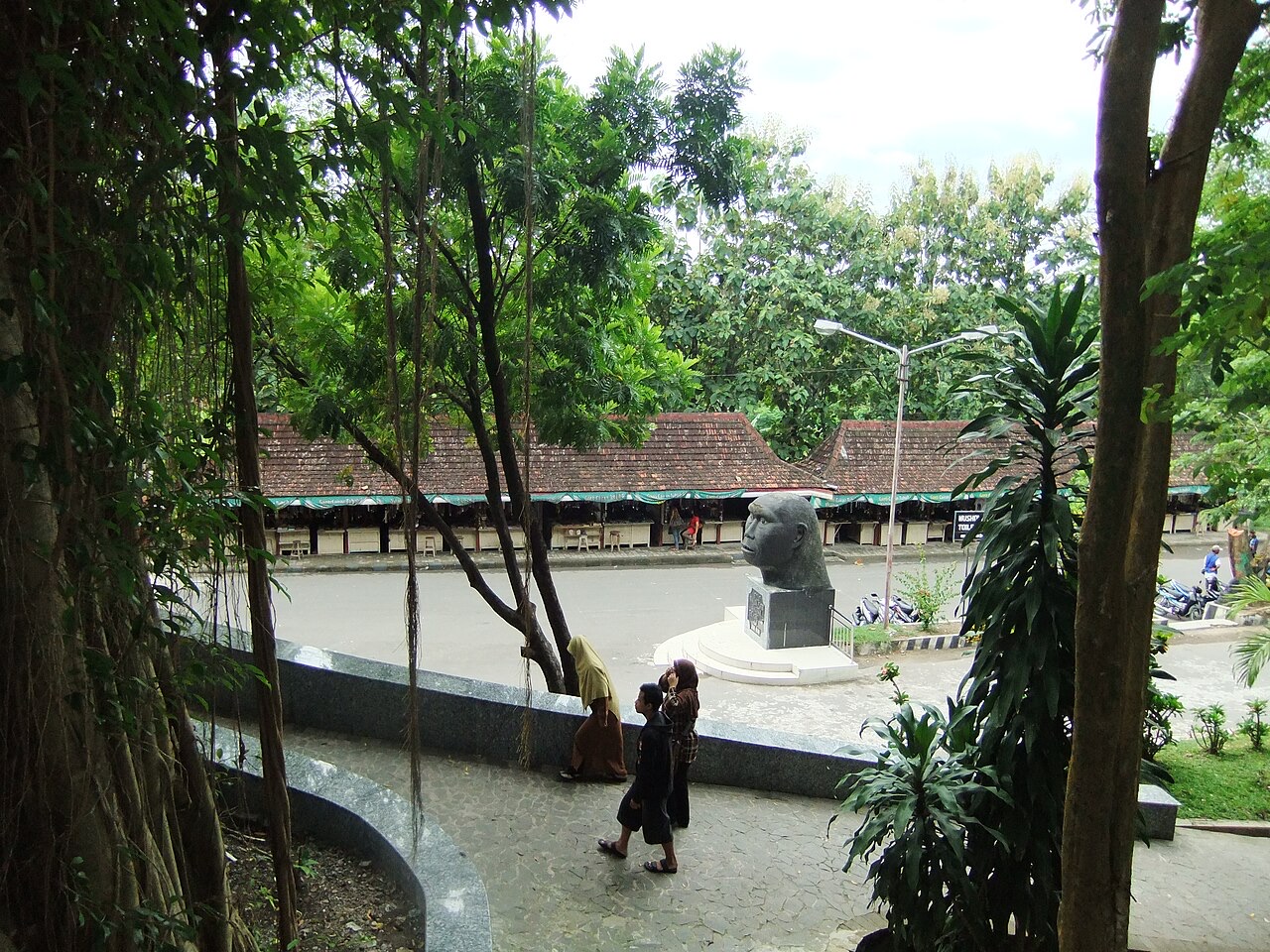 Asia
Indonesia ↗
Sangiran
Swampy deposits, river sediments and Homo erectus fossils record the growth of a terrestrial landscape amid Java’s volcanoes.
1.6 Ma → 1.1 Ma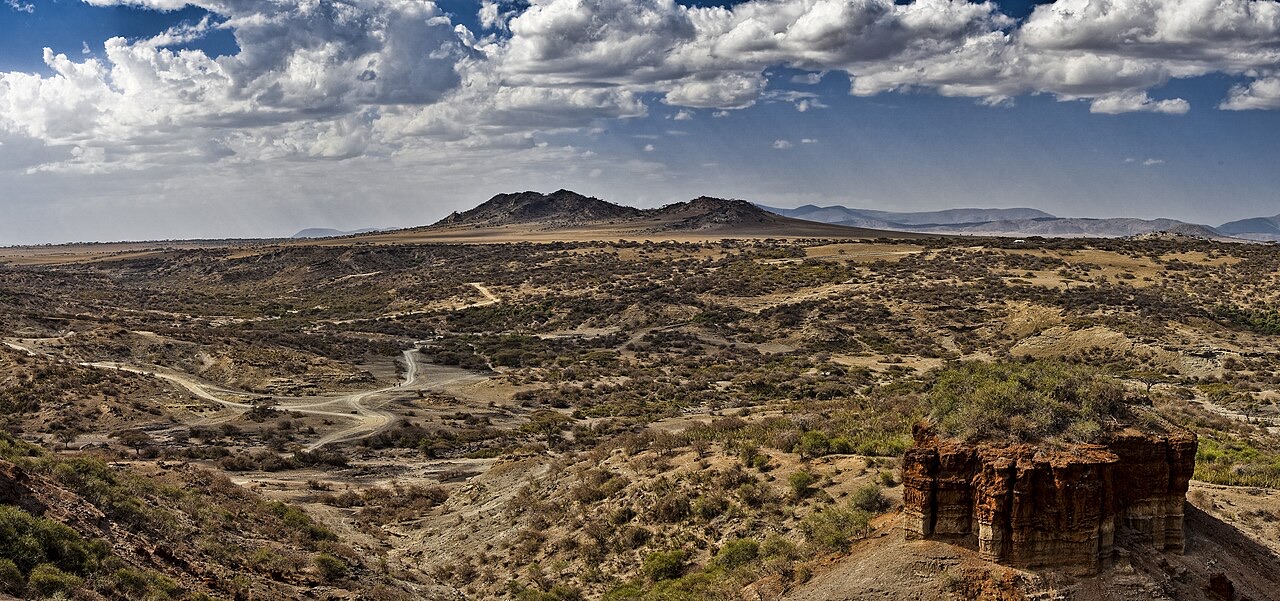 Africa
Tanzania ↗
Olduvai Gorge
Post-eruption rivers at Ewass Oldupa and younger spring-fed woodland at FLK Zinj reveal local habitat changes within an Early Pleistocene rift basin.
2.03 Ma → 1.84 Ma