
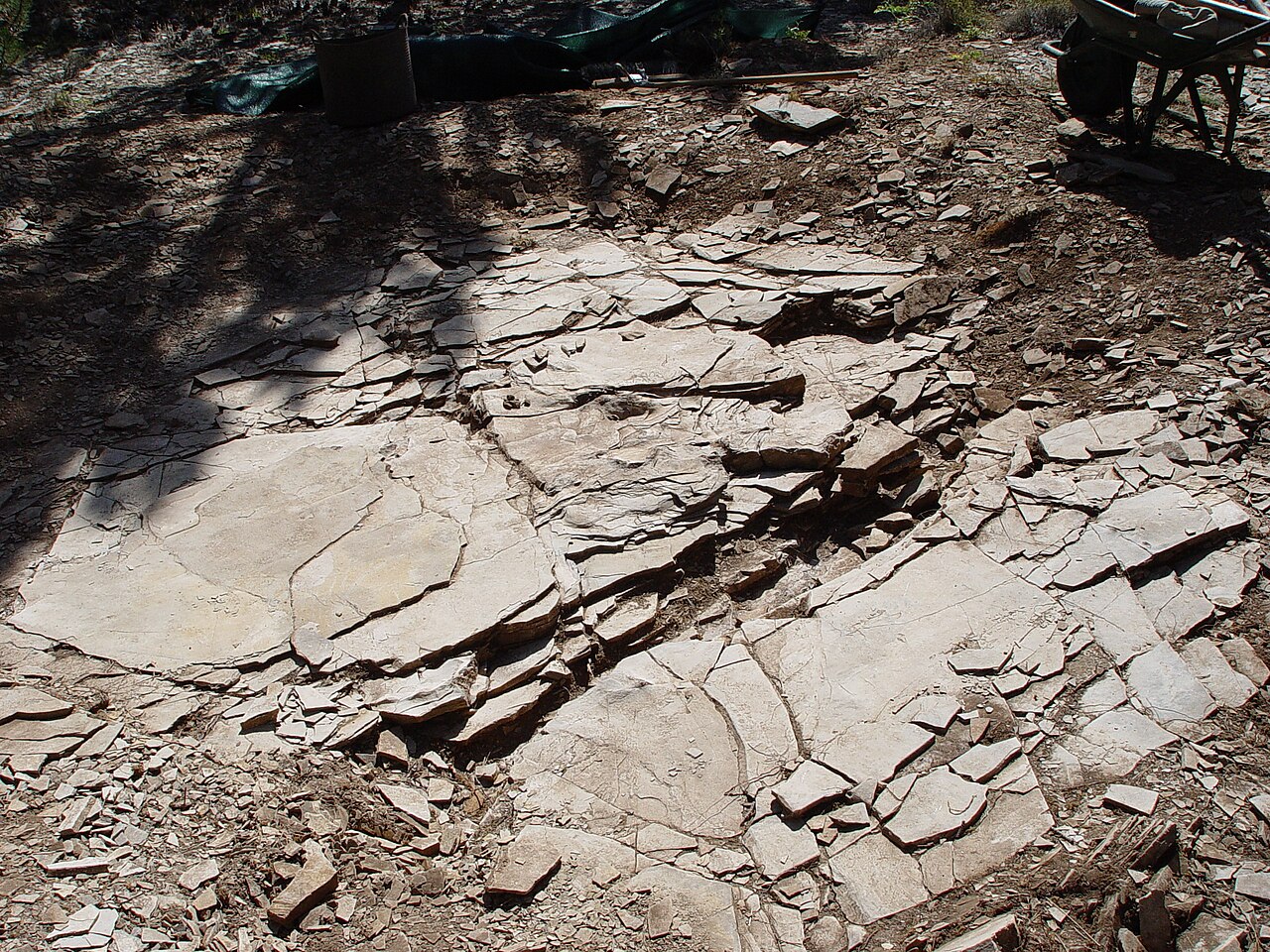
Why should fossils from nearby places not automatically appear in the same scene?
A museum can bring fossils from Las Hoyas and Lo Hueco into the same room, but geological time keeps their ecosystems apart. Both localities lie in the modern province of Cuenca, yet they belong to widely separated parts of the Cretaceous. A regional page must therefore do more than collect impressive animals. It must connect each specimen to its own deposit and ask what the rock preserves about the environment and the process of burial.
Las Hoyas records an Early Cretaceous wetland system. Fine limestone and favourable preservation retained aquatic organisms and remains from surrounding land. The articulated skeleton of Concavenator is especially striking, but its presence within a wetland deposit does not turn it into an exclusively aquatic animal. The smaller fossils and the sediment itself are necessary for understanding the setting that a large dinosaur skeleton alone cannot fully describe.
Lo Hueco belongs to a much later chapter. Its bone-bearing deposits include partial titanosaur skeletons, one of which was described as Lohuecotitan pandafilandi. The younger environment and accumulation history differ from those of Las Hoyas. Treating the two collections as one community would erase evolutionary and geographical changes across tens of millions of years, just as combining all rocks in a mountain range would erase their stratigraphy.
The selected windows use approximate ages widely applied to these sites rather than claiming exact dates for every fossil. Present coordinates represent the province, not a common ancient water body. Comparing the records teaches a useful habit: establish locality, formation and time before reconstructing an ecosystem. Only then can the completeness of a skeleton, the texture of its enclosing sediment and the identity of neighbouring fossils be interpreted together.
[1] [2] [3]Time windows and evidence
Older ages are on the left. Bars span the dated intervals. A dot marks a single age.
- Las Hoyas wetland preservation 121–126 Ma
- Lo Hueco’s later dinosaur landscape 70–75 Ma
- Concavenator from Las Hoyas 121–126 Ma
- Las Hoyas laminated limestone 121–126 Ma
- Lohuecotitan at Lo Hueco 70–75 Ma
Researched windowsEvidence records
125 Ma · interval 121–126 Ma
Las Hoyas wetland preservation
Fine carbonate sediment accumulated within a wetland system at Las Hoyas. Aquatic organisms and material from surrounding terrestrial habitats entered this record. The conventional approximate age of 125 Ma is used with a broad bracket because published age language and numerical scales differ. A schematic lake represents part of a wetland mosaic; it does not imply one deep, permanent basin covering the modern province.
[1] [2]Locate this time in the atlas ↗Observed
Laminated limestone and exceptionally preserved fossils occur at Las Hoyas.
Reconstructed
Wetland conditions and microbial processes favoured preservation.
Uncertain
Exact water-body geometry and the age of individual bedding surfaces remain unresolved here.
Evidence windows overlapping this state: 2. Overlap does not establish exact coexistence.
body fossil · Cuenca ↗
Concavenator from Las Hoyas
The articulated theropod Concavenator corcovatus is a prominent example of Las Hoyas preservation. Its skeleton records an animal from the surrounding terrestrial ecosystem within a wetland deposit. Completeness permits anatomical comparisons that isolated teeth cannot provide. It does not establish that the dinosaur spent its whole life in the water or that every preserved animal belonged to the same immediate habitat.
sediment · Cuenca ↗
Las Hoyas laminated limestone
Fine limestone beds preserve a varied community that includes aquatic and terrestrial organisms. Their preservation is connected to wetland conditions and microbial processes discussed in the site studies. Delicate remains make the deposit informative, but the abundance of a fossil still depends on delivery, burial and decay. The rock is therefore evidence for both environmental conditions and a selective route into the fossil record.
72 Ma · interval 70–75 Ma
Lo Hueco’s later dinosaur landscape
A later Cretaceous terrestrial depositional system accumulated many vertebrate remains at Lo Hueco. Partial titanosaur skeletons provide direct evidence for large herbivorous dinosaurs, while the sediment records their burial context. The broad 75–70 Ma window accommodates the site’s placement near the Campanian–Maastrichtian transition and different rounded public age estimates. It is not a continuous record connecting Lo Hueco to Las Hoyas.
[1] [3]Locate this time in the atlas ↗Observed
Dinosaur-bearing sediment includes partial sauropod skeletons.
Reconstructed
Terrestrial animals entered a river-influenced depositional system.
Uncertain
Transport, accumulation and incomplete excavation limit a whole-community reconstruction.
Evidence windows overlapping this state: 1. Overlap does not establish exact coexistence.
What this story cannot resolve
This region intentionally groups two distinct localities. Their fossils must not be shown as one simultaneous fauna. Ages are broad teaching windows, not exact dates for each specimen.
Keep these ideas handy
Taphonomy
Studying what happens between an organism’s life, death, burial, preservation and eventual discovery. Explore the idea ↗
Exceptional preservation
Preservation that retains normally lost features such as soft tissues. Geologists call a deposit rich in such fossils a Konservat-Lagerstätte. Explore the idea ↗
Geologic time scale
A shared hierarchy of eons, eras, periods and finer units that lets researchers correlate Earth history. Explore the idea ↗
The evidence notebook
body fossil · Cuenca ↗
Concavenator from Las Hoyas
The articulated theropod Concavenator corcovatus is a prominent example of Las Hoyas preservation. Its skeleton records an animal from the surrounding terrestrial ecosystem within a wetland deposit. Completeness permits anatomical comparisons that isolated teeth cannot provide. It does not establish that the dinosaur spent its whole life in the water or that every preserved animal belonged to the same immediate habitat.
sediment · Cuenca ↗
Las Hoyas laminated limestone
Fine limestone beds preserve a varied community that includes aquatic and terrestrial organisms. Their preservation is connected to wetland conditions and microbial processes discussed in the site studies. Delicate remains make the deposit informative, but the abundance of a fossil still depends on delivery, burial and decay. The rock is therefore evidence for both environmental conditions and a selective route into the fossil record.
body fossil · Cuenca ↗
Lohuecotitan at Lo Hueco
A partial skeleton from Lo Hueco provided the basis for naming Lohuecotitan pandafilandi, a titanosaurian sauropod. This specimen belongs to a much later Cretaceous assemblage than the dinosaurs of Las Hoyas. Comparing it with the older site emphasizes time as well as anatomy: sharing a modern province does not mean sharing an ancient ecosystem. The skeleton is one documented individual within a larger bone-bearing deposit.
Follow the evidence
Sources & credits
- Museo de Paleontología de Castilla-La Mancha ↗
Government of Castilla-La Mancha · Not stated
Use, credit & modifications
Reference only; no source text, figures or photographs reproduced. Original educational synthesis.
Credit: Government of Castilla-La Mancha. Facts synthesized in original language; ages expressed as explicit teaching windows rather than exact dates of all specimens. No source asset reuse; territorial asset permissions not applicable.
- Yacimiento paleontológico de Las Hoyas: protected site description ↗
Government of Castilla-La Mancha · 2020
Use, credit & modifications
Reference only; no source text, figures or photographs reproduced. Original educational synthesis.
Credit: Government of Castilla-La Mancha. Facts synthesized in original language; ages expressed as explicit teaching windows rather than exact dates of all specimens. No source asset reuse; territorial asset permissions not applicable.
- A new titanosaur from the Upper Cretaceous of Lo Hueco ↗
Cretaceous Research · 2016
Use, credit & modifications
Reference only; no source text, figures or photographs reproduced. Original educational synthesis.
Credit: Cretaceous Research. Facts synthesized in original language; ages expressed as explicit teaching windows rather than exact dates of all specimens. No source asset reuse; territorial asset permissions not applicable.
Follow the connections
 South America
Brazil ↗
The Araripe Basin
The Crato and Romualdo formations preserve contrasting Early Cretaceous depositional settings during the reorganization of northeastern Brazil.
118 Ma → 113 Ma North America
United States ↗
Hell Creek & the Williston Basin
Floodplain fossils on either side of the end-Cretaceous boundary reveal major biological turnover. Pollen and leaves help place the change in time, alongside the more conspicuous dinosaur bones.
67 Ma → 65.5 Ma