
How do nearby caves preserve different chapters of early human history?
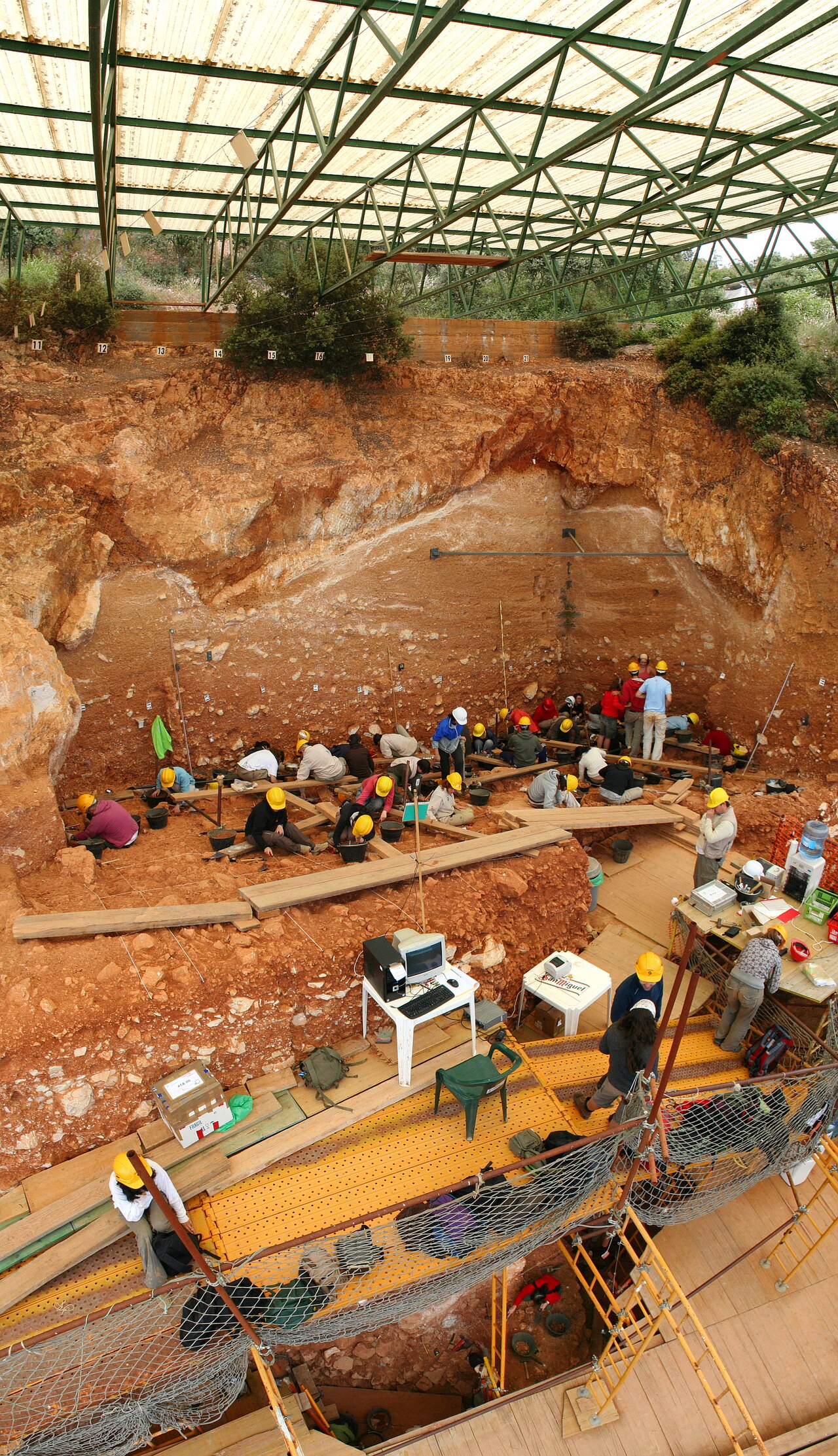
Atapuerca is a system of caves and sedimentary fills, not one continuous room occupied by an unchanged human population. Remains entered different spaces at different times, and later exposure made those records available for study. The first task is therefore contextual: establish which cave, which layer and which accumulation process a fossil belongs to. Without those connections, a collection of important human bones can become a misleading timeless family portrait.
The older window focuses on Sima del Elefante. A facial fragment described in 2025 belongs to an interval between about 1.4 and 1.1 million years ago. Its anatomy prompted a provisional comparison with Homo erectus. That qualified interpretation matters: a partial face can establish human presence and provide anatomical information without resolving every question of species identity. Early arrival in a region also does not prove uninterrupted settlement there.
The younger window follows Gran Dolina’s TD6 record, often summarized at approximately 850,000 years. Fossils assigned to Homo antecessor provide a different anatomical sample. Sedimentological investigation helps assess how much movement occurred before burial. Cave context is essential because a deposit may mix material from repeated episodes, even where transport was limited. Nearby finds can therefore be related through stratigraphy without being treated as the same group of individuals.
These records contribute to a branching and geographically complex account of human evolution. The sequence does not establish a direct ancestor-descendant chain between the two populations. Nor does one cave deposit summarize all the habitats they used. The schematic cave scenes emphasize the places where remains accumulated, while the evidence panels retain the more secure observations: dated sediment, identifiable anatomy and the specific circumstances of accumulation.
[1] [2] [3] [4]Time windows and evidence
Older ages are on the left. Bars span the dated intervals. A dot marks a single age.
- Sima del Elefante’s early human presence 1.1–1.4 Ma
- Gran Dolina’s TD6 assemblage 0.77–0.95 Ma
- The Sima del Elefante facial fragment 1.1–1.4 Ma
- Homo antecessor at Gran Dolina TD6 0.77–0.95 Ma
- The sedimentary context of TD6 0.77–0.95 Ma
Researched windowsEvidence records
1.25 Ma · interval 1.1–1.4 Ma
Sima del Elefante’s early human presence
Sediment in the Sima del Elefante cave system preserved human remains from an early phase of occupation of western Europe. The cave scene represents a place of accumulation; its geometry is schematic, not a survey of the excavation. The facial fragment’s published age range is retained rather than reduced to a false exact date. The midpoint serves only as the atlas’s representative time.
[1]Locate this time in the atlas ↗Observed
A human facial fragment occurs in the dated cave sequence.
Reconstructed
Early humans used the surrounding terrestrial landscape.
Uncertain
Exact species assignment, vegetation pattern and continuity of settlement remain uncertain.
Evidence windows overlapping this state: 1. Overlap does not establish exact coexistence.
0.85 Ma · interval 0.77–0.95 Ma
Gran Dolina’s TD6 assemblage
The TD6 layers contain human remains assigned to Homo antecessor together with other evidence of cave accumulation. The broad interval brackets this Early Pleistocene record and the representative age follows the commonly used approximate 850,000-year description. The schematic cave scene identifies the place of accumulation without treating every recovered organism as a cave-dweller or reconstructing the excavation layout.
[2] [3] [4]Locate this time in the atlas ↗Observed
Human fossils and associated material occur in a studied sedimentary unit.
Reconstructed
A later population contributed to a cave assemblage with limited transport of some remains.
Uncertain
Dating precision and accumulation processes vary among specimens and layers.
Evidence windows overlapping this state: 2. Overlap does not establish exact coexistence.
body fossil · Atapuerca ↗
Homo antecessor at Gran Dolina TD6
Human remains from the TD6 unit support anatomical study of Homo antecessor. Multiple elements allow comparisons that one isolated fragment cannot sustain. Their presence establishes a later human population in the Atapuerca record, but does not by itself demonstrate direct ancestry from the Sima del Elefante individuals. Population relationships require broader evidence than chronological succession at nearby caves.
sediment · Atapuerca ↗
The sedimentary context of TD6
Sedimentological work on TD6 investigates how remains entered and moved within the cave. Evidence for limited transport helps constrain how the assemblage formed, but does not turn the cave fill into an untouched living community. Bones, sediment and artefacts must be interpreted together. A cave can collect material through several processes, and each layer requires its own history.
What this story cannot resolve
Coordinates identify the cave complex. The two windows concern different sites and populations. Provisional taxonomic comparisons are not presented as a settled direct lineage.
Keep these ideas handy
Stratigraphy
Studying the order, relationships and distribution of rock layers and the events they preserve. Explore the idea ↗
Taphonomy
Studying what happens between an organism’s life, death, burial, preservation and eventual discovery. Explore the idea ↗
Evolutionary tree
A branching hypothesis of relationships among organisms, inferred from shared evidence rather than arranged as a ladder of progress. Explore the idea ↗
The evidence notebook
body fossil · Atapuerca ↗
The Sima del Elefante facial fragment
A partial human face recovered at Sima del Elefante documents an early population in western Europe. Its anatomy was provisionally compared with Homo erectus rather than automatically assigned to the later Homo antecessor sample. The specimen illustrates how fragmentary evidence can be informative while leaving classification open. Its geological age is a bracket, not a birthday established for the individual.
body fossil · Atapuerca ↗
Homo antecessor at Gran Dolina TD6
Human remains from the TD6 unit support anatomical study of Homo antecessor. Multiple elements allow comparisons that one isolated fragment cannot sustain. Their presence establishes a later human population in the Atapuerca record, but does not by itself demonstrate direct ancestry from the Sima del Elefante individuals. Population relationships require broader evidence than chronological succession at nearby caves.
sediment · Atapuerca ↗
The sedimentary context of TD6
Sedimentological work on TD6 investigates how remains entered and moved within the cave. Evidence for limited transport helps constrain how the assemblage formed, but does not turn the cave fill into an untouched living community. Bones, sediment and artefacts must be interpreted together. A cave can collect material through several processes, and each layer requires its own history.
Follow the evidence
Sources & credits
- Atapuerca rewrites the history of Europe’s first inhabitants ↗
CENIEH · 2025
Use, credit & modifications
Reference only; no source text, figures or photographs reproduced. Original educational synthesis.
Credit: CENIEH. Original synthesis with explicit approximate teaching windows. No source asset reuse; territorial permissions not applicable.
- Balance de la campaña de excavaciones 2025 de Atapuerca ↗
CENIEH · 2025
Use, credit & modifications
Reference only; no source text, figures or photographs reproduced. Original educational synthesis.
Credit: CENIEH. Original synthesis with explicit approximate teaching windows. No source asset reuse; territorial permissions not applicable.
- The Gran Dolina-TD6 human fossil remains and the origin of Neanderthals ↗
CENIEH / Journal of Human Evolution · 2010
Use, credit & modifications
Reference only; no source text, figures or photographs reproduced. Original educational synthesis.
Credit: CENIEH / Journal of Human Evolution. Original synthesis with explicit approximate teaching windows. No source asset reuse; territorial permissions not applicable.
- Conociendo un poco más cómo vivió Homo antecessor ↗
Fundación Atapuerca · 2016
Use, credit & modifications
Reference only; no source text, figures or photographs reproduced. Original educational synthesis.
Credit: Fundación Atapuerca. Original synthesis with explicit approximate teaching windows. No source asset reuse; territorial permissions not applicable.
Follow the connections
 Africa
Ethiopia ↗
Hadar & the Afar Rift
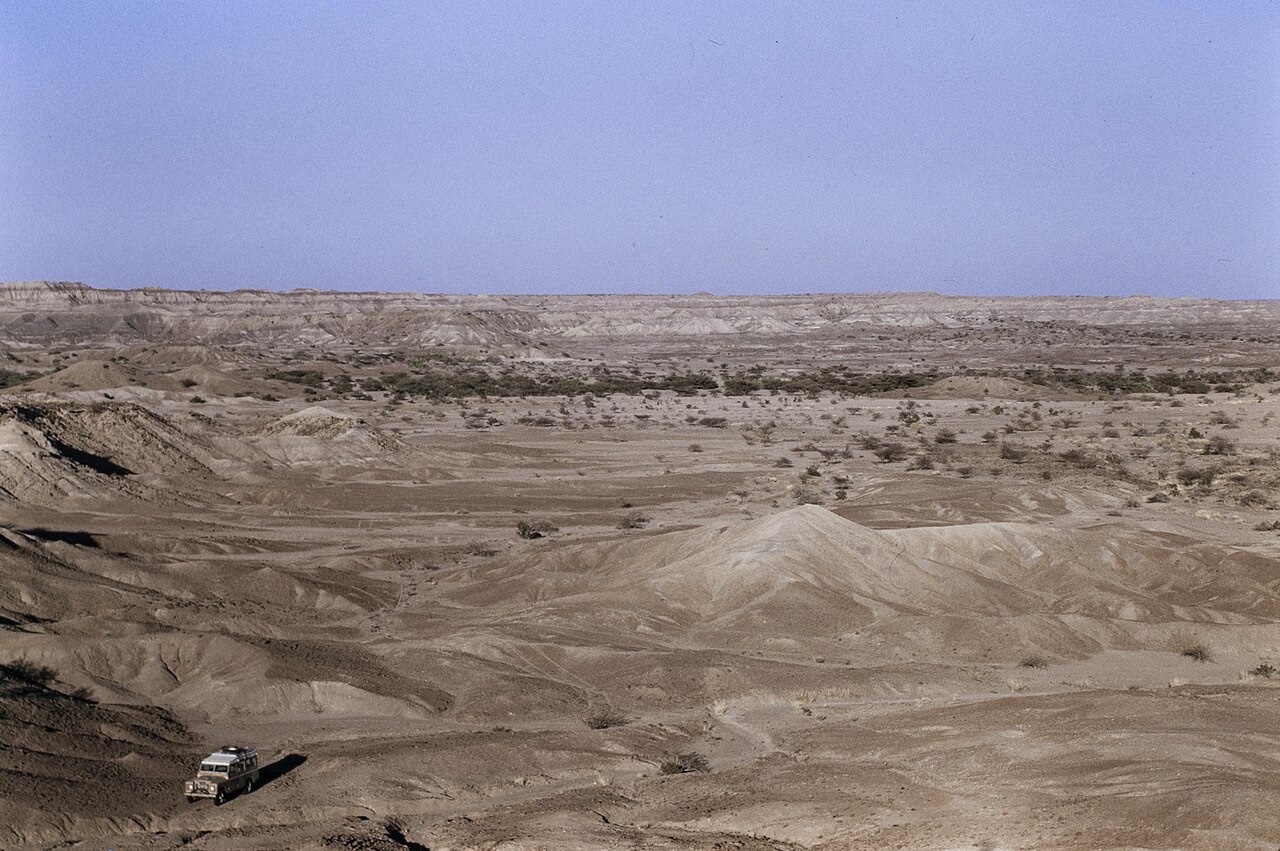
Lucy’s skeleton belongs within a wider Pliocene record of lakes, river margins, pollen and changing vegetation in the Afar basin.
3.2 Ma → Today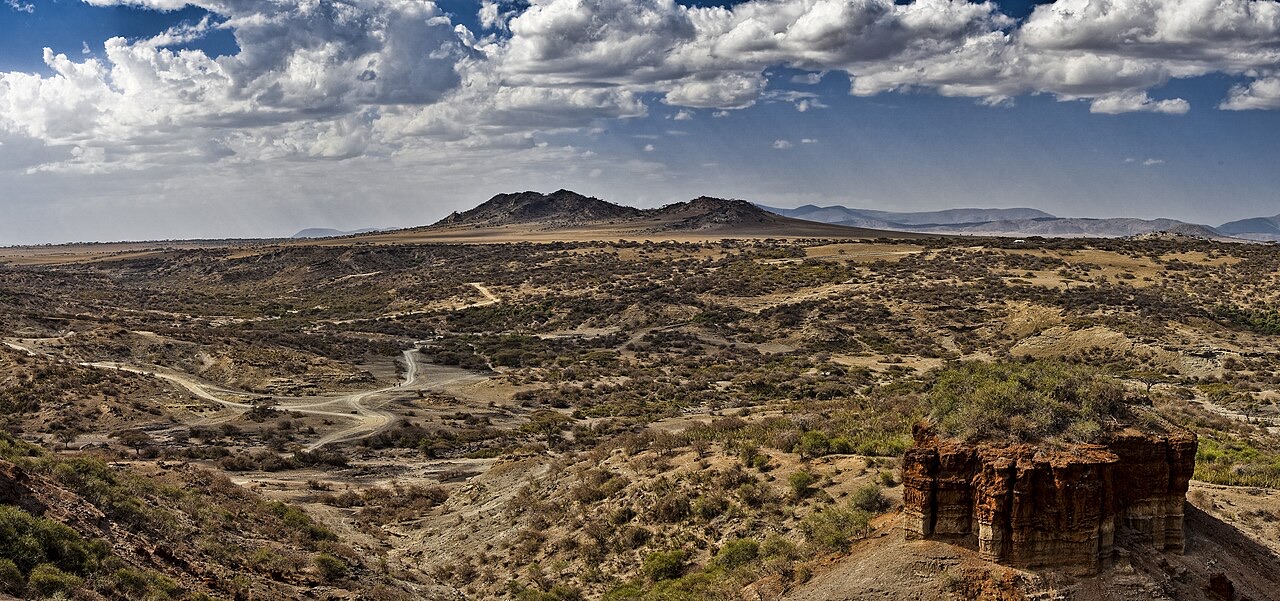 Africa
Tanzania ↗
Olduvai Gorge
Post-eruption rivers at Ewass Oldupa and younger spring-fed woodland at FLK Zinj reveal local habitat changes within an Early Pleistocene rift basin.
2.03 Ma → 1.84 Ma