
Both sites preserve information often missing from ordinary fossil assemblages. Their shared fame makes it tempting to combine them, but they are separate geographic and temporal windows into Cambrian marine life.
Window A / 518 Ma
Chengjiang
A Cambrian delta margin
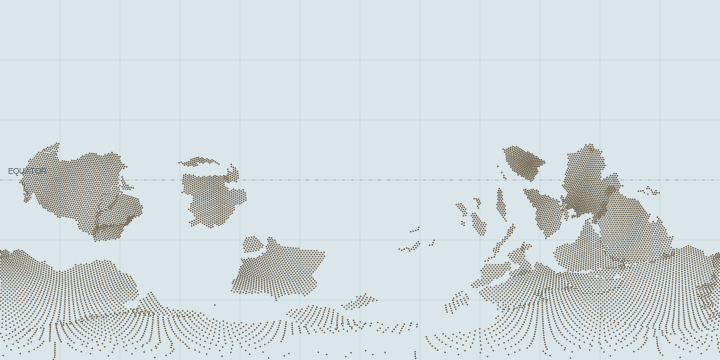
Research window 517–519 Ma
A Cambrian delta delivered sediment to a marine basin. The setting is based in part on an unweathered drill core from the Yu’anshan Formation. Its sediments suggest that bodies of animals from shallower, oxygenated water could be carried to quieter settings, where burial preserved unusual detail. The 518 Ma snapshot is rounded from zircon dating. The youngest dated zircon grains tell us the fossil-bearing sediment could have accumulated at that age or later.
[7] [8]- Observed
- Soft-bodied fossils occur in fine-grained Cambrian deposits alongside sedimentary evidence for delta processes.
- Reconstructed
- A delta margin supplied animals and sediment to depositional settings capable of exceptional preservation.
- Uncertain
- Transport distances, original abundances and anatomical interpretation vary in certainty.
Window B / 508 Ma
Burgess Shale
Life below a Cambrian platform margin
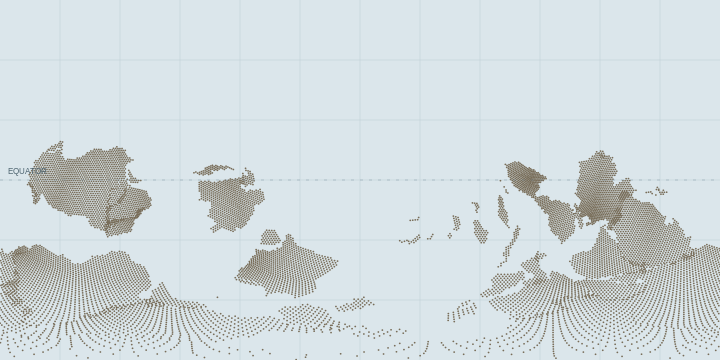
Research window 505–510 Ma
The selected scene represents the classic Burgess Shale marine ecosystem around 508 million years ago. Fine mud accumulated beside a carbonate platform, preserving both hard and soft anatomy in favourable circumstances. The illustrated organisms and seabed are conceptual, and their spacing is not a reconstruction of population density. This state uses a rounded interval encompassing the classic deposits, rather than implying every Burgess Shale locality or species was exactly contemporaneous.
[9] [10] [11]- Observed
- Flattened marine fossils, fine bedding and carbonate platform rocks are documented.
- Reconstructed
- A marine community near a platform margin, with episodic burial and unusual preservation.
- Uncertain
- Water depth, transport distance and exact preservation conditions vary by locality and remain research questions.
What the evidence shows
The Chengjiang window is centred on about 518 Ma and that of the Burgess Shale on about 508 Ma. Both preserve delicate anatomy in fine sediment. At Chengjiang, a sediment-core study identified delta deposits. The Walcott Quarry samples mud deposited near a carbonate platform margin.
[7] [8] [9] [10]What we infer from it
Comparing anatomy and ecological roles can illuminate continuity and change through the Cambrian. The method works best when age and preservation differences are retained. Shared body plans need not indicate identical communities, and a group unique to one collection may reflect a sampling difference.
[5] [6]What remains open
This pair is not a standardized biodiversity experiment. It supplies no abundance measure, complete species range or proof that a missing taxon was absent from the other ancient environment.
Follow the evidence
Sources & credits
- palaeoverse: palaeogeographic reconstruction files, v2.0.0 ↗
Lewis A. Jones / Zenodo · 2024-09-19
Use, credit & modifications
CC BY 4.0; verified on dataset API metadata, not inferred from paper
Credit: Lewis A. Jones (2024), palaeoverse v2.0.0; Jones & Domeier (2024); MERDITH2021 model. RDS converted to static JSON and original dot maps; selected ages; nearest-centroid regional matching; display rounding. Worldwide under CC BY 4.0.
- A Phanerozoic gridded dataset for palaeogeographic reconstructions ↗
Jones & Domeier, Scientific Data 11:710 · 2024
Use, credit & modifications
Reference only; no paper text or figures reproduced
Credit: Jones & Domeier (2024). Original methodological synthesis. No reproduced asset.
- Chengjiang Fossil Site ↗
UNESCO World Heritage Centre · Not stated
Use, credit & modifications
Reference only. No source text, photographs, charts or other assets reproduced; original factual synthesis.
Credit: UNESCO World Heritage Centre. Original explanatory synthesis; geological boundary ages normalized to ICS 2026/06 where relevant. No third-party asset reuse; no territorial asset licence asserted.
- The Cambrian Period ↗
University of California Museum of Paleontology · 2011 compilation; older underlying material
Use, credit & modifications
Reference only. No source text, photographs, charts or other assets reproduced; original factual synthesis.
Credit: University of California Museum of Paleontology. Original explanatory synthesis; geological boundary ages normalized to ICS 2026/06 where relevant. No third-party asset reuse; no territorial asset licence asserted.
- Across space and time: A review of sampling, preservational, analytical, and anthropogenic biases in fossil data across macroecological scales ↗
Earth-Science Reviews · 2023
Use, credit & modifications
Reference only. No source text, photographs, charts or other assets reproduced; original factual synthesis.
Credit: Earth-Science Reviews. Original explanatory synthesis; geological boundary ages normalized to ICS 2026/06 where relevant. No third-party asset reuse; no territorial asset licence asserted.
- Taphonomy—Death & Decay ↗
US National Park Service · Not stated
Use, credit & modifications
Reference only. No source text, photographs, charts or other assets reproduced; original factual synthesis.
Credit: US National Park Service. Original explanatory synthesis; geological boundary ages normalized to ICS 2026/06 where relevant. No third-party asset reuse; no territorial asset licence asserted.
- The Chengjiang Biota inhabited a deltaic environment ↗
Saleh et al.; Nature Communications · 2022
Use, credit & modifications
Reference only. No third-party prose, figures, photographs or datasets reproduced; factual interpretation written originally for this atlas.
Credit: Saleh et al.; Nature Communications — The Chengjiang Biota inhabited a deltaic environment. Original educational synthesis; geological ages rounded into explicitly labelled teaching intervals. No licensed media incorporated; no territorial reuse permission asserted.
- Geochronological constraint on the Cambrian Chengjiang biota, South China ↗
Yang et al.; Journal of the Geological Society / British Geological Survey · 2018
Use, credit & modifications
Reference only. No third-party prose, figures, photographs or datasets reproduced; factual interpretation written originally for this atlas.
Credit: Yang et al.; Journal of the Geological Society / British Geological Survey — Geochronological constraint on the Cambrian Chengjiang biota, South China. Original educational synthesis; geological ages rounded into explicitly labelled teaching intervals. No licensed media incorporated; no territorial reuse permission asserted.
- Geological Background — The Burgess Shale ↗
Royal Ontario Museum / Parks Canada · Not stated
Use, credit & modifications
Reference only. No source text, photographs, figures or datasets reproduced. Original factual synthesis; no reuse licence asserted.
Credit: Royal Ontario Museum / Parks Canada — Geological Background — The Burgess Shale. Facts paraphrased into original educational text; ages rounded to declared teaching intervals. No asset reuse requested; territorial permissions not applicable.
- Marrella splendens ↗
Royal Ontario Museum / Parks Canada · Not stated
Use, credit & modifications
Reference only. No source text, photographs, figures or datasets reproduced. Original factual synthesis; no reuse licence asserted.
Credit: Royal Ontario Museum / Parks Canada — Marrella splendens. Facts paraphrased into original educational text; ages rounded to declared teaching intervals. No asset reuse requested; territorial permissions not applicable.
- Waptia fieldensis ↗
Royal Ontario Museum / Parks Canada · Not stated
Use, credit & modifications
Reference only. No source text, photographs, figures or datasets reproduced. Original factual synthesis; no reuse licence asserted.
Credit: Royal Ontario Museum / Parks Canada — Waptia fieldensis. Facts paraphrased into original educational text; ages rounded to declared teaching intervals. No asset reuse requested; territorial permissions not applicable.