
Late Ediacaran impressions and early Cambrian exceptionally preserved bodies reveal different aspects of early animal history. This is an evidence comparison between regions, not a continuous local section or a direct ancestor–descendant sequence.
Window A / 555 Ma
Ediacara & Nilpena
A patchwork of marine communities
No geographic reconstruction is supplied for this age. It falls outside this dataset’s 540–0 Ma coverage.
Research window 550–560 Ma
This scene represents the late Ediacaran seafloor recorded by the Ediacara Member of the Rawnsley Quartzite. Multiple fossil-bearing surfaces reveal differently composed communities. The schematic shows organisms distributed across a substrate, with no claim to reproduce a surveyed Nilpena bed or the precise bodies of uncertain taxa. The rounded age interval provides context for the fossil assemblage, not a single instantaneous date for every surface.
[7] [8] [11]- Observed
- Soft-bodied impressions and sedimentary textures occur together on extensive bedding surfaces.
- Reconstructed
- Organisms occupied a marine floor in spatially variable communities.
- Uncertain
- Affinities, life habits and the completeness of each preserved community vary in confidence.
Window B / 518 Ma
Chengjiang
A Cambrian delta margin
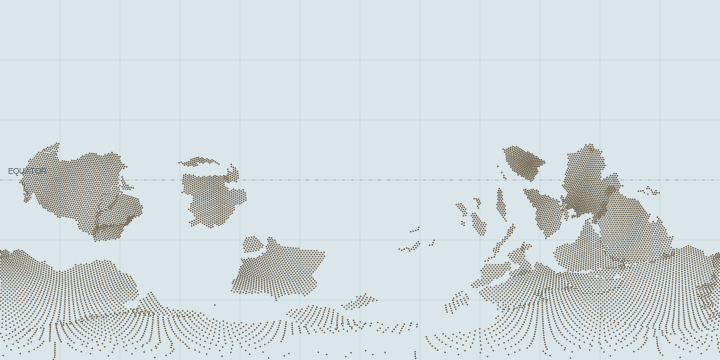
Research window 517–519 Ma
A Cambrian delta delivered sediment to a marine basin. The setting is based in part on an unweathered drill core from the Yu’anshan Formation. Its sediments suggest that bodies of animals from shallower, oxygenated water could be carried to quieter settings, where burial preserved unusual detail. The 518 Ma snapshot is rounded from zircon dating. The youngest dated zircon grains tell us the fossil-bearing sediment could have accumulated at that age or later.
[9] [10]- Observed
- Soft-bodied fossils occur in fine-grained Cambrian deposits alongside sedimentary evidence for delta processes.
- Reconstructed
- A delta margin supplied animals and sediment to depositional settings capable of exceptional preservation.
- Uncertain
- Transport distances, original abundances and anatomical interpretation vary in certainty.
What the evidence shows
Some Ediacara bedding surfaces preserve low-relief impressions alongside sediment textures. Chengjiang’s fine-grained rock preserves details of body structures, often including parts that usually decay. Differences in burial and preservation affect what investigators can compare.
[7] [8] [9] [10]What we infer from it
Biological diversification and ecological change contributed to the difference, while the preservation filters changed the observable sample. Evaluating their relative roles requires additional localities, dating and anatomical comparison. A dramatic visual contrast is a starting question rather than a complete explanation.
[3] [4] [6]What remains open
The selected sites cannot determine when every animal group originated, nor prove that unrecorded organisms were absent. Their ages must be read explicitly rather than equated through a broad period label.
Follow the evidence
Sources & credits
- palaeoverse: palaeogeographic reconstruction files, v2.0.0 ↗
Lewis A. Jones / Zenodo · 2024-09-19
Use, credit & modifications
CC BY 4.0; verified on dataset API metadata, not inferred from paper
Credit: Lewis A. Jones (2024), palaeoverse v2.0.0; Jones & Domeier (2024); MERDITH2021 model. RDS converted to static JSON and original dot maps; selected ages; nearest-centroid regional matching; display rounding. Worldwide under CC BY 4.0.
- A Phanerozoic gridded dataset for palaeogeographic reconstructions ↗
Jones & Domeier, Scientific Data 11:710 · 2024
Use, credit & modifications
Reference only; no paper text or figures reproduced
Credit: Jones & Domeier (2024). Original methodological synthesis. No reproduced asset.
- What the earliest evidence for life tells us about the early evolution of the biosphere ↗
Philosophical Transactions of the Royal Society B · 2025
Use, credit & modifications
Reference only. No source text, photographs, charts or other assets reproduced; original factual synthesis.
Credit: Philosophical Transactions of the Royal Society B. Original explanatory synthesis; geological boundary ages normalized to ICS 2026/06 where relevant. No third-party asset reuse; no territorial asset licence asserted.
- The Cambrian Period ↗
University of California Museum of Paleontology · 2011 compilation; older underlying material
Use, credit & modifications
Reference only. No source text, photographs, charts or other assets reproduced; original factual synthesis.
Credit: University of California Museum of Paleontology. Original explanatory synthesis; geological boundary ages normalized to ICS 2026/06 where relevant. No third-party asset reuse; no territorial asset licence asserted.
- Chengjiang Fossil Site ↗
UNESCO World Heritage Centre · Not stated
Use, credit & modifications
Reference only. No source text, photographs, charts or other assets reproduced; original factual synthesis.
Credit: UNESCO World Heritage Centre. Original explanatory synthesis; geological boundary ages normalized to ICS 2026/06 where relevant. No third-party asset reuse; no territorial asset licence asserted.
- Across space and time: A review of sampling, preservational, analytical, and anthropogenic biases in fossil data across macroecological scales ↗
Earth-Science Reviews · 2023
Use, credit & modifications
Reference only. No source text, photographs, charts or other assets reproduced; original factual synthesis.
Credit: Earth-Science Reviews. Original explanatory synthesis; geological boundary ages normalized to ICS 2026/06 where relevant. No third-party asset reuse; no territorial asset licence asserted.
- Heterogeneity of the Ediacaran seafloor: An example from the Ediacaran of South Australia ↗
Droser and Gehling; PNAS · 2015
Use, credit & modifications
Reference only. No third-party prose, figures, photographs or datasets reproduced; factual interpretation written originally for this atlas.
Credit: Droser and Gehling; PNAS — Heterogeneity of the Ediacaran seafloor: An example from the Ediacaran of South Australia. Original educational synthesis; geological ages rounded into explicitly labelled teaching intervals. No licensed media incorporated; no territorial reuse permission asserted.
- Museum Director marks Ediacara’s 80th anniversary with visit to fossil beds ↗
South Australian Museum · 2026
Use, credit & modifications
Reference only. No third-party prose, figures, photographs or datasets reproduced; factual interpretation written originally for this atlas.
Credit: South Australian Museum — Museum Director marks Ediacara’s 80th anniversary with visit to fossil beds. Original educational synthesis; geological ages rounded into explicitly labelled teaching intervals. No licensed media incorporated; no territorial reuse permission asserted.
- The Chengjiang Biota inhabited a deltaic environment ↗
Saleh et al.; Nature Communications · 2022
Use, credit & modifications
Reference only. No third-party prose, figures, photographs or datasets reproduced; factual interpretation written originally for this atlas.
Credit: Saleh et al.; Nature Communications — The Chengjiang Biota inhabited a deltaic environment. Original educational synthesis; geological ages rounded into explicitly labelled teaching intervals. No licensed media incorporated; no territorial reuse permission asserted.
- Geochronological constraint on the Cambrian Chengjiang biota, South China ↗
Yang et al.; Journal of the Geological Society / British Geological Survey · 2018
Use, credit & modifications
Reference only. No third-party prose, figures, photographs or datasets reproduced; factual interpretation written originally for this atlas.
Credit: Yang et al.; Journal of the Geological Society / British Geological Survey — Geochronological constraint on the Cambrian Chengjiang biota, South China. Original educational synthesis; geological ages rounded into explicitly labelled teaching intervals. No licensed media incorporated; no territorial reuse permission asserted.
- Species of Dickinsonia Sprigg from the Ediacaran of South Australia ↗
Evans et al.; Palaeontology / Stanford University · 2023
Use, credit & modifications
Reference only. No third-party prose, figures, photographs or datasets reproduced; factual interpretation written originally for this atlas.
Credit: Evans et al.; Palaeontology / Stanford University — Species of Dickinsonia Sprigg from the Ediacaran of South Australia. Original educational synthesis; geological ages rounded into explicitly labelled teaching intervals. No licensed media incorporated; no territorial reuse permission asserted.