
Ancient rocks record microbial worlds, early crust and oceans. Deciding whether a structure was made by life is part of the investigation.
The Archean record contains some of the oldest widely accepted evidence of life. Layered microbial structures, microscopic textures and chemical signatures provide different kinds of clues. None works as a universal shortcut. Later heating can change minerals, deformation can mimic biological shapes, and nonbiological reactions can sometimes produce carbon signatures that resemble biological ones. Strong interpretations therefore bring several observations together. [2]
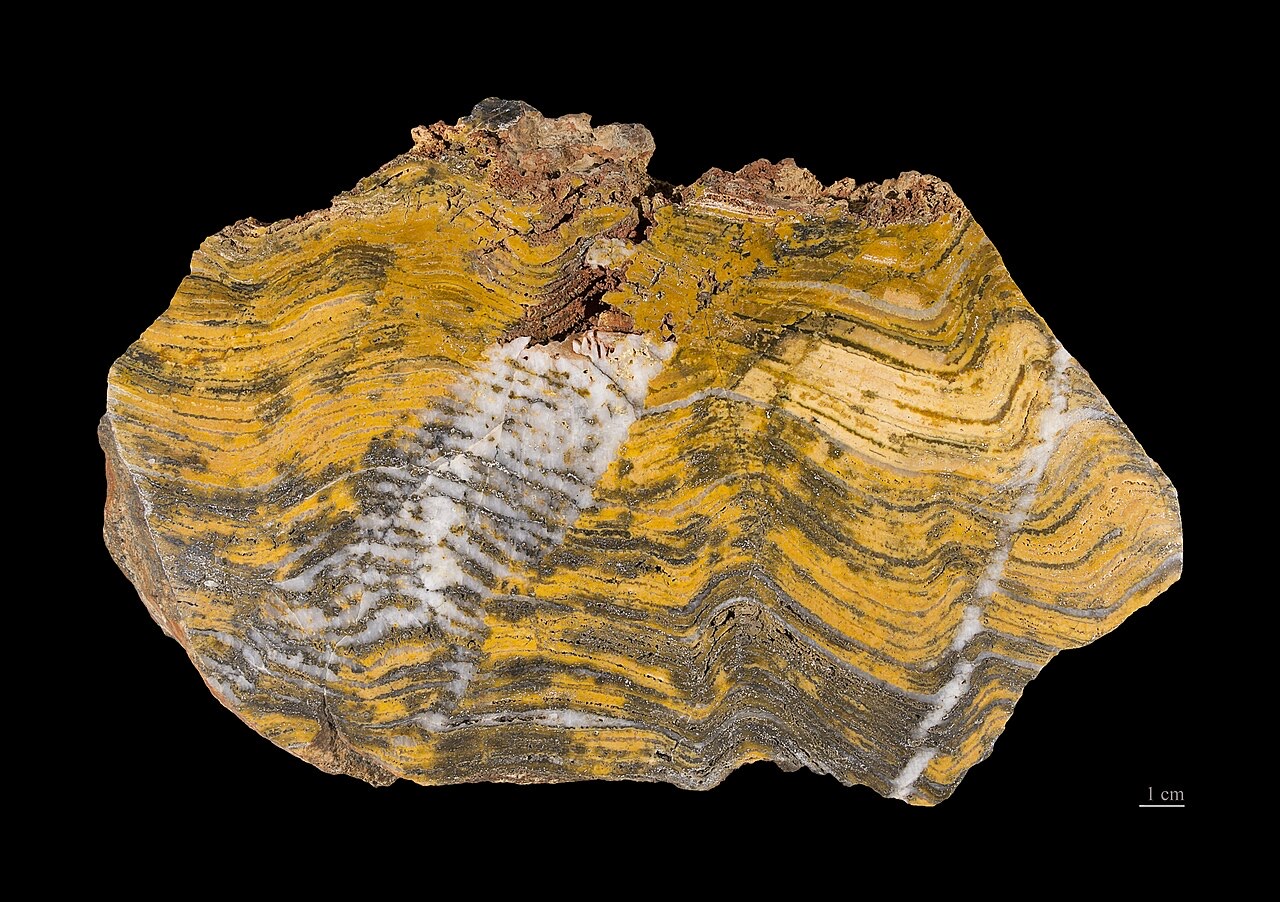
Stromatolites are a useful example. Their layers can form through the interaction of microbial communities with sediment and mineral precipitation. Their shape tells a story about growth and the local environment, but a stromatolite does not by itself identify every microorganism that made it. Nor does its presence prove that those microbes released oxygen. Different metabolisms can participate in apparently similar structures. [3] [2]
Two Pilbara windows make the difference concrete. At about 3,480 Ma, silica deposits from the Dresser Formation preserve textures interpreted as evidence of hot springs and possible microbial growth. The younger Strelley Pool rocks preserve repeated layered forms on a shallow carbonate platform. Together the rocks let researchers ask where early microbes lived and what could mimic their traces. [5] [6]
A turning point
Persistent microbial ecosystems became part of the geological record long before animals.
Reading this chapter carefully
The Pilbara records two local settings. They give no precise Archean coastline or date for the origin of life. Some proposed signatures of microbial activity remain contested.
Ma means millions of years before the present. The international chart gives the estimated boundary ages. [1]
Where to see this chapter in the rocks
These places preserve selected windows from the chapter. Find all overlapping regional histories.
Follow the evidence
Sources & credits
- International Chronostratigraphic Chart, version 2026/06 ↗
International Commission on Stratigraphy · 2026-06
Use, credit & modifications
Reference only. No source text, photographs, charts or other assets reproduced; original factual synthesis.
Credit: International Commission on Stratigraphy. Original explanatory synthesis; geological boundary ages normalized to ICS 2026/06 where relevant. No third-party asset reuse; no territorial asset licence asserted.
- What the earliest evidence for life tells us about the early evolution of the biosphere ↗
Philosophical Transactions of the Royal Society B · 2025
Use, credit & modifications
Reference only. No source text, photographs, charts or other assets reproduced; original factual synthesis.
Credit: Philosophical Transactions of the Royal Society B. Original explanatory synthesis; geological boundary ages normalized to ICS 2026/06 where relevant. No third-party asset reuse; no territorial asset licence asserted.
- Stromatolites ↗
Western Australian Museum · Not stated
Use, credit & modifications
Reference only. No source text, photographs, charts or other assets reproduced; original factual synthesis.
Credit: Western Australian Museum. Original explanatory synthesis; geological boundary ages normalized to ICS 2026/06 where relevant. No third-party asset reuse; no territorial asset licence asserted.
- Clues to Oxygen on Earth before the Great Oxidation Event ↗
NASA Astrobiology · 2021
Use, credit & modifications
Reference only. No source text, photographs, charts or other assets reproduced; original factual synthesis.
Credit: NASA Astrobiology. Original explanatory synthesis; geological boundary ages normalized to ICS 2026/06 where relevant. No third-party asset reuse; no territorial asset licence asserted.
- Earliest signs of life on land preserved in ca. 3.5 Ga hot spring deposits ↗
Djokic et al.; Nature Communications · 2017-05-09; corrected 2017-08-16
Use, credit & modifications
Reference only. No third-party prose, figures or media reproduced in the regional narrative; original factual synthesis.
Credit: Djokic et al.; Nature Communications — Earliest signs of life on land preserved in ca. 3.5 Ga hot spring deposits. Original educational synthesis. Age envelopes are explicitly rounded teaching intervals, not new analytical uncertainties. No media licence or territorial reuse permission asserted for this reference. Photographs have separate item-level credits.
- Stromatolite reef from the Early Archaean era of Australia ↗
Allwood et al.; Nature · 2006-06-08
Use, credit & modifications
Reference only. No third-party prose, figures or media reproduced in the regional narrative; original factual synthesis.
Credit: Allwood et al.; Nature — Stromatolite reef from the Early Archaean era of Australia. Original educational synthesis. Age envelopes are explicitly rounded teaching intervals, not new analytical uncertainties. No media licence or territorial reuse permission asserted for this reference. Photographs have separate item-level credits.