
What does a marine shell bed add to a famous dinosaur story?
Tendaguru is famous for giant dinosaurs, but its rock succession does not describe an exclusively inland landscape. Dinosaur-bearing units alternate with marine deposits. That pattern matters because each fossil must be interpreted within the environment that buried it. A large sauropod bone and a marine bivalve can belong to the same regional geological history without coming from one simultaneous community or one unchanging habitat.
The older window centres on the Middle Dinosaur Member and associated coastal deposits. Kentrosaurus, sauropods and other vertebrates contributed to the fossil record, while sedimentary structures and smaller organisms constrain the environments around them. The animals’ presence does not by itself identify whether a particular accumulation formed on a floodplain, near a lagoon or after transport. Those distinctions require the surrounding rock and field relationships.
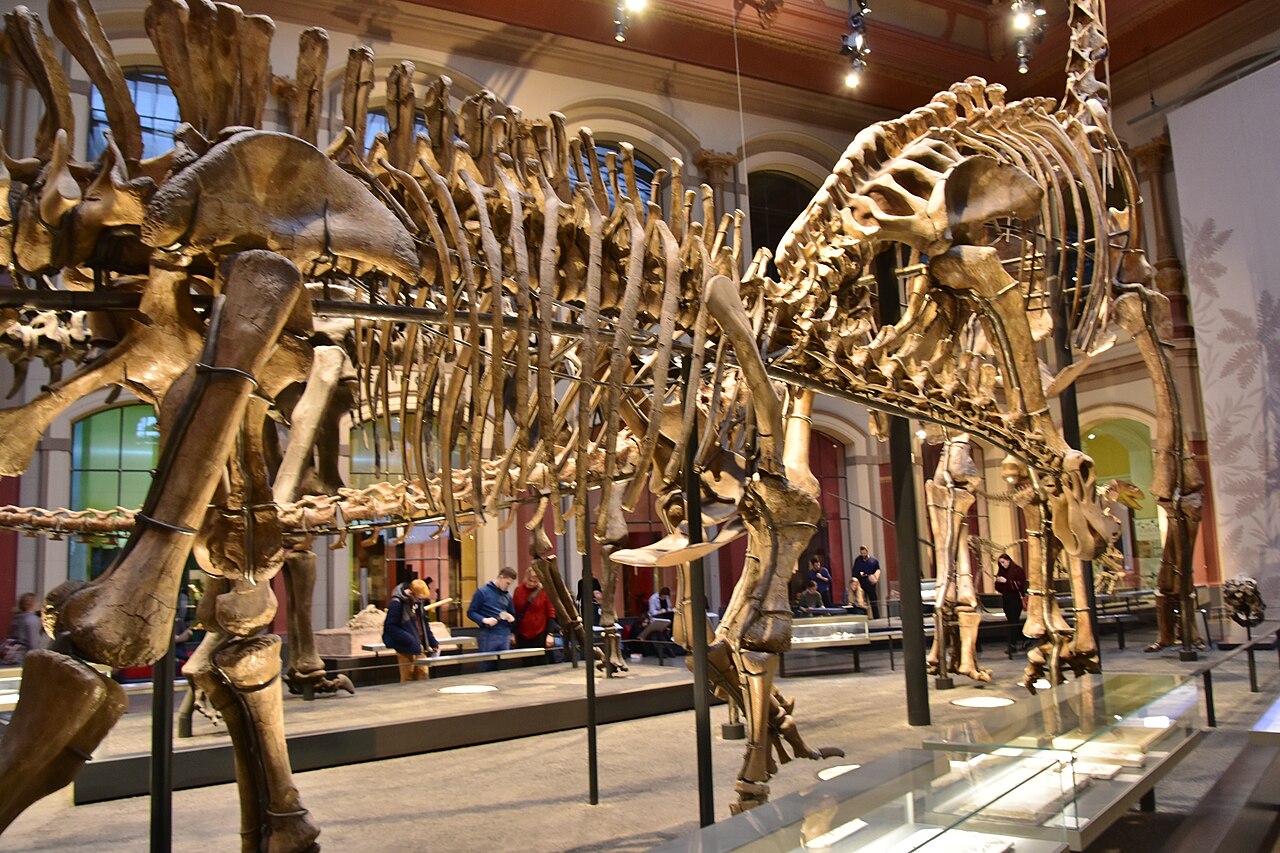
The younger Upper Dinosaur Member records another terrestrial-influenced phase after intervening marine deposition. Giraffatitan is among the dinosaurs represented in the broader succession. The famous mounted skeleton in Berlin is a scientific and exhibition reconstruction, not an animal preserved standing upright. Its elements and restoration draw on documented fossil material, and the original excavation records help retain connections that a museum gallery alone cannot display.
The history of collecting is also part of this page. Much material was removed during German colonial rule, with African labour and knowledge central to the expeditions. Museum archives now provide a route back to excavation contexts and that human history. The two broad age windows avoid pretending that every historic specimen has equally precise provenance. Together, marine strata, dinosaur bones and documentation reveal a richer record than a single scene of giants.
[1] [2] [3] [4]Time windows and evidence
Older ages are on the left. Bars span the dated intervals. A dot marks a single age.
- The Middle Dinosaur coastal landscape 149.2–155 Ma
- A later dinosaur-bearing coastal interval 143.1–149.2 Ma
- Kentrosaurus in the dinosaur-bearing succession 143.1–155 Ma
- Giraffatitan from Tendaguru 143.1–155 Ma
- The Indotrigonia africana marine interval 145–152 Ma
Researched windowsEvidence records
152 Ma · interval 149.2–155 Ma
The Middle Dinosaur coastal landscape
Dinosaur-bearing sediment accumulated within a low-relief coastal system influenced by terrestrial water and nearby marine environments. The Middle Dinosaur Member supplies a major vertebrate record. The broad bracket represents its Late Jurassic placement and associated uncertainty; it is not an exact date for every excavation. The conceptual river and coastal plain illustrate the depositional range rather than a mapped channel.
[1] [2]Locate this time in the atlas ↗Observed
Dinosaur remains occur alongside sedimentary and invertebrate evidence of coastal conditions.
Reconstructed
Terrestrial ecosystems occupied land close to a changing marine margin.
Uncertain
Transport histories and correlation vary among sites and beds.
Evidence windows overlapping this state: 3. Overlap does not establish exact coexistence.
body fossil · Tendaguru ↗
Kentrosaurus in the dinosaur-bearing succession
Kentrosaurus aethiopicus remains occur in the Tendaguru dinosaur-bearing sequence, including the Middle Dinosaur Member. Plates, spines and other skeletal elements support anatomical comparison of this stegosaur. The accumulation should not be reduced to a single fully connected herd. Specimens collected from different excavations and levels need their individual records before they can support ecological or population interpretations.
body fossil · Tendaguru ↗
Giraffatitan from Tendaguru
The sauropod now called Giraffatitan brancai is represented by substantial Tendaguru material, historically described under Brachiosaurus. Fossils occur in more than one dinosaur-bearing member. The famous Berlin mount makes its anatomy accessible, but is an assembled exhibition reconstruction rather than one untouched skeleton in its original burial pose. The excavation and archival history are necessary parts of the evidence.
body fossil · Tendaguru ↗
The Indotrigonia africana marine interval
Marine bivalves characterize a unit between dinosaur-bearing intervals in the Tendaguru succession. This alternation reveals changing relationships between land, coastal environments and marine sedimentation. A dinosaur bone elsewhere in the formation does not make all the rocks terrestrial, just as a shell bed does not mean every dinosaur lived offshore. Facies and stratigraphy connect these different observations.
147 Ma · interval 143.1–149.2 Ma
A later dinosaur-bearing coastal interval
The Upper Dinosaur Member records a younger phase in the alternating terrestrial and marine succession. Sauropod and other vertebrate remains entered deposits influenced by coastal processes. Its exact relation to the Jurassic–Cretaceous boundary has been discussed in the literature, so the selected window is a broad latest Jurassic teaching bracket. The scene does not imply that every named dinosaur is known from one shared surface.
[1] [2]Locate this time in the atlas ↗Observed
A younger dinosaur-bearing member overlies an intervening marine unit.
Reconstructed
Coastal environments shifted repeatedly as sedimentation and marine influence changed.
Uncertain
Uppermost age assignments and individual specimen provenance are not uniformly precise.
Evidence windows overlapping this state: 3. Overlap does not establish exact coexistence.
body fossil · Tendaguru ↗
Kentrosaurus in the dinosaur-bearing succession
Kentrosaurus aethiopicus remains occur in the Tendaguru dinosaur-bearing sequence, including the Middle Dinosaur Member. Plates, spines and other skeletal elements support anatomical comparison of this stegosaur. The accumulation should not be reduced to a single fully connected herd. Specimens collected from different excavations and levels need their individual records before they can support ecological or population interpretations.
body fossil · Tendaguru ↗
Giraffatitan from Tendaguru
The sauropod now called Giraffatitan brancai is represented by substantial Tendaguru material, historically described under Brachiosaurus. Fossils occur in more than one dinosaur-bearing member. The famous Berlin mount makes its anatomy accessible, but is an assembled exhibition reconstruction rather than one untouched skeleton in its original burial pose. The excavation and archival history are necessary parts of the evidence.
body fossil · Tendaguru ↗
The Indotrigonia africana marine interval
Marine bivalves characterize a unit between dinosaur-bearing intervals in the Tendaguru succession. This alternation reveals changing relationships between land, coastal environments and marine sedimentation. A dinosaur bone elsewhere in the formation does not make all the rocks terrestrial, just as a shell bed does not mean every dinosaur lived offshore. Facies and stratigraphy connect these different observations.
What this story cannot resolve
Modern coordinates locate the Tendaguru region. Broad member ages and historic collection records limit exact comparisons. Museum mounts include interpretation and restoration, and the colonial collection context is retained.
Keep these ideas handy
Facies
The observable characteristics of a rock body that help describe and interpret its depositional setting. Explore the idea ↗
Sea level & shorelines
The position of the sea relative to the land, affected by both water-volume changes and movements of the solid Earth. Explore the idea ↗
Taphonomy
Studying what happens between an organism’s life, death, burial, preservation and eventual discovery. Explore the idea ↗
The evidence notebook
body fossil · Tendaguru ↗
Kentrosaurus in the dinosaur-bearing succession
Kentrosaurus aethiopicus remains occur in the Tendaguru dinosaur-bearing sequence, including the Middle Dinosaur Member. Plates, spines and other skeletal elements support anatomical comparison of this stegosaur. The accumulation should not be reduced to a single fully connected herd. Specimens collected from different excavations and levels need their individual records before they can support ecological or population interpretations.
body fossil · Tendaguru ↗
Giraffatitan from Tendaguru
The sauropod now called Giraffatitan brancai is represented by substantial Tendaguru material, historically described under Brachiosaurus. Fossils occur in more than one dinosaur-bearing member. The famous Berlin mount makes its anatomy accessible, but is an assembled exhibition reconstruction rather than one untouched skeleton in its original burial pose. The excavation and archival history are necessary parts of the evidence.
body fossil · Tendaguru ↗
The Indotrigonia africana marine interval
Marine bivalves characterize a unit between dinosaur-bearing intervals in the Tendaguru succession. This alternation reveals changing relationships between land, coastal environments and marine sedimentation. A dinosaur bone elsewhere in the formation does not make all the rocks terrestrial, just as a shell bed does not mean every dinosaur lived offshore. Facies and stratigraphy connect these different observations.
Follow the evidence
Sources & credits
- The Tendaguru Formation: definition, palaeoenvironments and sequence stratigraphy ↗
Fossil Record · 2009
Use, credit & modifications
Reference only; no source text, figures or photographs reproduced. Original educational synthesis.
Credit: Fossil Record. Original synthesis with explicit approximate teaching windows. No source asset reuse; territorial permissions not applicable.
- Theropod dinosaurs from the Late Jurassic of Tendaguru, Tanzania ↗
Palaeontological Association · 2011
Use, credit & modifications
Reference only; no source text, figures or photographs reproduced. Original educational synthesis.
Credit: Palaeontological Association. Original synthesis with explicit approximate teaching windows. No source asset reuse; territorial permissions not applicable.
- Digital Tendaguru: fossil and archival material ↗
Museum für Naturkunde Berlin · Not stated
Use, credit & modifications
Reference only; no source text, figures or photographs reproduced. Original educational synthesis.
Credit: Museum für Naturkunde Berlin. Original synthesis with explicit approximate teaching windows. No source asset reuse; territorial permissions not applicable.
- The Empire and colonial interconnections, 1889–1918 ↗
Museum für Naturkunde Berlin · Not stated
Use, credit & modifications
Reference only; no source text, figures or photographs reproduced. Original educational synthesis.
Credit: Museum für Naturkunde Berlin. Original synthesis with explicit approximate teaching windows. No source asset reuse; territorial permissions not applicable.
Follow the connections
 North America
United States ↗
Dinosaur National Monument
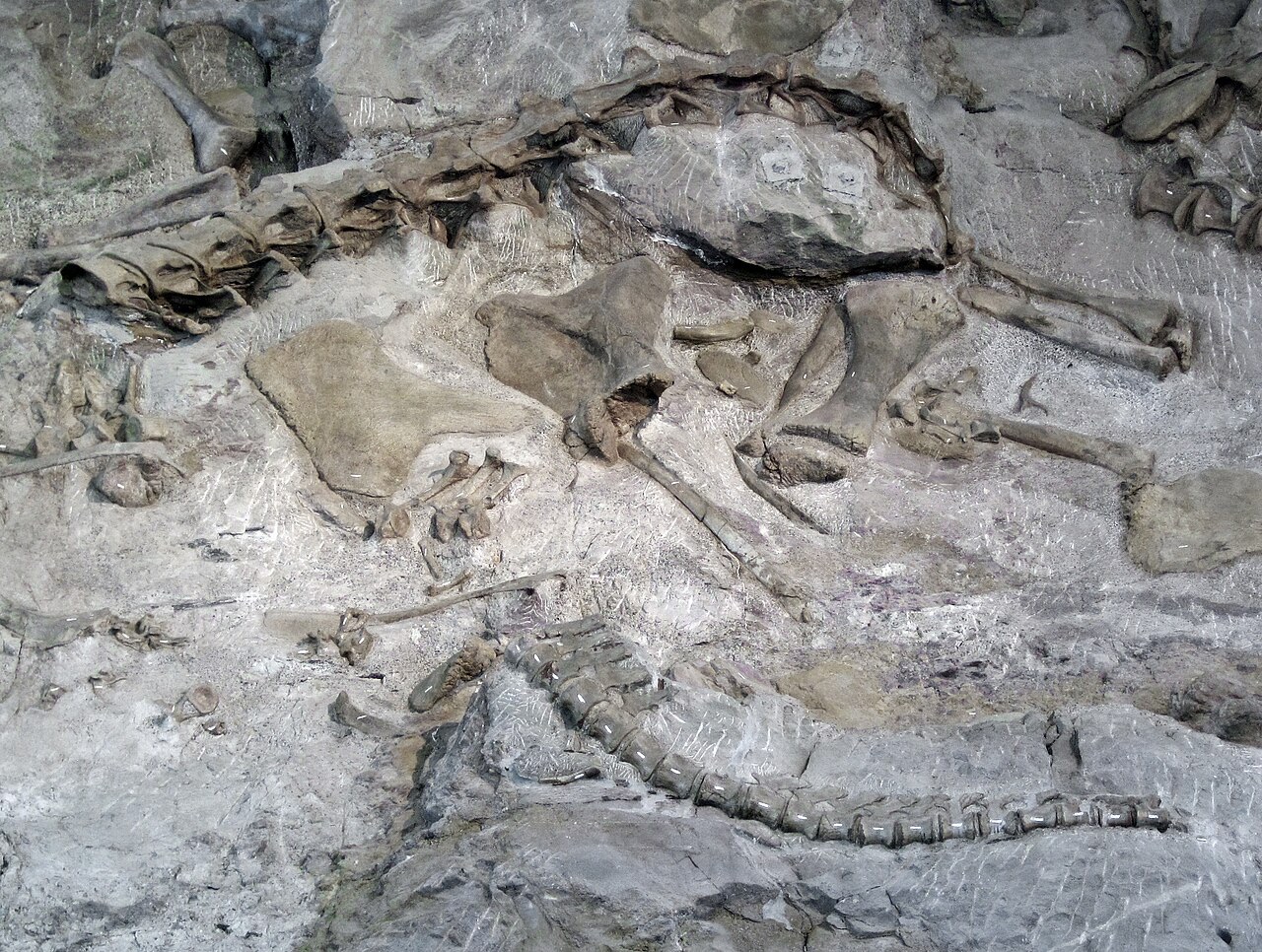
The monument preserves more than the Morrison dinosaur quarry. Older Nugget Sandstone records animals crossing desert dunes; younger river deposits preserve bones, wood and evidence of a different ecosystem.
200 Ma → 151 Ma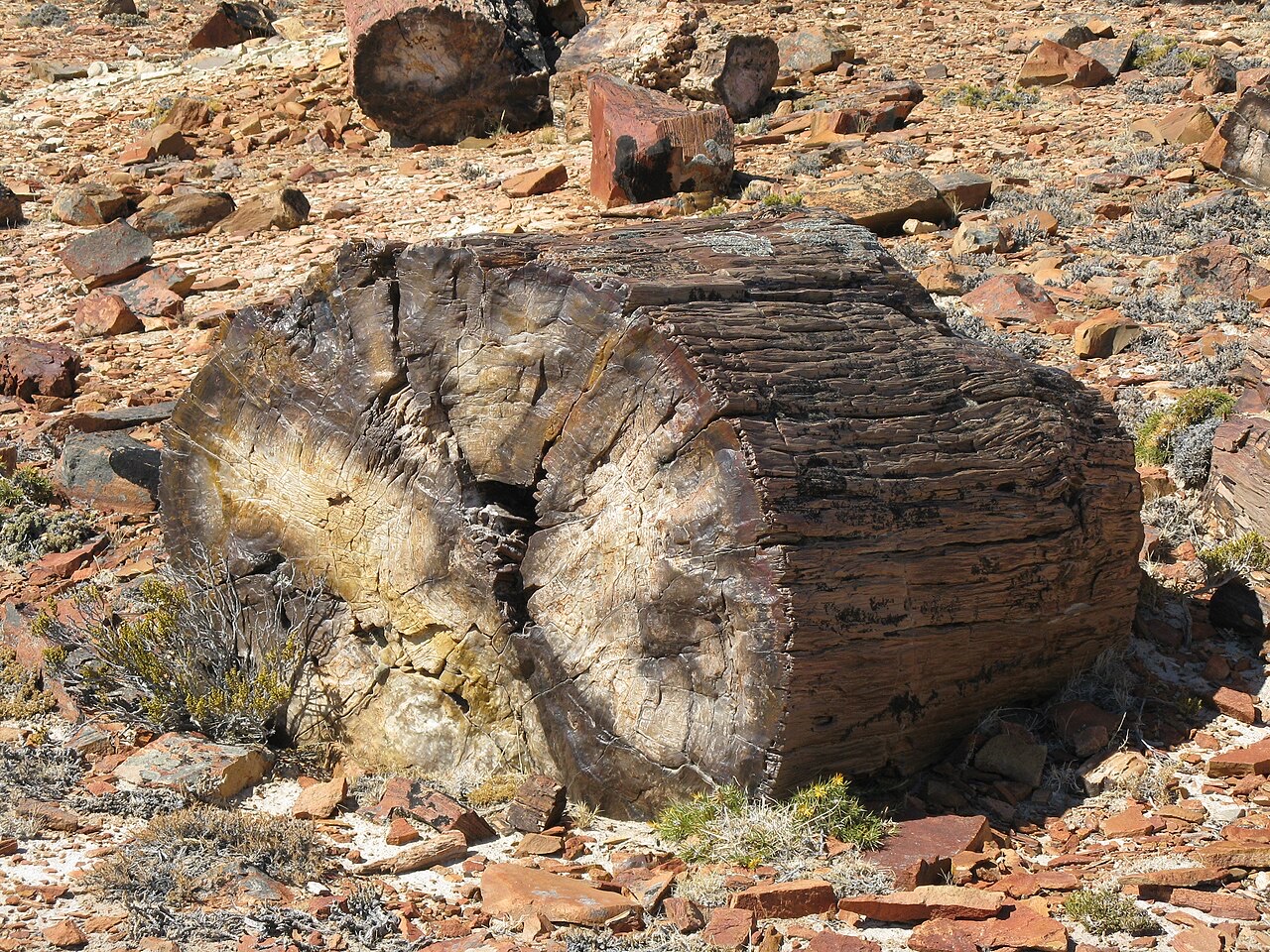 South America
Argentina ↗
Southern Patagonia
Jurassic petrified conifers and Miocene mammals reveal two distinct southern Patagonian ecosystems without treating “forest” as an unchanging habitat.
160 Ma → 17 Ma