
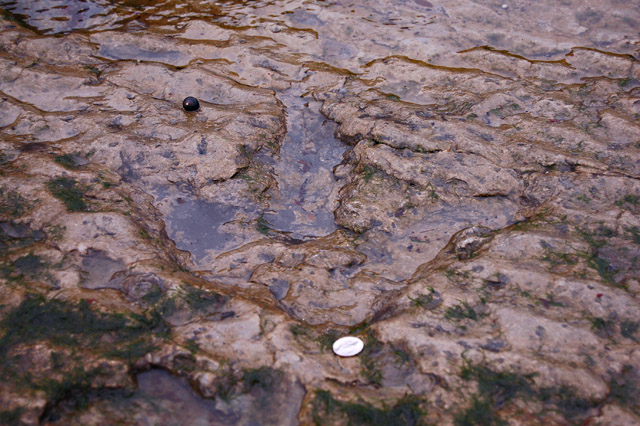
What can a footprint establish when the animal’s skeleton is missing?
Skye’s dinosaur record is written partly in footprints. A step deforms sediment and may survive even when the animal itself leaves no bones nearby. This gives tracks a particular strength: they record an animal using a place. It also gives them limitations. Foot shape, motion, soft mud and later erosion all contribute to the final impression, so naming the maker requires more caution than matching a silhouette to a familiar dinosaur.
At Brothers’ Point, older Middle Jurassic surfaces preserve large rounded prints and other tracks in a shallow lagoonal setting. These impressions support the presence of several dinosaur groups in coastal environments. They do not demonstrate that every trackmaker was a specialist swimmer or that every animal crossed at the same instant. Individual trackways capture short episodes within a much longer succession of sediment accumulation.
Younger units, including the Duntulm Formation, show that track preservation was repeated as regional environments changed. The Valtos Sandstone adds a further record, although some specimens occur in loose coastal blocks whose exact original horizons are difficult to recover. Comparing formations requires attention to both time and facies. A difference in the tracks exposed today may reflect shoreline conditions and preservation opportunities as well as a change in the animals present.
The modern rocky shore is the place of discovery, not the Jurassic coastline restored intact. Tides and weathering reveal surfaces and can also damage them. Later geological disruption complicates connections between outcrops. The two windows therefore use broad Middle Jurassic intervals, and their schematic lagoons are deliberately not exact coastal maps. Together, they show how behavioural evidence can broaden a body-fossil record while remaining dependent on the sediment that captured it.
[1] [2] [3]Time windows and evidence
Older ages are on the left. Bars span the dated intervals. A dot marks a single age.
- Brothers’ Point’s shallow lagoon 168–171 Ma
- Later coastal surfaces in the Duntulm succession 166–168 Ma
- Brothers’ Point lagoon tracks 168–171 Ma
- Tracks in the Duntulm Formation 166–168 Ma
- Valtos Sandstone track-bearing blocks 166–170 Ma
Researched windowsEvidence records
170 Ma · interval 168–171 Ma
Brothers’ Point’s shallow lagoon
Dinosaurs crossed muddy surfaces in a shallow lagoonal environment represented by the older Middle Jurassic tracksites. Large prints and smaller track forms provide complementary evidence about animals using the coast. A preserved step is a local event, while the selected window groups many depositional episodes. The waterline and animals in the conceptual scene are not a surveyed reconstruction of one moment.
[1] [2]Locate this time in the atlas ↗Observed
Trackways and isolated footprints occur on lagoonal sedimentary surfaces.
Reconstructed
Several dinosaur groups visited or crossed shallow coastal habitats.
Uncertain
Exact species, group behaviour and track simultaneity are uncertain.
Evidence windows overlapping this state: 2. Overlap does not establish exact coexistence.
trace fossil · Isle of Skye ↗
Brothers’ Point lagoon tracks
Large and smaller dinosaur footprints at Brothers’ Point occur in a marine-influenced lagoonal succession. Their shapes and arrangements help distinguish broad trackmaker groups and sequences of movement. The prints are direct evidence that animals crossed this surface, while species-level identities are less secure. A trackway is a short behavioural record and should not be turned into proof of a permanent aquatic lifestyle.
locality · Isle of Skye ↗
Valtos Sandstone track-bearing blocks
The Valtos Sandstone contains a varied footprint record, including specimens collected from loose coastal blocks. A detached block can preserve a valuable footprint while weakening the connection to its exact bed. Recording the locality and formation therefore matters as much as displaying its shape. This evidence illustrates a practical limitation of coastal palaeontology: erosion exposes fossils while sometimes removing their most precise stratigraphic context.
167 Ma · interval 166–168 Ma
Later coastal surfaces in the Duntulm succession
Later Middle Jurassic deposits preserve additional dinosaur footprints as shallow coastal environments continued to evolve. The Duntulm record is compared with neighbouring formations rather than treated as a continuation of one unbroken trackway. Sediment supply, salinity and exposure varied across the system. The window is approximate, and the figure does not imply a mapped boundary between lagoon and land at exactly 167 Ma.
[3]Locate this time in the atlas ↗Observed
Duntulm Formation surfaces preserve dinosaur tracks.
Reconstructed
Coastal habitats repeatedly created conditions suitable for preserving footprints.
Uncertain
Chronological correlations and exposure vary among individual sites.
Evidence windows overlapping this state: 2. Overlap does not establish exact coexistence.
trace fossil · Isle of Skye ↗
Tracks in the Duntulm Formation
The younger Middle Jurassic succession includes dinosaur tracks in the Duntulm Formation. Their presence extends the record beyond one famous beach surface. Comparisons across formations ask whether apparent differences reflect animals, environments or unequal exposure. Even when two tracksites are broadly similar, their sediments may record different water conditions and episodes. The bracket is a rounded Middle Jurassic window rather than an exact date for each footprint.
locality · Isle of Skye ↗
Valtos Sandstone track-bearing blocks
The Valtos Sandstone contains a varied footprint record, including specimens collected from loose coastal blocks. A detached block can preserve a valuable footprint while weakening the connection to its exact bed. Recording the locality and formation therefore matters as much as displaying its shape. This evidence illustrates a practical limitation of coastal palaeontology: erosion exposes fossils while sometimes removing their most precise stratigraphic context.
What this story cannot resolve
The older and younger brackets are broad regional teaching windows. A footprint is evidence of contact with sediment, not an automatic species identification or proof of permanent aquatic life.
Keep these ideas handy
Trace fossils
Preserved evidence of an organism’s activity, such as a footprint, burrow, feeding mark or coprolite. Explore the idea ↗
Facies
The observable characteristics of a rock body that help describe and interpret its depositional setting. Explore the idea ↗
Relative dating
Determining which event came first without necessarily assigning a numerical age. Explore the idea ↗
The evidence notebook
trace fossil · Isle of Skye ↗
Brothers’ Point lagoon tracks
Large and smaller dinosaur footprints at Brothers’ Point occur in a marine-influenced lagoonal succession. Their shapes and arrangements help distinguish broad trackmaker groups and sequences of movement. The prints are direct evidence that animals crossed this surface, while species-level identities are less secure. A trackway is a short behavioural record and should not be turned into proof of a permanent aquatic lifestyle.
trace fossil · Isle of Skye ↗
Tracks in the Duntulm Formation
The younger Middle Jurassic succession includes dinosaur tracks in the Duntulm Formation. Their presence extends the record beyond one famous beach surface. Comparisons across formations ask whether apparent differences reflect animals, environments or unequal exposure. Even when two tracksites are broadly similar, their sediments may record different water conditions and episodes. The bracket is a rounded Middle Jurassic window rather than an exact date for each footprint.
locality · Isle of Skye ↗
Valtos Sandstone track-bearing blocks
The Valtos Sandstone contains a varied footprint record, including specimens collected from loose coastal blocks. A detached block can preserve a valuable footprint while weakening the connection to its exact bed. Recording the locality and formation therefore matters as much as displaying its shape. This evidence illustrates a practical limitation of coastal palaeontology: erosion exposes fossils while sometimes removing their most precise stratigraphic context.
Follow the evidence
Sources & credits
- Rare Scottish dinosaur prints give key insight into era lost in time ↗
University of Edinburgh · 2018
Use, credit & modifications
Reference only; no source text, figures or photographs reproduced. Original educational synthesis.
Credit: University of Edinburgh. Facts synthesized in original language; ages expressed as explicit teaching windows rather than exact dates of all specimens. No source asset reuse; territorial asset permissions not applicable.
- Footprints show stegosaurs left mark on Skye ↗
University of Edinburgh · 2020
Use, credit & modifications
Reference only; no source text, figures or photographs reproduced. Original educational synthesis.
Credit: University of Edinburgh. Facts synthesized in original language; ages expressed as explicit teaching windows rather than exact dates of all specimens. No source asset reuse; territorial asset permissions not applicable.
- A comparison of dinosaur communities from the Middle Jurassic Cleveland and Hebrides basins ↗
Geosciences · 2018
Use, credit & modifications
Reference only; no source text, figures or photographs reproduced. Original educational synthesis.
Credit: Geosciences. Facts synthesized in original language; ages expressed as explicit teaching windows rather than exact dates of all specimens. No source asset reuse; territorial asset permissions not applicable.
Follow the connections
 Europe
United Kingdom ↗
Lyme Regis & Pinhay Bay
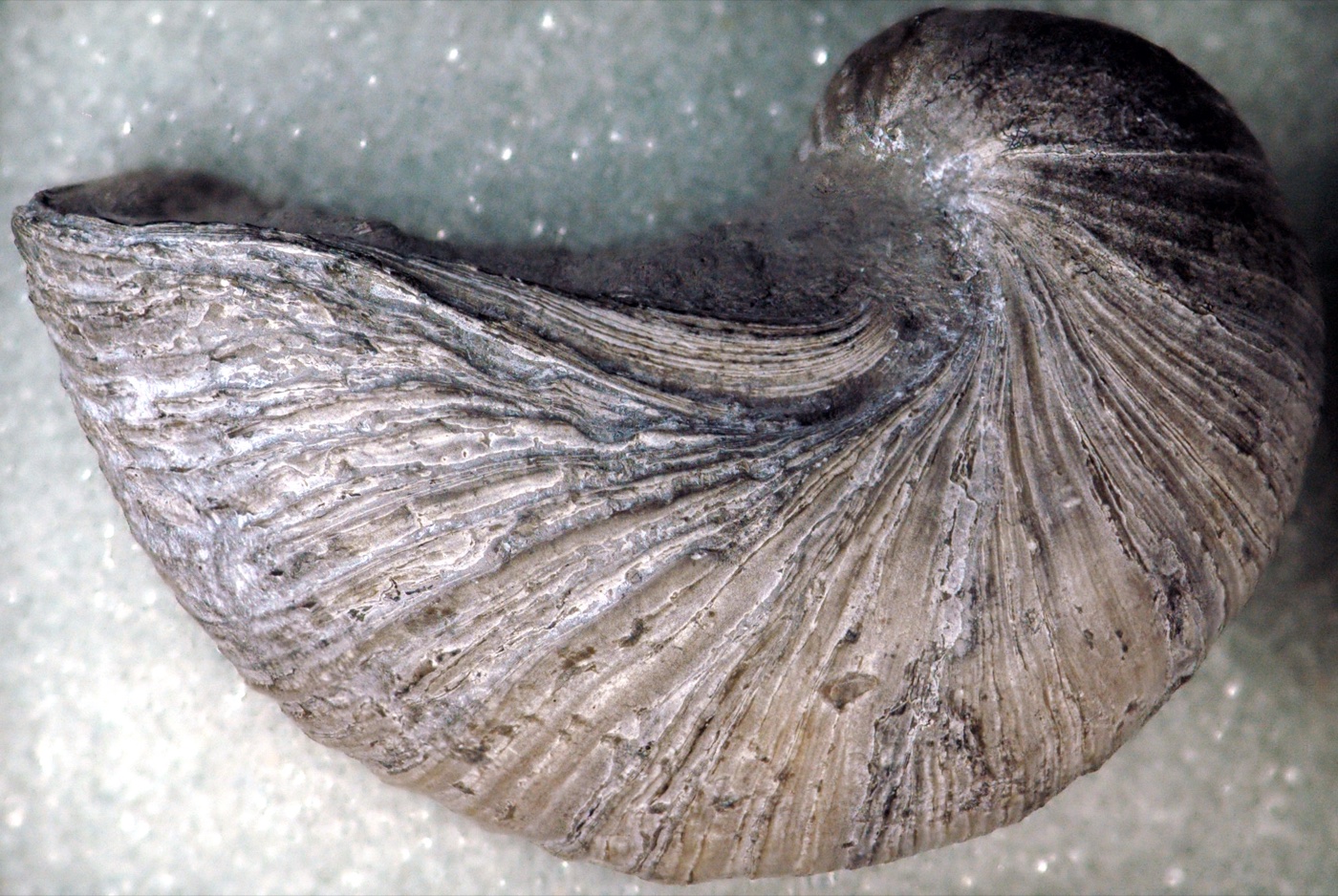
The coastal succession near Lyme Regis connects latest Triassic marginal seas with Early Jurassic marine life. Rock layers, ammonites and fish help separate environmental change from the definition of a time boundary.
202 Ma → 199 Ma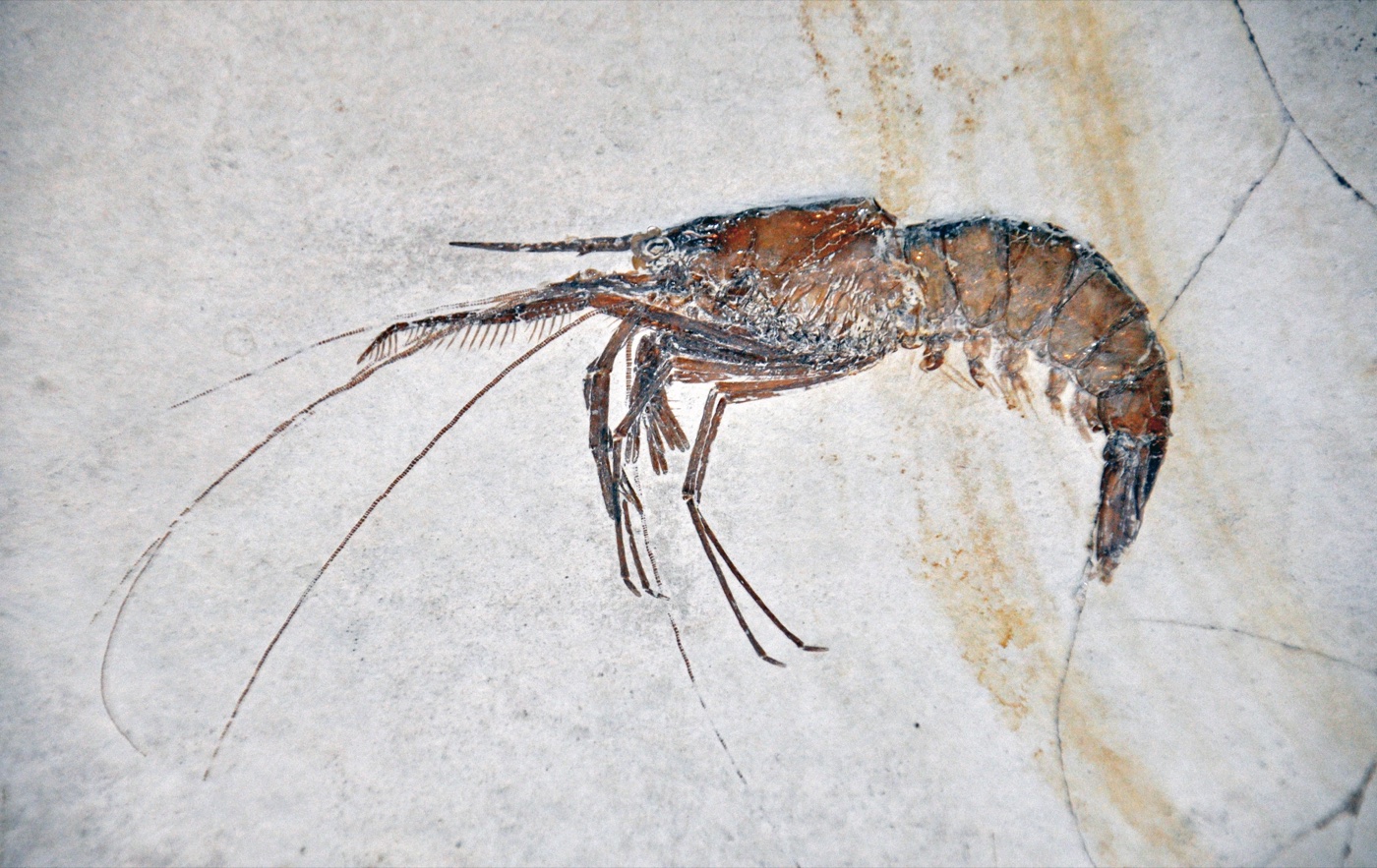 Europe
Germany ↗
Solnhofen–Eichstätt
Fine Jurassic limestone preserves feathered dinosaurs, marine animals and traces of movement. Their shared burial place need not mean a shared habitat or a single cause of death.
150 Ma → Today