
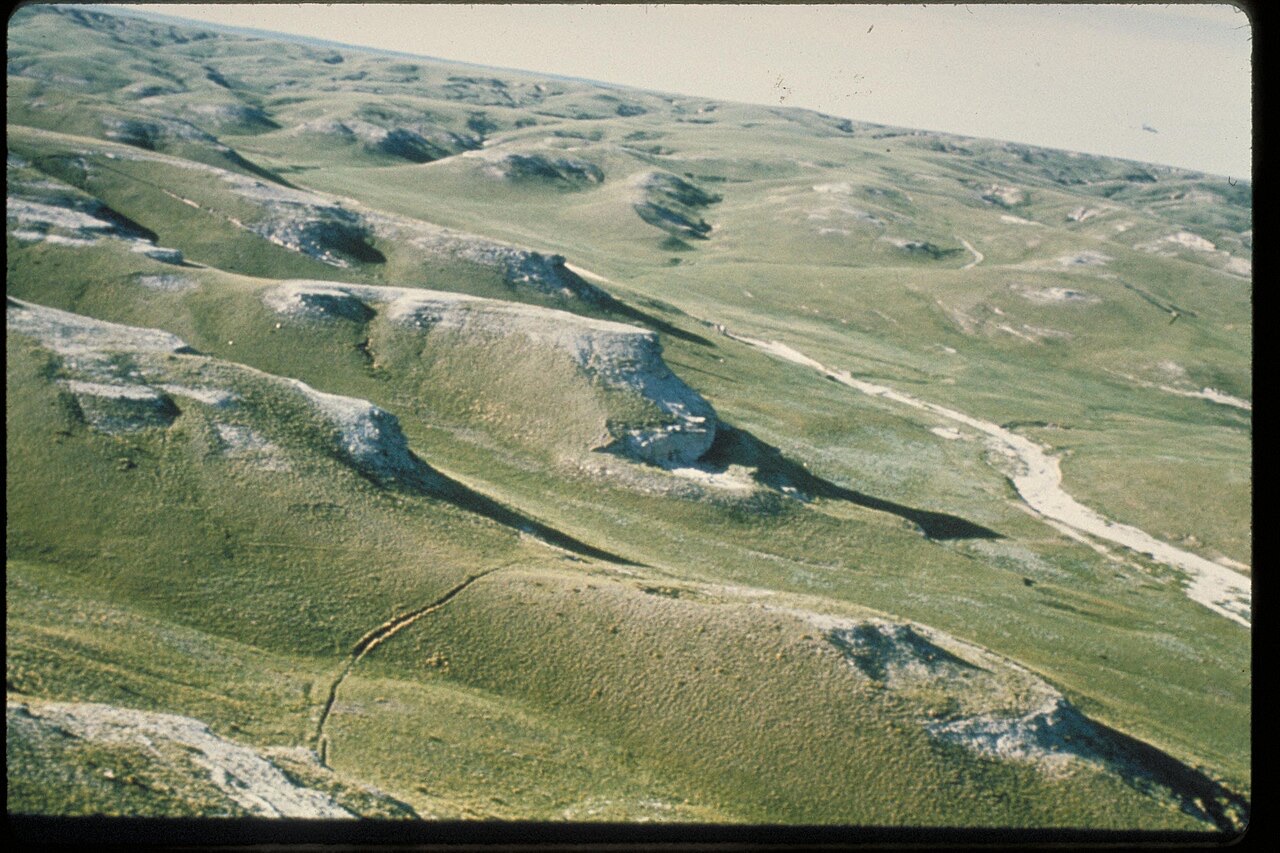
Does a crowded bonebed preserve a thriving herd or a landscape under stress?
Agate’s fossil hills preserve several distinct early Miocene communities. The most famous bonebeds should not swallow the rest of that history. Older strata contain spiral structures named Daemonelix, once mistaken for unusual plant remains. Beaver bones and the geometry of the structures support their interpretation as burrows. They record behavior directly: an animal excavated a route through the ground, leaving a shape that sediment could fill and preserve.
These were terrestrial burrowing beavers, not evidence of dams like those built by living aquatic beavers. Seasonal dryness, sandy streams and patches of vegetation shaped their environment. The small camel Stenomylus occurs at a separate quarry in older rocks than the main waterhole assemblage. Similar-looking museum displays can therefore conceal a meaningful difference in age and burial history.
The principal bonebeds at Carnegie and University hills accumulated around a waterhole. Menoceras rhinoceroses dominate the remains, accompanied by animals such as the clawed chalicothere Moropus. Drought is an important part of the interpretation, but the deposit was not necessarily produced by one instantaneous catastrophe. Sedimentary units and bone associations indicate accumulation over time, with disarticulation, scavenging and burial contributing to the final concentration.
Dated beds bracket the main bonebeds. Zircon from a sandstone below them gives about 22.9 million years, while the younger Eagle Crag Ash above the upper bonebed gives about 19.2 million years. Neither sample dates an individual death. The older burrows have a separate age constraint from volcanic ash above the Harrison beds. The same volcanic debris that helped bury fossils also helps put these events in order.
[1] [2] [3] [4]Time windows and evidence
Older ages are on the left. Bars span the dated intervals. A dot marks a single age.
- Streams and burrowing beavers 22–23 Ma
- Animals gather at a shrinking waterhole 19–20 Ma
- Daemonelix burrows in the Harrison Formation 22–23 Ma
- Stenomylus Quarry 22–23 Ma
- Menoceras in the Carnegie Hill bonebeds 19–20 Ma
Researched windowsEvidence records
22.5 Ma · interval 22–23 Ma
Streams and burrowing beavers
The older Harrison Formation preserves Daemonelix burrows in a seasonally dry terrestrial landscape with sandy streams. The river setting represents the broader drainage environment, not water inside the burrows. An overlying ash and stratigraphic relationships support an approximate 22–23 million year age for this record.
[1] [2]Locate this time in the atlas ↗Observed
Spiral sediment-filled burrows occur with remains of burrowing beavers.
Reconstructed
Dry ground beside a seasonal drainage network supported burrowing mammals.
Uncertain
Vegetation and water availability varied locally and seasonally.
Evidence windows overlapping this state: 2. Overlap does not establish exact coexistence.
trace fossil · Agate Fossil Beds ↗
Daemonelix burrows in the Harrison Formation
Spiral burrow casts preserve the underground activity of terrestrial beavers. Skeletons associated with some burrows and the structures’ architecture support the interpretation. An overlying ash helps constrain their early Miocene age. These traces are evidence of excavation and shelter, not a fossilized water-filled beaver dam. The structure records behavior even where a complete skeleton is absent, complementing body fossils with evidence about how mammals used the ground beneath their habitat.
body fossil · Agate Fossil Beds ↗
Stenomylus Quarry
The Stenomylus locality preserves small camel skeletons in rocks approximately three million years older than the main Agate waterhole bonebed. Articulated remains suggest comparatively rapid burial for some animals. Keeping this locality separate prevents an attractive but misleading composite scene in which every mammal found at Agate appears together. Differences in articulation also invite comparison with the main bonebed, where decomposition and repeated accumulation produced a different arrangement of remains before final burial.
19.2 Ma · interval 19–20 Ma
Animals gather at a shrinking waterhole
The main bonebeds record a waterhole in a shallow valley, where mammals accumulated during environmental stress. The lake symbol represents a small standing-water basin rather than a large permanent lake. The 20–19 million year display window is deliberately rounded around the approximately 19.2 million year overlying ash constraint; it is not a measured duration of the mortality event.
[1] [3] [4]Locate this time in the atlas ↗Observed
Dense mammal bones occur in sedimentary beds beneath the Eagle Crag Ash.
Reconstructed
A waterhole attracted animals during dry conditions and concentrated their remains.
Uncertain
The lower and upper bonebeds record separate episodes, and the 19.2-million-year ash above the upper bed dates later deposition.
Evidence windows overlapping this state: 1. Overlap does not establish exact coexistence.
What this story cannot resolve
Waterhole age bounds are a rounded teaching window around a stratigraphic ash constraint. The older and younger fossil localities are distinct.
Keep these ideas handy
Trace fossils
Preserved evidence of an organism’s activity, such as a footprint, burrow, feeding mark or coprolite. Explore the idea ↗
Taphonomy
Studying what happens between an organism’s life, death, burial, preservation and eventual discovery. Explore the idea ↗
Radiometric dating
Estimating the time of a geological event from radioactive decay and the isotopic composition of a suitable material. Explore the idea ↗
The evidence notebook
trace fossil · Agate Fossil Beds ↗
Daemonelix burrows in the Harrison Formation
Spiral burrow casts preserve the underground activity of terrestrial beavers. Skeletons associated with some burrows and the structures’ architecture support the interpretation. An overlying ash helps constrain their early Miocene age. These traces are evidence of excavation and shelter, not a fossilized water-filled beaver dam. The structure records behavior even where a complete skeleton is absent, complementing body fossils with evidence about how mammals used the ground beneath their habitat.
body fossil · Agate Fossil Beds ↗
Stenomylus Quarry
The Stenomylus locality preserves small camel skeletons in rocks approximately three million years older than the main Agate waterhole bonebed. Articulated remains suggest comparatively rapid burial for some animals. Keeping this locality separate prevents an attractive but misleading composite scene in which every mammal found at Agate appears together. Differences in articulation also invite comparison with the main bonebed, where decomposition and repeated accumulation produced a different arrangement of remains before final burial.
body fossil · Agate Fossil Beds ↗
Menoceras in the Carnegie Hill bonebeds
The lower Carnegie Hill bonebed is especially rich in Menoceras rhinoceroses. Bones are often disarticulated, but their arrangement and limited abrasion suggest that many carcasses decomposed close to the waterhole where the animals died. A separate upper bed may contain remains redistributed from its former bank. The approximate 19.2-million-year date comes from Eagle Crag Ash deposited above the upper bed, so it dates the ash rather than each rhinoceros.
Follow the evidence
Sources & credits
- Agate Fossil Beds Geologic Resources Inventory Report ↗
National Park Service · 2009
Use, credit & modifications
Reference only. No source text or assets reproduced. Original factual synthesis; no reuse licence asserted.
Credit: National Park Service — Agate Fossil Beds Geologic Resources Inventory Report. Facts synthesized in original educational language. Rounded teaching intervals are distinguished from measured dates. No source assets reused; territorial permissions not applicable.
- Mammal Fossils ↗
National Park Service · Not stated
Use, credit & modifications
Reference only. No source text or assets reproduced. Original factual synthesis; no reuse licence asserted.
Credit: National Park Service — Mammal Fossils. Facts synthesized in original educational language. Rounded teaching intervals are distinguished from measured dates. No source assets reused; territorial permissions not applicable.
- Agate Fossil Beds: Park Brochure ↗
National Park Service · Not stated
Use, credit & modifications
Reference only. No source text or assets reproduced. Original factual synthesis; no reuse licence asserted.
Credit: National Park Service — Agate Fossil Beds: Park Brochure. Facts synthesized in original educational language. Rounded teaching intervals are distinguished from measured dates. No source assets reused; territorial permissions not applicable.
- Geology at Agate Fossil Beds ↗
U.S. National Park Service · Not stated
Use, credit & modifications
Reference only; no text or images reproduced.
Credit: U.S. National Park Service. Original explanation of the zircon age below the bonebed. No third-party media reproduced.
Follow the connections
 North America
United States ↗
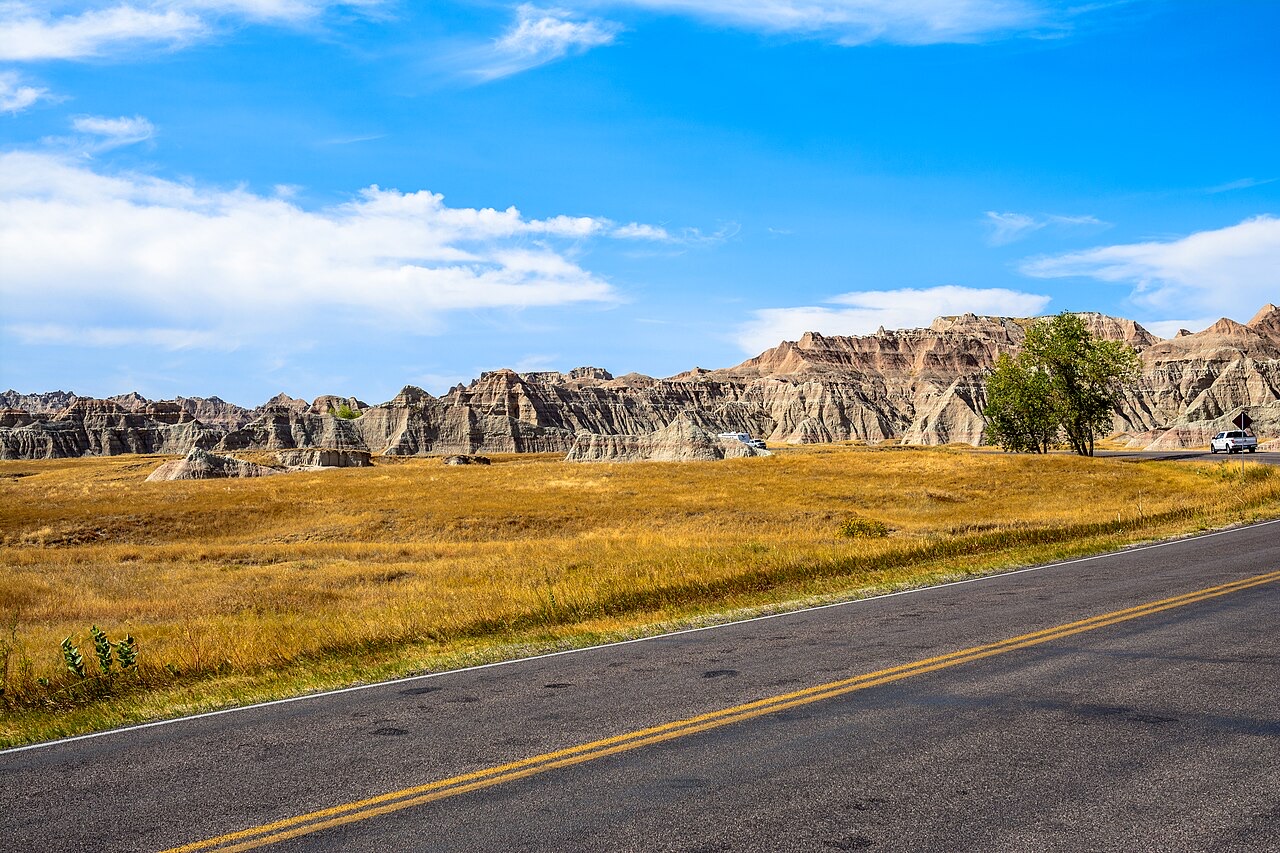
Badlands, South Dakota
Marine shale and younger mammal-bearing floodplain deposits record different worlds beneath the sharp ridges of today.
72 Ma → 32 Ma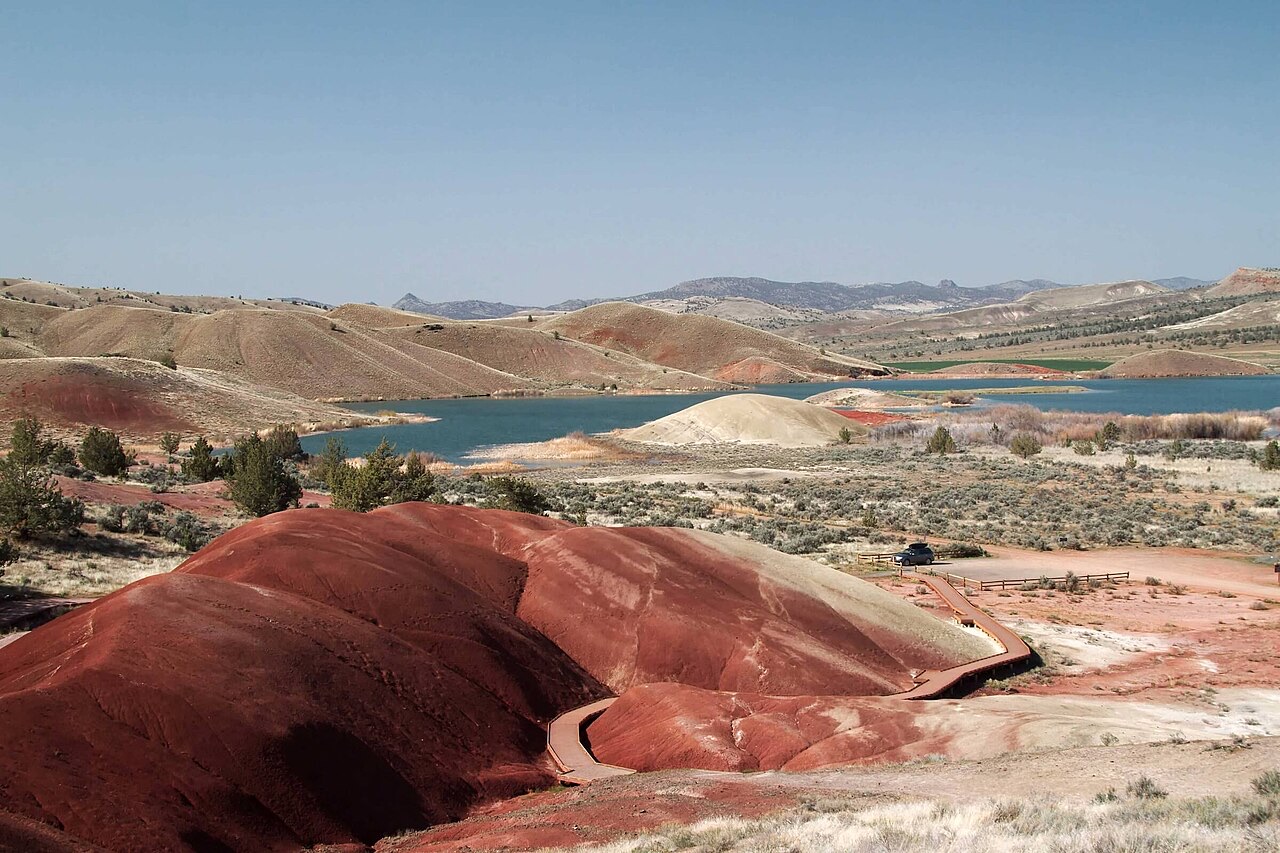 North America
United States ↗
John Day Basin
Separate formations and localities in Oregon preserve Eocene forests, river accumulations and younger Oligocene mammal communities.
44 Ma → 29 Ma