
The late Permian and early Triassic states bracket an interval of major ecological change. This regional terrestrial comparison complements broader extinction research while making its own limits explicit.
Window A / 253 Ma
Karoo Basin
Late Permian terrestrial communities
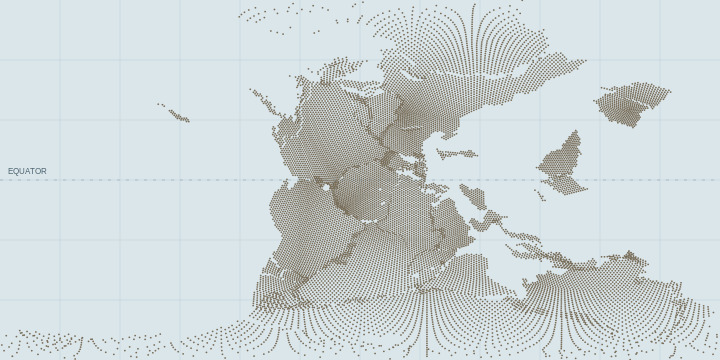
Research window 252–255 Ma
Late Permian Karoo sediments record rivers and floodplains inhabited by diverse terrestrial vertebrates, including therapsids. This scene represents a regional depositional system rather than a single contemporaneous herd. Fossil associations provide relative ordering, and ash dates supply numerical constraints in some sections. The illustration does not show an exact extinction horizon because the relationship between local fossil zones and the globally defined boundary remains a subject of research.
[6] [7]- Observed
- Vertebrate fossils occur within late Permian sandstone-and-mudstone successions.
- Reconstructed
- A varied terrestrial ecosystem supported by a changing fluvial landscape.
- Uncertain
- Local depositional conditions, sampling and age calibration affect the apparent pace of turnover.
Window B / 251 Ma
Karoo Basin
Early Triassic survivors and reorganization
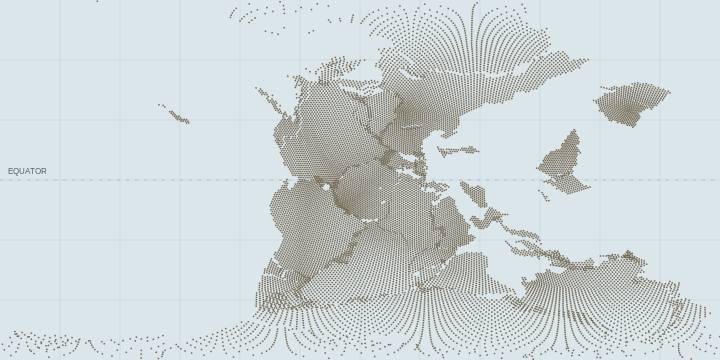
Research window 247.2–251.9 Ma
Early Triassic Karoo deposits contain a reorganized terrestrial community in which Lystrosaurus is a prominent fossil. The continued river setting should not be mistaken for ecological continuity: the identities and relative representation of organisms changed. The scene begins younger than the globally dated Permian–Triassic boundary, but does not equate the base of a local Lystrosaurus assemblage zone with that boundary. Recovery and survivorship are regional interpretations built from many occurrences.
[6] [7]- Observed
- Early Triassic assemblages differ from late Permian ones and include abundant Lystrosaurus records.
- Reconstructed
- Ecological reorganization followed a severe interval of terrestrial turnover.
- Uncertain
- Fossil abundance is influenced by preservation and collection, while the timing and duration of extinction differ among analyses.
What the evidence shows
Successive Karoo strata preserve different assemblages of land vertebrates. Lystrosaurus is common in some early Triassic beds, and one study dated ash within its assemblage zone to 252.24 ± 0.11 Ma. That date falls on the Permian side of the international boundary estimate of 251.902 Ma.
[6] [7] [8]What we infer from it
The wider end-Permian crisis is strongly associated with Siberian Traps magmatism and environmental disturbance. That causal explanation comes from independent records and timing tests, rather than from a Karoo fossil directly measuring distant volcanism. Recovery likewise needs a clearly defined ecological measure.
[3] [4]What remains open
The age identifies one layer and helps constrain its assemblage zone. The timing of turnover across the basin depends on how researchers correlate sections. Atlas card counts give no measure of diversity, population size or extinction severity.
Follow the evidence
Sources & credits
- palaeoverse: palaeogeographic reconstruction files, v2.0.0 ↗
Lewis A. Jones / Zenodo · 2024-09-19
Use, credit & modifications
CC BY 4.0; verified on dataset API metadata, not inferred from paper
Credit: Lewis A. Jones (2024), palaeoverse v2.0.0; Jones & Domeier (2024); MERDITH2021 model. RDS converted to static JSON and original dot maps; selected ages; nearest-centroid regional matching; display rounding. Worldwide under CC BY 4.0.
- A Phanerozoic gridded dataset for palaeogeographic reconstructions ↗
Jones & Domeier, Scientific Data 11:710 · 2024
Use, credit & modifications
Reference only; no paper text or figures reproduced
Credit: Jones & Domeier (2024). Original methodological synthesis. No reproduced asset.
- Initial pulse of Siberian Traps sills as the trigger of the end-Permian mass extinction ↗
Burgess et al., Nature Communications · 2017
Use, credit & modifications
Reference only. No source text, photographs, charts or other assets reproduced; original factual synthesis.
Credit: Burgess et al., Nature Communications. Original explanatory synthesis; geological boundary ages normalized to ICS 2026/06 where relevant. No third-party asset reuse; no territorial asset licence asserted.
- Mass Extinctions Through Geologic Time ↗
US National Park Service · Not stated
Use, credit & modifications
Reference only. No source text, photographs, charts or other assets reproduced; original factual synthesis.
Credit: US National Park Service. Original explanatory synthesis; geological boundary ages normalized to ICS 2026/06 where relevant. No third-party asset reuse; no territorial asset licence asserted.
- Across space and time: A review of sampling, preservational, analytical, and anthropogenic biases in fossil data across macroecological scales ↗
Earth-Science Reviews · 2023
Use, credit & modifications
Reference only. No source text, photographs, charts or other assets reproduced; original factual synthesis.
Credit: Earth-Science Reviews. Original explanatory synthesis; geological boundary ages normalized to ICS 2026/06 where relevant. No third-party asset reuse; no territorial asset licence asserted.
- Evidence from South Africa for a protracted end-Permian extinction on land ↗
Viglietti and colleagues / Proceedings of the National Academy of Sciences · 2021
Use, credit & modifications
Reference only. No source text, photographs, figures or datasets reproduced. Original factual synthesis; no reuse licence asserted.
Credit: Viglietti and colleagues / Proceedings of the National Academy of Sciences — Evidence from South Africa for a protracted end-Permian extinction on land. Facts paraphrased into original educational text; ages rounded to declared teaching intervals. No asset reuse requested; territorial permissions not applicable.
- The base of the Lystrosaurus Assemblage Zone, Karoo Basin, predates the end-Permian marine extinction ↗
Gastaldo and colleagues / Nature Communications · 2020-03-18
Use, credit & modifications
Reference only. No source text, photographs, figures or datasets reproduced. Original factual synthesis; no reuse licence asserted.
Credit: Gastaldo and colleagues / Nature Communications — The base of the Lystrosaurus Assemblage Zone, Karoo Basin, predates the end-Permian marine extinction. Facts paraphrased into original educational text; ages rounded to declared teaching intervals. No asset reuse requested; territorial permissions not applicable.
- International Chronostratigraphic Chart, version 2026/06 ↗
International Commission on Stratigraphy · 2026-06
Use, credit & modifications
Reference only. No source text, photographs, charts or other assets reproduced; original factual synthesis.
Credit: International Commission on Stratigraphy. Original explanatory synthesis; geological boundary ages normalized to ICS 2026/06 where relevant. No third-party asset reuse; no territorial asset licence asserted.