
This comparison moves from a latest Cretaceous floodplain record into the early Paleocene. It combines a recognizable regional story with the discipline of separating fossil occurrence, extinction and recovery.
Window A / 67 Ma
Hell Creek & the Williston Basin
A latest Cretaceous floodplain
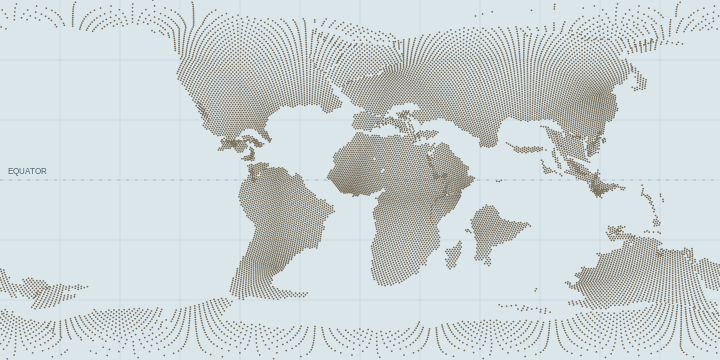
Research window 66–68 Ma
Rivers crossed a vegetated lowland that supported dinosaurs alongside many smaller organisms. This scene represents the broader Hell Creek depositional system rather than a single quarry or day. Channel sands, floodplain muds, leaves and bones provide complementary evidence. The diagram shows their environmental relationships schematically. It does not estimate herd size, regional forest coverage or the relative numbers of different dinosaurs from the number of fossils collected.
[6] [7]- Observed
- Plant fossils and vertebrate remains occur within fluvial and floodplain sediments.
- Reconstructed
- A patchwork of rivers, wetlands and vegetated floodplains.
- Uncertain
- Local habitat and sampling differ among beds; the exact appearance of a particular forest is unresolved.
Window B / 65.5 Ma
Hell Creek & the Williston Basin
Life after the boundary
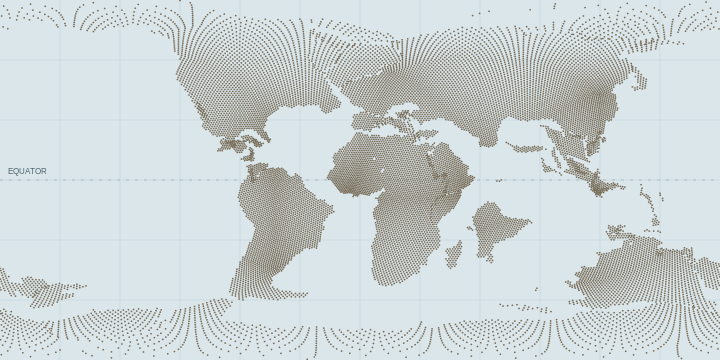
Research window 65–66 Ma
Early Paleocene deposits record a terrestrial ecosystem after the end-Cretaceous biological turnover. The landscape still included sediment-carrying rivers; the most consequential change was not simply a switch from water to land. Plant composition and vertebrate communities changed, with recovery unfolding over time. This teaching interval begins at the boundary and extends beyond the immediate aftermath, so it must not be mistaken for a depiction of the first days or years after impact.
[8] [9]- Observed
- Pollen and leaf assemblages change across measured boundary sections; non-avian dinosaurs are absent from securely younger communities.
- Reconstructed
- Ecological reorganization and recovery within a continuing lowland depositional system.
- Uncertain
- Recovery was not identical everywhere, and a named formation boundary is not a globally synchronous time line.
What the evidence shows
Measured sections preserve changes in pollen and leaf assemblages around the boundary. Non-avian dinosaurs are documented in older Hell Creek strata. The crater and impact deposits at Chicxulub give independent physical evidence of the event.
[8] [9] [3]What we infer from it
The impact caused major environmental disruption, while its local ecological consequences depended on habitat and organismal traits. The younger record documents an aftermath rather than an instantaneous replacement of every organism. Birds survived even though non-avian dinosaurs disappeared.
[3] [4]What remains open
A last local fossil is not necessarily the final living member of a species. This regional terrestrial pair cannot measure global marine losses or establish a universal recovery duration.
Follow the evidence
Sources & credits
- palaeoverse: palaeogeographic reconstruction files, v2.0.0 ↗
Lewis A. Jones / Zenodo · 2024-09-19
Use, credit & modifications
CC BY 4.0; verified on dataset API metadata, not inferred from paper
Credit: Lewis A. Jones (2024), palaeoverse v2.0.0; Jones & Domeier (2024); MERDITH2021 model. RDS converted to static JSON and original dot maps; selected ages; nearest-centroid regional matching; display rounding. Worldwide under CC BY 4.0.
- A Phanerozoic gridded dataset for palaeogeographic reconstructions ↗
Jones & Domeier, Scientific Data 11:710 · 2024
Use, credit & modifications
Reference only; no paper text or figures reproduced
Credit: Jones & Domeier (2024). Original methodological synthesis. No reproduced asset.
- The Chicxulub impact and its environmental consequences ↗
Morgan et al., Nature Reviews Earth & Environment · 2022
Use, credit & modifications
Reference only. No source text, photographs, charts or other assets reproduced; original factual synthesis.
Credit: Morgan et al., Nature Reviews Earth & Environment. Original explanatory synthesis; geological boundary ages normalized to ICS 2026/06 where relevant. No third-party asset reuse; no territorial asset licence asserted.
- Mass Extinctions Through Geologic Time ↗
US National Park Service · Not stated
Use, credit & modifications
Reference only. No source text, photographs, charts or other assets reproduced; original factual synthesis.
Credit: US National Park Service. Original explanatory synthesis; geological boundary ages normalized to ICS 2026/06 where relevant. No third-party asset reuse; no territorial asset licence asserted.
- Across space and time: A review of sampling, preservational, analytical, and anthropogenic biases in fossil data across macroecological scales ↗
Earth-Science Reviews · 2023
Use, credit & modifications
Reference only. No source text, photographs, charts or other assets reproduced; original factual synthesis.
Credit: Earth-Science Reviews. Original explanatory synthesis; geological boundary ages normalized to ICS 2026/06 where relevant. No third-party asset reuse; no territorial asset licence asserted.
- Dig Deeper at Home: The Plants of Hell Creek ↗
Smithsonian National Museum of Natural History · Not stated
Use, credit & modifications
Reference only. No source text, photographs, figures or datasets reproduced. Original factual synthesis; no reuse licence asserted.
Credit: Smithsonian National Museum of Natural History — Dig Deeper at Home: The Plants of Hell Creek. Facts paraphrased into original educational text; ages rounded to declared teaching intervals. No asset reuse requested; territorial permissions not applicable.
- UW, Burke researchers discover four dinosaurs in Montana ↗
University of Washington / Burke Museum · 2021-09-21
Use, credit & modifications
Reference only. No source text, photographs, figures or datasets reproduced. Original factual synthesis; no reuse licence asserted.
Credit: University of Washington / Burke Museum — UW, Burke researchers discover four dinosaurs in Montana. Facts paraphrased into original educational text; ages rounded to declared teaching intervals. No asset reuse requested; territorial permissions not applicable.
- Palynologically calibrated vertebrate record from North Dakota consistent with abrupt dinosaur extinction at the Cretaceous-Tertiary boundary ↗
Pearson, Schaefer, Johnson and Nichols / US Geological Survey · 2001
Use, credit & modifications
Reference only. No source text, photographs, figures or datasets reproduced. Original factual synthesis; no reuse licence asserted.
Credit: Pearson, Schaefer, Johnson and Nichols / US Geological Survey — Palynologically calibrated vertebrate record from North Dakota consistent with abrupt dinosaur extinction at the Cretaceous-Tertiary boundary. Facts paraphrased into original educational text; ages rounded to declared teaching intervals. No asset reuse requested; territorial permissions not applicable.
- Land plant extinction at the end of the Cretaceous: a quantitative analysis of the North Dakota megafloral record ↗
Wilf and Johnson / Paleobiology · 2004
Use, credit & modifications
Reference only. No source text, photographs, figures or datasets reproduced. Original factual synthesis; no reuse licence asserted.
Credit: Wilf and Johnson / Paleobiology — Land plant extinction at the end of the Cretaceous: a quantitative analysis of the North Dakota megafloral record. Facts paraphrased into original educational text; ages rounded to declared teaching intervals. No asset reuse requested; territorial permissions not applicable.