
Marine deposits in the Atacama region and the modern arid setting record different stages of a place’s history. The contrast is a prompt to separate ancient habitat, later geological change and present-day conditions of exposure.
Window A / 6.1 Ma
Atacama’s fossil coast
A Miocene coast receives carcasses
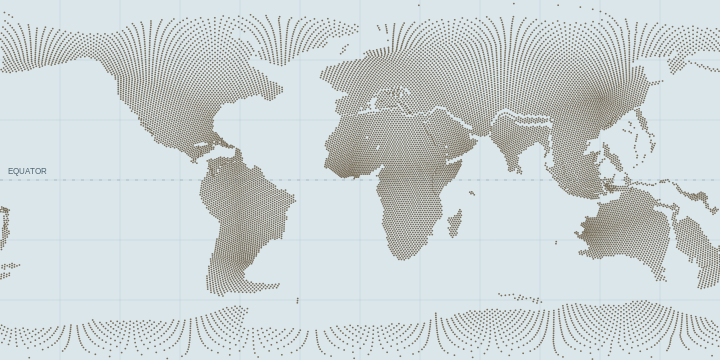
Research window 6–6.5 Ma
A 2025 chronostratigraphic study places Cerro Ballena burial near 6.1 million years ago and interprets a sheltered shoreface setting. This revises the original broader biostratigraphic estimate and supratidal interpretation. The 6.5–6 Ma window is an explicitly rounded teaching bracket, not a reported confidence interval. Marine carcasses reached a coastal depositional setting repeatedly; the schematic depicts neither a measured coastline nor a directly observed toxin plume.
[6] [7] [8]- Observed
- Marine vertebrate remains occur in four distinct fossil-bearing levels.
- Reconstructed
- Repeated mortality and coastal burial episodes produced the observed accumulation.
- Uncertain
- Harmful algal blooms are a proposed explanation; precise event spacing and every carcass history are unresolved.
Window B / Today
Atacama’s fossil coast
A fossil coast within the modern desert
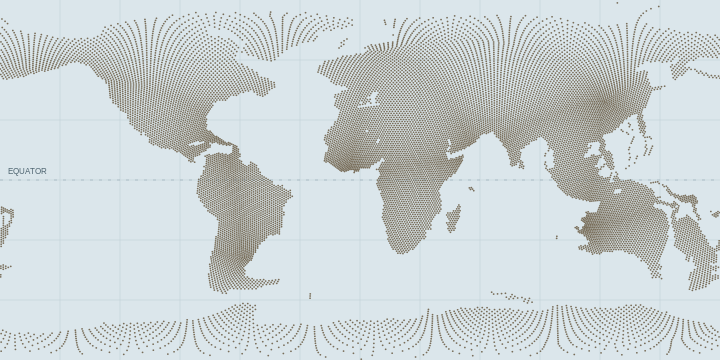
Research window Today
The modern setting is an arid coastal part of Chile near Caldera. Road expansion temporarily exposed the fossil-bearing deposits, which researchers recorded and excavated. This state illustrates the difference between an ancient environment and the present location of its evidence. It is not a promise that the original excavation remains open or that a visitor will find the skeletons lying where they were documented.
[8] [9]- Observed
- Marine fossils were excavated from an exposed terrestrial road-construction site.
- Reconstructed
- An older coastal sedimentary archive is now accessible through terrestrial exposures.
- Uncertain
- The interval between burial and exposure is not reconstructed as a continuous uplift curve.
What the evidence shows
At Cerro Ballena, marine vertebrate skeletons occur in several distinct layers. Road construction exposed the fossil-bearing outcrop in today’s desert. Examine the spacing and arrangement of the skeletons to distinguish separate burial episodes.
[6] [7] [8]What we infer from it
The sequence involves deposition followed by changes that brought the archive into its present setting. Regional tectonic and environmental history are needed to explain the transition. Aridity can help make an archive visible, but it does not create the ancient marine community that the fossils document.
[6] [7] [5]What remains open
This pair does not establish one uplift rate, one cause for every fossil accumulation or the history of the entire Atacama. Marine fossils at one locality cannot be generalized across all present-day desert terrain.
Follow the evidence
Sources & credits
- palaeoverse: palaeogeographic reconstruction files, v2.0.0 ↗
Lewis A. Jones / Zenodo · 2024-09-19
Use, credit & modifications
CC BY 4.0; verified on dataset API metadata, not inferred from paper
Credit: Lewis A. Jones (2024), palaeoverse v2.0.0; Jones & Domeier (2024); MERDITH2021 model. RDS converted to static JSON and original dot maps; selected ages; nearest-centroid regional matching; display rounding. Worldwide under CC BY 4.0.
- A Phanerozoic gridded dataset for palaeogeographic reconstructions ↗
Jones & Domeier, Scientific Data 11:710 · 2024
Use, credit & modifications
Reference only; no paper text or figures reproduced
Credit: Jones & Domeier (2024). Original methodological synthesis. No reproduced asset.
- Taphonomy—Death & Decay ↗
US National Park Service · Not stated
Use, credit & modifications
Reference only. No source text, photographs, charts or other assets reproduced; original factual synthesis.
Credit: US National Park Service. Original explanatory synthesis; geological boundary ages normalized to ICS 2026/06 where relevant. No third-party asset reuse; no territorial asset licence asserted.
- Sedimentary Rocks ↗
US National Park Service · Not stated
Use, credit & modifications
Reference only. No source text, photographs, charts or other assets reproduced; original factual synthesis.
Credit: US National Park Service. Original explanatory synthesis; geological boundary ages normalized to ICS 2026/06 where relevant. No third-party asset reuse; no territorial asset licence asserted.
- Understanding plate motions ↗
US Geological Survey · Not stated
Use, credit & modifications
Reference only. No source text, photographs, charts or other assets reproduced; original factual synthesis.
Credit: US Geological Survey. Original explanatory synthesis; geological boundary ages normalized to ICS 2026/06 where relevant. No third-party asset reuse; no territorial asset licence asserted.
- Controls on late Miocene marine vertebrate bonebed genesis in northern Chile ↗
Martinez et al.; Palaeogeography, Palaeoclimatology, Palaeoecology · 2025-02-01
Use, credit & modifications
Reference only. No third-party prose, figures, photographs or datasets reproduced; factual interpretation written originally for this atlas.
Credit: Martinez et al.; Palaeogeography, Palaeoclimatology, Palaeoecology — Controls on late Miocene marine vertebrate bonebed genesis in northern Chile. Original educational synthesis; geological ages rounded into explicitly labelled teaching intervals. No licensed media incorporated; no territorial reuse permission asserted.
- Repeated mass strandings of Miocene marine mammals from Atacama Region of Chile point to sudden death at sea ↗
Pyenson et al.; Proceedings of the Royal Society B · 2014-02-26
Use, credit & modifications
Reference only. No third-party prose, figures, photographs or datasets reproduced; factual interpretation written originally for this atlas.
Credit: Pyenson et al.; Proceedings of the Royal Society B — Repeated mass strandings of Miocene marine mammals from Atacama Region of Chile point to sudden death at sea. Original educational synthesis; geological ages rounded into explicitly labelled teaching intervals. No licensed media incorporated; no territorial reuse permission asserted.
- Cerro Ballena Fact Sheet ↗
Smithsonian Institution · 2014-02-25
Use, credit & modifications
Reference only. No third-party prose, figures, photographs or datasets reproduced; factual interpretation written originally for this atlas.
Credit: Smithsonian Institution — Cerro Ballena Fact Sheet. Original educational synthesis; geological ages rounded into explicitly labelled teaching intervals. No licensed media incorporated; no territorial reuse permission asserted.
- Mystery of marine mammal stranding solved ↗
The Royal Society · 2014
Use, credit & modifications
Reference only. No third-party prose, figures, photographs or datasets reproduced; factual interpretation written originally for this atlas.
Credit: The Royal Society — Mystery of marine mammal stranding solved. Original educational synthesis; geological ages rounded into explicitly labelled teaching intervals. No licensed media incorporated; no territorial reuse permission asserted.