
The Alpine comparison follows a former marine depositional setting into its present mountain context. It asks how a rock can preserve evidence of its origin while acquiring folds, faults and a very different location during later events.
Window A / 241 Ma
Monte San Giorgio, Southern Alps
A restricted Triassic marine basin
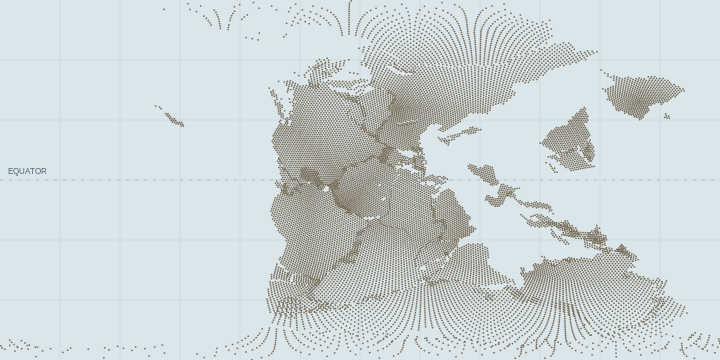
Research window 239.5–242.5 Ma
The selected interval represents fossil-rich Middle Triassic deposits of Monte San Giorgio and neighbouring Besano. A restricted marine basin lay within a carbonate platform in the Tethys region. The diagram places water and nearby land schematically, without a precise coast or depth. Fossil assemblages came from several horizons, so the scene represents an environmental framework rather than every organism living together at exactly 241 Ma.
[5] [6]- Observed
- Marine reptile and fish skeletons occur in the Besano Formation and Meride Limestone succession.
- Reconstructed
- A partly restricted basin with variable circulation and preservation-favouring bottom conditions.
- Uncertain
- Exact oxygen conditions and habitat use differ among beds and taxa; a whole-basin reconstruction has limited resolution.
Window B / Today
Monte San Giorgio, Southern Alps
Marine strata on a wooded mountain
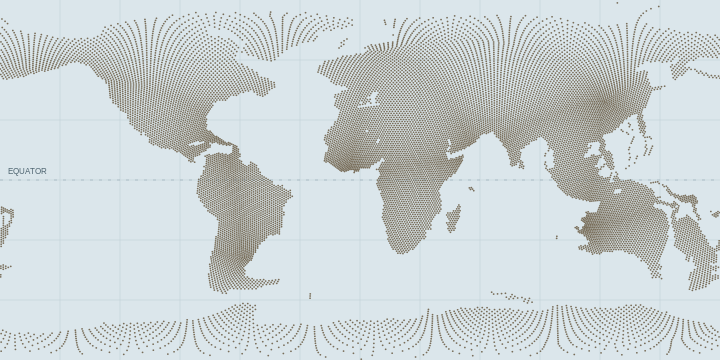
Research window Today
Today the Triassic deposits are exposed in a mountain landscape on the Switzerland–Italy border. Modern Lake Lugano is a separate geological feature from the ancient sea recorded in those rocks. The drawing shows a generalized elevated exposure, not a measured mountain profile. Fossils in the present rock are evidence of past marine life; their elevation records subsequent geological change and cannot be used as a direct measurement of Triassic sea level.
[7] [6]- Observed
- Fossil-bearing marine strata are exposed on Monte San Giorgio and adjacent slopes.
- Reconstructed
- Later tectonic change and erosion brought the former sedimentary basin into a terrestrial landscape.
- Uncertain
- The illustration does not provide a detailed Alpine uplift history or restore deformation bed by bed.
What the evidence shows
Marine reptiles and fish occur in the Triassic rocks of Monte San Giorgio and Besano. The skeletons preserve information about ancient animals. The position and orientation of exposed strata on the mountain provide a separate line of evidence about what happened to the rocks after burial.
[5] [6] [7]What we infer from it
Mountain building can stack and deform rocks originally deposited in distinct settings. The resulting belt is therefore an assembled archive, not a single vertical sequence of sea-level change. Some evidence survives later alteration better than other evidence.
[3] [6]What remains open
This is a regional teaching comparison. The Alps contain many units with different histories, and the selected states do not describe all of them or establish an exact ancient coastline.
Follow the evidence
Sources & credits
- palaeoverse: palaeogeographic reconstruction files, v2.0.0 ↗
Lewis A. Jones / Zenodo · 2024-09-19
Use, credit & modifications
CC BY 4.0; verified on dataset API metadata, not inferred from paper
Credit: Lewis A. Jones (2024), palaeoverse v2.0.0; Jones & Domeier (2024); MERDITH2021 model. RDS converted to static JSON and original dot maps; selected ages; nearest-centroid regional matching; display rounding. Worldwide under CC BY 4.0.
- A Phanerozoic gridded dataset for palaeogeographic reconstructions ↗
Jones & Domeier, Scientific Data 11:710 · 2024
Use, credit & modifications
Reference only; no paper text or figures reproduced
Credit: Jones & Domeier (2024). Original methodological synthesis. No reproduced asset.
- Convergent Plate Boundaries—Collisional Mountain Ranges ↗
US National Park Service · Not stated
Use, credit & modifications
Reference only. No source text, photographs, charts or other assets reproduced; original factual synthesis.
Credit: US National Park Service. Original explanatory synthesis; geological boundary ages normalized to ICS 2026/06 where relevant. No third-party asset reuse; no territorial asset licence asserted.
- Geologic Timescale, Geologic Dating Techniques, and Numeric Ages ↗
US National Park Service · Not stated
Use, credit & modifications
Reference only. No source text, photographs, charts or other assets reproduced; original factual synthesis.
Credit: US National Park Service. Original explanatory synthesis; geological boundary ages normalized to ICS 2026/06 where relevant. No third-party asset reuse; no territorial asset licence asserted.
- Monte San Giorgio — permanent exhibition ↗
Natural History Museum, University of Zurich · Not stated
Use, credit & modifications
Reference only. No source text, photographs, figures or datasets reproduced. Original factual synthesis; no reuse licence asserted.
Credit: Natural History Museum, University of Zurich — Monte San Giorgio — permanent exhibition. Facts paraphrased into original educational text; ages rounded to declared teaching intervals. No asset reuse requested; territorial permissions not applicable.
- The history of palaeontological research and excavations at Monte San Giorgio ↗
Heinz Furrer / Swiss Journal of Palaeontology · 2024-05-02
Use, credit & modifications
Reference only. No source text, photographs, figures or datasets reproduced. Original factual synthesis; no reuse licence asserted.
Credit: Heinz Furrer / Swiss Journal of Palaeontology — The history of palaeontological research and excavations at Monte San Giorgio. Facts paraphrased into original educational text; ages rounded to declared teaching intervals. No asset reuse requested; territorial permissions not applicable.
- Monte San Giorgio ↗
UNESCO World Heritage Centre · Not stated
Use, credit & modifications
Reference only. No source text, photographs, figures or datasets reproduced. Original factual synthesis; no reuse licence asserted.
Credit: UNESCO World Heritage Centre — Monte San Giorgio. Facts paraphrased into original educational text; ages rounded to declared teaching intervals. No asset reuse requested; territorial permissions not applicable.